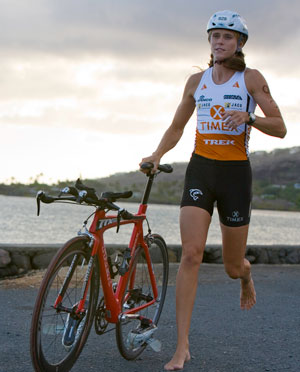
The case for swimming
The primary reason triathletes ought to pay a lot more attention to the swim is that it’s free speed.
by Slowman, August 29, 2006The primary reason triathletes ought to pay a lot more attention to the swim is that it’s free speed.
by Slowman, August 29, 2006As doping scandals savage the sport of cycling, and track & field reels from a positive test by a world record holder, many triathletes wonder about the state of drug use in their sport.
For the second time in as many decades the owners of the popular San Diego-based De Soto Clothing company have had to take its German distributor to court to protect its manufacturing and distribution rights.
“What does global warming have to do with triathlon?” you might ask.
The new Portland-based trade show that only a month ago had the bicycle industry buzzing is gone as quickly as it came.
It didn’t take Skip Gilbert long. For the first time in 16 years USA Triathlon’s board of directors has approved a deficit budget.
Though competition is not always healthy in the short term, the market works itself out in the fullness of time.
One of triathlon’s most exciting new bikes will have its formal coming out party today or tomorrow, depending on the time zone of the reader. On Thursday, January 13th, at Mission Bay’s downtown store.
America’s three glossy monthlies became two some months ago, when American Tri folded itself into Inside Triathlon and absorbed its editor/publisher Kyle DuFord.
Venerated Bicycle Sports, owned and run by John Cobb out of Shreveport, Louisiana and more recently Tyler, Texas, is no longer in business.
It’s one thing to comprehend concepts like trail and steering axis and gyroscopic forces, another thing altogether to know with precision how a bicycle is going to handle once a design is executed in the form of a road-ready machine.
I believe just about every reasonably fit male the age of 45 has the theoretical physiological capacity to run his age for a 10k, that is, a 10k in 45 minutes.
This is not an obituary. John Cobb’s Bicycle Sports is still in business.
Triathletes both allow and suffer some fairly egregious behavior in their races, especially that part of the race taking place in the water.
Yes, your favorite companies’ product managers were all over in Taipei working on next year’s bikes. They’re working hard, no-doubt, but are they designing and spec’ing good bikes?
Ipso facto, if you want to become a champion swimmer (or sinner, for that matter), practice, practice, practice.
Earlier in the decade I wrote an article on how bikes are sized, and the gist was that we ought to be looking at bikes from the point of view of head tubes and top tubes, and that’s it. — no more seat tube sizing.
Our primer on stack & reach continues with the second chapter in the series. We examine how stack and reach enable you to understand how a given bike will, or will not, fit you.
In the final chapter of our stack and reach primer, we compare stack and reach with other ways of remaking sizing nomenclature.
The science of swimming will make you fast in the pool. It’s the art of swimming that makes you fast in the open water.
It’s considered the aerodynamic benchmark for double-diamond (front and rear triangle) bikes.
With Interbike right around the corner I thought I’d write a bit about how the bike business works—not everything about it, but the nuts and bolts of how a bike gets from the “paper napkin sketch” to your local bike shop’s showroom floor.
Practitioners of motorized sports recognized the traction benefits of slick tires a long time ago.
I ride a 59cm bike or, if it’s a road race bike (as opposed to a tri bike) I’ll ride a 60cm bike. If it’s a Litespeed tri bike, I’ll ride 57cm, and so it goes. How are these bikes measured, and why do I ride different sizes depending on the manufacturer?
There have been real studies performed by real scientists on the subject of seat angles.