


RaceRanger for Age Groupers? It’s Closer Than You Think
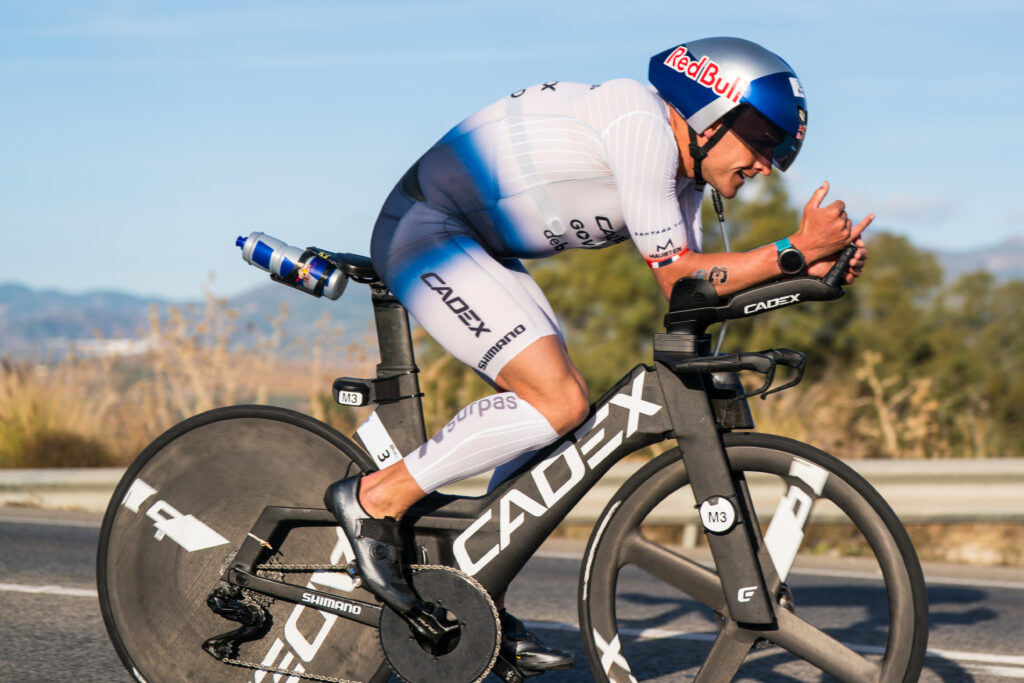
It always seemed a stretch to see the RaceRanger draft-detecting technology, which has become a mainstay at IRONMAN Pro Series, T100 and World Triathlon professional races, become a viable option at age-group races, but we could see that happen over the next few years. Originally conceived by former pro triathletes James Elvery and Dylan McNiece in 2014, RaceRanger got some financial backing from World Triathlon in 2017, and has been working closely with Jimmy Riccitello, IRONMAN’s Rules and Projects Coordinator since 2018.
Scaling up from a pro race with roughly 100 athletes is one thing, but being able to offer the service to hundreds, or even thousands, of competitors offers some daunting challenges for the New Zealand-based company. We caught up with Elvery to get some insights into where things stand as RaceRanger looks to expand its offerings to age-group racing in the future.
Slowtwitch.com: Let’s start with the 2026 RaceRanger forecast — where are things at?
James Elvery: 2024 was a big year where we grew to 37 pro races. The goal for 2025 was not to try and grow the number of pro races further, but to stay home more and work on the next version of the hardware and the whole system, with a view to making it really scalable.
So you personally weren’t at every race in 2025?
In 2024, I went to 25 races. But in 2025, I went to only eight. We had two people in Europe and one backup in North America. I came in and did some of the championship races where there was more media and I was more likely to get meetings with the decision makers for the following season. We’ve got the system pretty easy-to-operate and a growing team to run it now. This year, there’ll be two fairly full-time people in Europe and another two in North America.
How many races are you looking at for 2026?
We have more and more events coming to us. So far we have 65 events contracted for the year. A lot of that growth is from IRONMAN, where there’s an expansion beyond the pro series. I think there are around 60 pro races where slots are given away for 70.3 Worlds and Kona, and they, of course, want those to all be operated as fairly as possible. Also, with the 20-meter draft zone change, having Race Ranger at races where it hasn’t been before helps referees and athletes understand what 20 meters actually is.
The original vision was always that age group racing would be the make or break for RaceRanger. Is that still the goal?
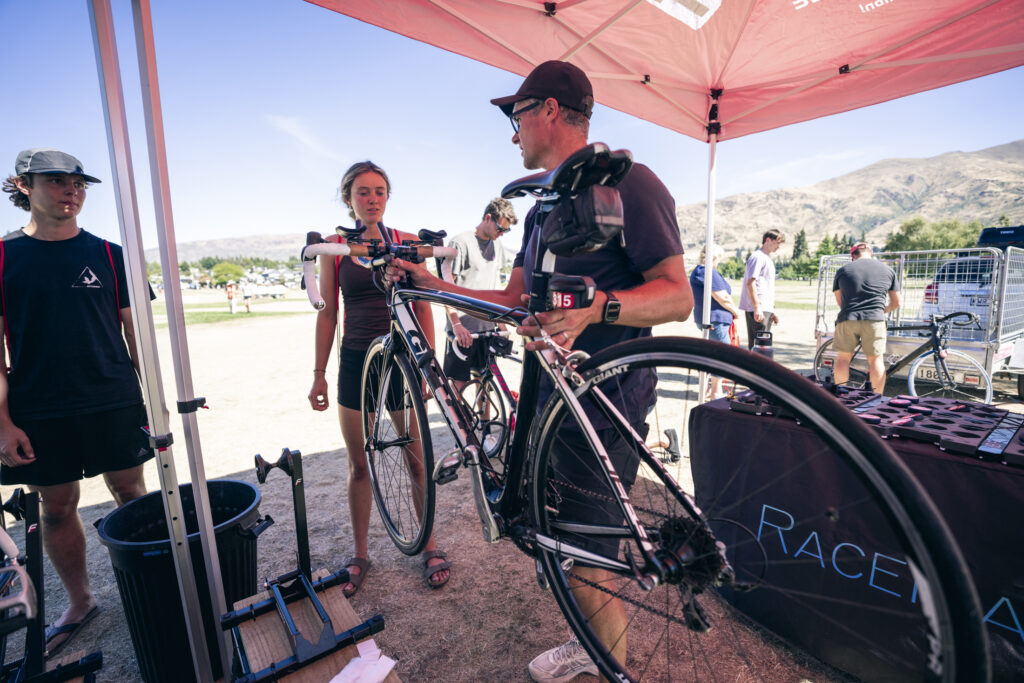
Very much so. All of last year was spent refining the product and the whole system to make it as scalable as possible. We’re now making a new version of the rear unit and a lot of peripheral infrastructure that people won’t always see — the back-end systems that make it possible to do really big numbers. We’ve done lots of pro races, probably around 100 pro events now over the last three or four years, some with 100 to 120 athletes. Then we did one in February last year with 285 age groupers in Wanaka, and that confirmed a few pinch points we’d identified. We’ve now hit go on production of 900 new sets, which we should have in-hand around mid-April. With those, plus the roughly 300 we already have, we’ll be in a position to do a larger age group event — ideally in New Zealand over the summer months, so we don’t have to ship everything overseas for the trial. We’re lining up good candidate races toward the end of this year and the start of next.
Can you walk us through the main pinch points you’ve identified for scaling to age group racing?
Sure. The first one is fitting the units. We were basically telling athletes to arrive at bike racking time — usually the day before the race — and it would take roughly five minutes to fit the units per bike. That works fine with pro numbers, but it’s not going to work for a thousand or three thousand athletes. You’d need a team of 20 people and there could potentially be huge queues. So, we’ve moved to distributing devices at registration, giving people enough time to fit them before they rack their bikes. For a 70.3, we found that giving them out at the briefing meant athletes were basically coming straight to bike racking with the pack — they didn’t have time to actually fit it. So, two days before, when registration opens, works much better.
The second pinch point is tracking which unit belongs to which athlete. We’ve been putting race number stickers on the devices — which meant buying a professional sticker printer, cutting them all, and then spending two or three hours in the hotel before each race matching serial numbers to the current start list. That’s a big time suck, and it won’t scale to 3,000 athletes. So, going forward, there won’t be number stickers on the devices. Instead, there’ll be a QR code on each unit, and we’ll scan it together with the athlete’s wristband QR code at registration to link them in our system.
The third is controlling the devices at the race. We’ve been using an iPad over Bluetooth, which works fine for maybe 200 athletes in an area, but beyond that the range breaks down. Now that we’ve added SIM cards to all the units, we’re moving to an online platform — sending commands through the internet to each device. We don’t even have to be at the race to do that. It also means we can push firmware updates remotely, and to thousands of devices in parallel.
Then there’s recovering devices after the race. If someone DNFs, we’d have to scramble to find them or their bike — sometimes athletes just go back to the hotel. With live tracking, we’ll be able to locate devices much more easily. The tracking frequency will drop after the race to preserve battery, but we’ll always know roughly where everything is.
And finally, washing them. We’ve been hand-washing with a towel and soapy water. That won’t work for thousands of units. We want to run them through a commercial machine, like a commercial dishwasher, 50 at a time. But, to survive that, they need a higher level of waterproofing — so we’re moving to a design with screws and a proper seal.
The vision was originally to get it down to one unit instead of two. Where did that land?
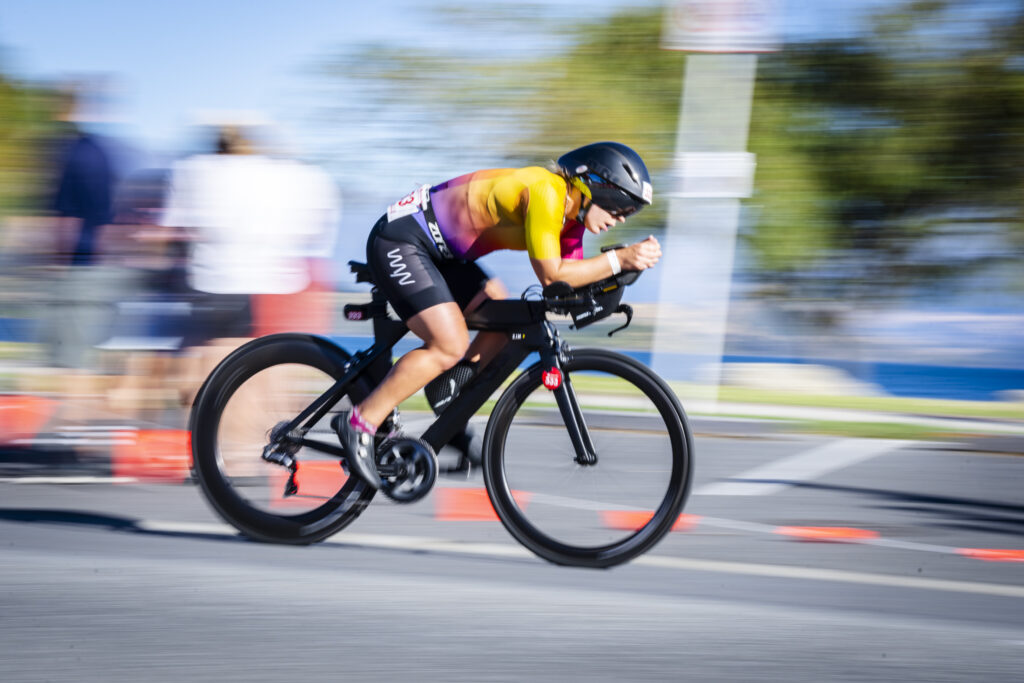
We worked really hard on that for the first four or five months of last year. We got it working about 90 percent of the time, but for that other 10 percent — when the course might pass through areas with weak cell signal — it was really hard to get it as reliable as the two-device setup. So, we settled on a compromise, and this is where we need the events to buy-into what RaceRanger can add to the sport, as it requires the splitting of age group fields into two categories. For a typical age group field, there’s a competitive portion, with athletes that are serious about triathlon as their sport. Then there are people who are perhaps newer to the sport and are there more for a personal challenge, rather than the competitive motivations. A lot of this group might not even know what drafting is.
So, the idea is to offer two categories: a competitive category with two devices each, for people who want to race fairly, be actively policed and potentially qualify for worlds, and a participation category who are given just a rear unit and the focus can be more on safety, having fun and their connection with their supporters. For the general participation group, we don’t want a sea of flashing red lights going, so their lights would only activate if they went in front of a competitive athlete.
We’re not sure exactly what the split of uptake between the two categories would look like — estimates I’ve heard range from 10 to 50 percent taking the competitive option — but there’d at least be a group that only needs the rear unit, which saves a lot of time and gear to haul between events. And the ones who are competitive probably want exactly what the pros have, and value the fairness benefits and clearer roads.
I strongly believe the split category model would be a really positive thing for triathlon. The event can then better cater to both groups, address the problem of competitive athletes not really getting a fair competition at the moment, and providing something for the “one and dones” to aspire to as a next step, and keep them in the sport.
What’s in it for the participation category athlete who still has to put a device on their bike and pay for it?
That’s where the live tracking system comes in. Everyone in the race who has a unit is constantly being tracked, which gives the event visibility of where everyone is at all times, but will also massively improve the tracker app experience for spectators. For participation athletes, that connection with their supporters is often a really big part of their race day. I’m often surprised talking to first-time finishers about how not just their family, but their whole office was following them on the tracker. That’s often how we get new people into the sport — following someone through their journey and getting inspired to do it themselves.
We’ve also got a vision for a post-race replay feature, where you’d get a course profile showing every interaction you had with other athletes — where you overtook someone, how fast you both were going, whether you were earned any illegal time through that pass etc. You could filter it by age group, compare your stats with others. Your results, available on your customer profile page on IRONMAN.com become a lot more than just a swim, bike, and run time, and hopefully it makes doing the race more engaging and motivates more people to come back and do another one.
What’s your read on where IRONMAN stands with all of this?
I’d say they’re cautiously supportive. They probably want to iron out the details and see it in practice. When you first think of RaceRanger for age groups, the mind jumps to a sea of crazy flashing red lights everywhere and chaos — so it’s really a matter of working through and understanding everything we’ve thought through and then for us to show it in action at some races as soon as we can. We plan to do a pilot event — not a 3,500-person race, more like around 1,000 people — to at least demonstrate that a good chunk of people value a fair race and that the live tracking is a real benefit for everyone else. But, we haven’t signed a deal for 50 age group races in 2027 or anything like that yet! It’s still a work in progress. A realistic timeline for age groups is that we could see some larger demonstration events at the end of 2026 / early 2027, and more widespread adoption in 2028.
Talk to us about the investment side — building all of this out must have been a significant undertaking.
We started working on this new design and all the scalability improvements early last year, and it’s finally in production now. Thankfully our existing investors have came along for the ride — we did a capital raise, and that’s allowed us to go ahead with the production run and should also keep us going for at least the next two to three years, which is nice. We’ll be doing a bit of a public push from early April to see if we can find a few more investors to add on top of that. But, yeah having that funding in the bank does take a lot of stress out of things. But there’s then still a lot of pressure to get it right. If something goes wrong with the build and 900 units all don’t work, we’d be in big trouble!
What about data ownership and releasing race data to the public? There’s been a lot of interest in that — especially after the Roth situation last year.
Generally the events own the data. Anything we gather at their event is theirs to do with as they choose. We can configure what gets reported — T100 events, for instance, ask us to exclude certain course segments like a chicane or a technical feature. With IRONMAN we just exclude the transition area. What they do with that data is up to them.
In terms of releasing it publicly, our main focus has been on getting data live to referees as it’s happening, rather than publishing post-race reports. We’ve been working on a referee app — a communication tool and penalty-logging system that works for any triathlon, from small races to IRONMAN distance. Its ben trialled and tested at eight events now, including a few big ones like WTCS Hamburg and the Grand Final in Wollongong. When RaceRanger is also on the bikes, the drafting data will soon feed directly into that app for the motorbike referees.
As for the privacy side, there are real concerns. If we publish data that makes someone look bad and they say they didn’t consent to that being released, that’s a problem we’d like to avoid. We envisage a set of new clauses in race agreements covering location tracking and data use before we could go down that road.
What about the 20-meter draft zone change? What was Race Ranger’s role in those tests, and were you surprised IRONMAN moved so quickly?
For our part in the test, we set up a modified version of the normal race program where the blue buffer zone was moved to sit right on top of each distance threshold and shortened to one meter, and we told the athletes to try and hold that blue light as closely as they could. We recorded the following distances ten times per second for every run — around 12,000 lines of data per athlete per round. That let us pinpoint exactly when an athlete was holding the zone we asked them to, timestamp by timestamp, and hand that clean distance data to Marc (Graveline), who then applied the power profiles and CdA analysis. It was just something that’s never been done before. I flew from New Zealand to Arizona twice to be part of it — it wasn’t something thrown together.
As for the decision to move as quickly as they did — I thought they’d do a couple of trial races and then review it. But they made a bold call, and it’s good to see. It doesn’t change a lot for us operationally. We’re generally reprogramming the devices before most races anyway, so switching between the 12-meter and 20-meter version is just a setting. And if we don’t need to maintain two versions going forward, well, my engineers are probably pretty happy about that — though we’ll still keep the 12-meter version ready for when we get to age group racing.
Tags:
Race RangerRulesRelated Articles:
Continue the discussion at forum.slowtwitch.com
75 more replies





One more thing to increase race entry fees.
And here’s a post and link to the World Triathlon interview/pod (wysiwyg), for those who want audio. It is not as good as @ironmandad 's article but covers the same ground.
Without a ‘class’ of competitors, discrete from ‘completers’, I struggle to see how a thousand red flashing lights is going to enhance the environment or change behaviours of amateurs (please let ‘age groupers’ as a term die off - no other sports uses this perjorative term; they have age goups but don’t demean participants thus - appreciate howling at the moon).
The GPS/tracking aspect is well worth pursuing. And there’s a safety/control benefit not mentioned.
As for the privacy side, that’s not a Race Ranger problem. Those data will be (is) provided to race organisers: they can address that (and Elvery suggests the way ahead on that).
There’s no reason to put Race Ranger on every bike. 80+% of folks don’t give a flying fuck. Give them to anyone trying to qualify for Worlds and charge an extra $50 or whatever.
Well if you read the interview they talk about that : who needs/wants what in the age group field.
Also, Ironman doesn’t need a reason to increase their prices, they do it regardless all the time. What is driving the prices up is just consumer demand, not new costs… Integrating Race Ranger is not gonna drive prices up or down. The overall willingness of triathletes to pay what Ironman is offering is.
Charging an extra 50$ for Race Ranger and a chance to qualify for Worlds ? Genius. Make it 100$, you’ll still have loads of takers and a healthy extra profit !
If they’re going to have a cost added it should be on the testing side.
Literally the very beginning of this article points out RaceRanger’s need to make money. That doesn’t magically get generated out of thin air.
The original vision was always that age group racing would be the make or break for RaceRanger. Is that still the goal?
Very much so.
How does that work exactly when the guys with the RR is sitting right on the wheel of someone that doesn’t have one? Seems to me it would need to be an all or nothing dynamic, or a special wave just for anyone trying to qualify, away from all other waves
This is just easily solved by updating the terms and conditions that no one reads and that we all click ‘accept.’ We all consent to have our race data published on the IM app and this is really no different. Is drafting data really any different than publically available data today that shows you cut a timing mat?
By participating in the race in a competitive age group classification (as opposed to open category/ies) you consent to have your location and draft data publically available on the IM or challenge website for the duration of the event. (And Kona/Awards is dependent on such consent, similar to doping controls)
If we’re worried about such a scenario, then it’s worth pointing out that this issue is likely constrained to the slower age groups. An M18-55 looking to qualify likely isn’t going to be drafting off a non-RR equipped bike, since those draftees will themselves be seeking podiums, or world’s slots.
If an F75 wants to draft on her way to her worlds slot, it’s an issue, but one likely less pressing than the massive M55 cohort (which gets solved).
The question then is whether it’s worth worrying about on the margins - say F50-54 where top of the age group is typically nestled in with the bulk of less competive men.
(Either way, such a solution is better than what we have now, which is to say that it solves 80% of Kona slots)
In a world where every fast person is actually looking for slots perhaps, but reality is a lot of fast people just want to go and race without anything more to gain than that day. We used to have some women bring their domestics to races(pros and AG’ers) to pull them though races, now it will be someone naked of RR to do so, only now no one will be watching because it is left up to the machines to make calls..
[general commentary] I think that the key here for this to work is that we’d need some sort of automatic enforcement. No sense stating that the guy who finished just ahead of you in the KQ seeding had 3hrs of draft time while you kept your nose in the wind, if this isn’t heading in a direction where concrete action is taken with this info.
Obviously the first few iterations will need to be informative, as opposed to disciplinary - but if the ultimate goal of such a system isn’t to weed out the bad actors, and to employ enforceable policy, then such a system looses it’s purpose - especially if the buy-in from competitive amateurs (and the associated registration cost) is that it keeps the KQ chase honest.
If I know someone to be a chronic drafter, I can get one to put on his bike?
And general reply here too: I’m all for RR in the AG’s, but there will be a lot of people as well as machine learning before it becomes the standard. For once in our sport it would be great if all the potential problems could be thought of ahead of time, and fixed before actual racers get screwed over. It really is not that hard to figure out, but perhaps time pressures on a new company will make it go full speed ahead and work the kinks out on the playing field..
So then the solution is one system that solves both - for the KQ crowd drafting enforcement, and for the completion live tracking.
For everyone else, then this is just part of the cost of doing business (same as we’d view tracking chips today). And so you need to put one on everyone if there’s a material share of sub 11hr finishers who opt not to buy into the KQ/Podium eligibility that you’d ostensibly tie this to
If RR is going to be used in a meaningful way for all amateurs, IM would have to change some courses. Loop courses make it very hard for the middle of the pack. It would be a sea of red.
If RR were limited to the competitive amateurs, how would it work with roll downs? If someone signed up as a regular participant and lucked their way into a slot due to a larger than expected roll down, would they be prohibited from accepting the slot? That matters more for the 70.3 WC where the slots can roll deep.
All that said, I like the idea of RR for the masses. As a competitive amateur my experience is that most people toward the front are pretty good about not drafting. But every race I see a handful of people who are just so blatantly cheating, it’s enraging. I really like the idea that there would be some consequences for them.