


Meet the 2025 IRONMAN 70.3 Age Group World Champions
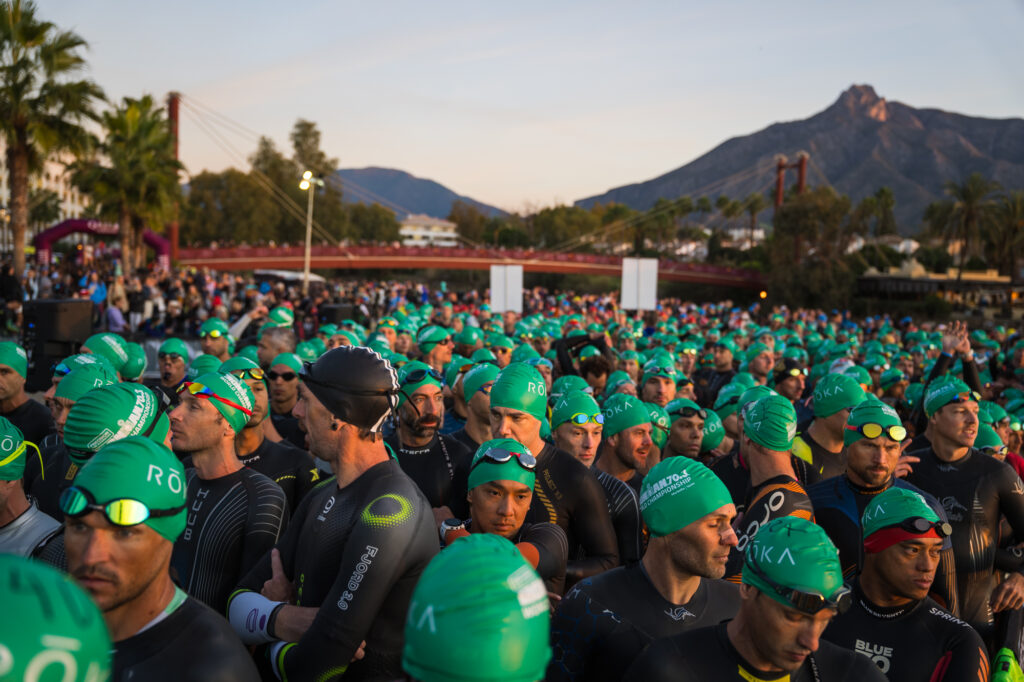
Lucy Charles-Barclay and Jelle Geens were just two of the 27 world champions crowned this past weekend in Marbella, Spain. There were 25 age-group championships earned this weekend, including those by a former IRONMAN professional world champion, and by a former Olympic gold medalist
2006 IRONMAN World Champion Michellie Jones earned her second straight IRONMAN 70.3 world champion, winning the women’s 55-59 crown. She had a nearly ten minute margin over second placed Rachel Crunk at the finish. On the men’s side, former professional cyclist and 2016 Olympic road race gold medalist Greg Van Avermaet won men’s 40-44 in his first attempt at the 70.3 world championship. Van Avermaet had a 4:40 gap over Wolfgang Teuchner.
The two overall age group champions were Corina Hengartner, who won women’s 45-49, and Samuel Studer, competing in the M18-24 bracket. Jan Tomanek won the men’s handicap category title; there were no women in the corresponding category.
Despite having roughly a quarter of the total athletes racing, with nearly 1,500 athletes, the United States did not lead the championship table. France, who had the third-most athletes racing with 441, had the most age group winners, with two men and two women earning titles. Switzerland, the United Kingdom and United States each had three age group champions.
Below are the women’s age group champions.
| Division | Name | Country Represented | Swim | Bike | Run | Finish |
|---|---|---|---|---|---|---|
| F18-24 | Juliette Lucet | France | 00:28:51 | 02:52:18 | 01:28:45 | 04:55:22 |
| F25-29 | Larissa Jasper | Germany | 00:30:33 | 02:52:59 | 01:23:31 | 04:54:15 |
| F30-34 | Natasha Harris-White | United Kingdom | 00:31:36 | 02:56:45 | 01:23:15 | 04:58:13 |
| F35-39 | Ewelina Wolos | Poland | 00:37:21 | 02:51:00 | 01:25:21 | 04:59:30 |
| F40-44 | Christine Verdonck | Belgium | 00:31:59 | 02:48:21 | 01:32:48 | 04:59:30 |
| F45-49 | Corina Hengartner | Switzerland | 00:32:09 | 02:47:28 | 01:26:52 | 04:52:35 |
| F50-54 | Sharon Schmidt-Mongrain | USA | 00:35:32 | 03:08:55 | 01:27:47 | 05:20:34 |
| F55-59 | Michellie Jones | Australia | 00:32:28 | 03:07:46 | 01:37:59 | 05:25:36 |
| F60-64 | Sophie Kerlaouezo | France | 00:41:48 | 03:23:27 | 01:41:14 | 05:55:12 |
| F65-69 | Judy McNary | USA | 00:38:28 | 03:28:39 | 01:54:58 | 06:11:37 |
| F70-74 | Alexandra Dronkers | Netherlands | 00:43:10 | 03:59:16 | 02:22:52 | 07:17:28 |
And here are the men’s age group champions.
| Division | Name | Country Represented | Swim | Bike | Run | Finish |
|---|---|---|---|---|---|---|
| M18-24 | Samuel Studer | Switzerland | 00:24:02 | 02:18:34 | 01:17:01 | 04:06:14 |
| M25-29 | Quentin Amaral | France | 00:27:40 | 02:23:47 | 01:14:43 | 04:11:55 |
| M30-34 | Luke Tasker | Canada | 00:25:26 | 02:23:07 | 01:14:04 | 04:08:18 |
| M35-39 | Lars Wichert | Germany | 00:29:27 | 02:23:08 | 01:18:59 | 04:17:40 |
| M40-44 | Greg Van Avermaet | Belgium | 00:31:02 | 02:16:08 | 01:21:30 | 04:15:56 |
| M45-49 | Donald Brooks | United Kingdom | 00:26:26 | 02:29:48 | 01:17:23 | 04:18:57 |
| M50-54 | Paul Lunn | United Kingdom | 00:30:58 | 02:33:07 | 01:22:38 | 04:33:05 |
| M55-59 | Lennie Kristensen | Denmark | 00:34:11 | 02:32:40 | 01:27:04 | 04:41:41 |
| M60-64 | Adrian Santonastaso | Switzerland | 00:33:07 | 02:41:18 | 01:30:59 | 04:51:59 |
| M65-69 | Eben Jones | USA | 00:27:29 | 02:51:11 | 01:42:03 | 05:09:20 |
| M70-74 | Christos Garefis | Greece | 00:31:46 | 03:09:28 | 01:59:06 | 05:48:23 |
| M75-79 | Guido Dona | Italy | 00:39:15 | 03:25:59 | 02:17:51 | 06:34:43 |
| M80-84 | Albert Dulac | France | 00:58:26 | 03:53:56 | 02:24:35 | 07:33:08 |
| HC | Jan Tomanek | Czech Republic | 00:37:48 | 04:33:06 | 01:41:50 | 07:02:50 |
The 2026 IRONMAN 70.3 World Championship will head to another difficult course, with Nice, France hosting that event as part of the switch back to a single day IRONMAN World Championship in Kona. Nice will also host the 2028 IRONMAN 70.3 World Championship. The 2027 race date and location are yet to be determined.
Tags:
IRONMANIRONMAN 70.3 World Championshipmarbella 2025Related Articles:
Continue the discussion at forum.slowtwitch.com
20 more replies



Is young Sam Studer the brother of Max?
Thought it’d be interesting to see which athletes were ‘best of the best’, using the AG Div Kona Standard performance pool factors. Acknowledge that, for 70.3Q, M and W are in discrete performance pools. Note the M80 in the middle of the pack.
Somehow, methinks that if at the World Championships, we only see one woman in the top 10 off of that system…the math is probably wrong.
Somewhat interesting that Eben got dusted by Jelle but Corina spanked LCB with the age graded times.
And still too many older guys, this magic math is just not right. It can be, but it’s not.
I think you are misunderstanding the coefficients from Kona when they are applied to a course with massive elevation. The coefficients are generated based on degradation on a course where watts per kilo are not super important.
Men inherently have higher watts per kilo than women. It’s just the way it is at the pointy end.
So if you apply the coefficients on a course that gives high watts per kilo people better performances, those with lower watts per kilo won’t get a good “assist” from the coefficient.
the assist from the coefficient will inherently help low watts per kilo people LESS on a hilly course, and this course was relatively unprecedented for total climbing, so when you apply the Kona coefficient to this race, you’ll see the results that @Ajax_Bay computed for us.
It’s not that the coefficients are wrong, as they will help low watts per kilo more on flat courses and will help them less on hilly courses.
I know you have an axe to grind on this, so just calling you out that you are just trying to see what you want to see, rather than understanding how this works out.
He applied the Kona coeffiecients to a half Ironman with a ton of elevation. It’s all irrelevant. If you want to see how younger and older guys stacked up to each other, a closer analysis would apply the half IM coefficients, because at least they were generated from two years of St. George, one year of Lahti, one year of Taupo and one year of Nice so they include three hilly courses and two rolling courses (but none of those courses were even inside 500m of vertical of Marbella).
And let’s not forget that 1.00 baseline in the half IM men’s side is 18-24
@Ajax_Bay can you just re run these based on the half IM coefficients and keep two different groups, one for men, one for women and don’t mix the genders? Just to see how different winners stacked up with their own genders with the half IM coefficients (this pitting genders against each other is just all around problematic). In the women’s field, all the age group winners under 49 were 4:52 to 4:58.
You missed something. Lucy would also get an assist because these are age x sex graded times. You would need to apply the 30-34 womens coefficient to Lucy’s time and Jelle would get no assist as he is in the 1.00 coefficient age group for KonaQ
We have to keep in mind that this race was not a “normal” men/women final time distribution. When you look at the pro times, the mens race was much faster than the womens, mostly from the factors dev pointed out. On a flat course we often see the differential in the 20+ minute range. This race was in the 30+ range. And besides the obvious difficult bike times, for some reason the swim times were off too. So either they moved the buoys, womens negative current was worse, or the men just out swam their normal times. But I find that one harder to believe, as Lucy was in the race and she drilled it hard enough to shake all cling ons, but her delta was 3 minutes or so from the lead man. Who incidentally was just a tiny off the front, losing all of it in transition to the actual huge lead mens group. And the run times were also off, likely due to the harder bike too perhaps? 10 minutes from lead man to lead woman is on the high end of the usual delta. Typically if you got guys running 1;07’s, there is a woman running sub 1;15 in these super stacked fields…
What does HC mean? Im sitting hre thinking that run split is feral
HC = handcycle
Dev - I actually did this at first and then realised that this would not compare all the AG divs on the same basis, and edited my post with the factored times by Kona Standard. Here are the separated lists, using the 70.3 factors. Edit: Comparing men and women in the two tables below is entirely flawed - for that go to my first table ^^^. That’s why the list below is sorted all W then all M.
Hengartner must have an ‘interesting’ history.
And for those who think it useful, here are the Pro winners, age factored. I’d normally expect a differential in the MPro/WPro to be circa 24 minutes (last 5 years: 25, 21, 26, 23, 30 - Nice last one with climb). This year it was 32 minutes. This is partly because the race winning times were longer, but even on a % view, Marbella and Nice were outliers.
So men 45+ are all better then M45 and under and most are better then LCB.
Screw them,the guy in the 70-74 beat Lucy by 11mins
“men 45+ are all better then M45” Have no idea where you get the first bit from: young Studer comes out as second best man. Brooks (M45) sits in the middle of the pack.
And no, you can’t compare across the sexes in that second list: the first list gives a better picture for the comparison you seek to make. In my first table M65 Jones tops it at 3:53 and LCB’s factored time is ~3:48. Jones clearly a phenomenon or just had an amazing race, most likely both.
@monty offers some excellent context/points, but on this one, we were deprived of the top WPro runner hitting sub-1:15 and giving us a much closer finish. Think LCB would’ve still won as I can’t see Matthews (whose gap was >3:20 to LCB leaving T2) running sub 1:14 last Saturday even with both legs functioning. LCB’s run was about a minute faster than her previous best half (a full 21.2km).