
Same As It Ever Was: USA Triathlon Updates Elite Qualification Standards
Coming off the back of our reporting from Oceanside on fast age-groupers and their times relative to some professional athletes, a classic triathlon debate lit up for the first time since the COVID pandemic: who should be racing as a professional athlete? It’s been one of the most hotly debated topics over the past fifteen years, especially in the United States, though it had largely quieted down during the COVID years.

Yet with newly revised rule differences between professional and amateur athletes, particularly on the bike, and how the interactions between professional and age group fields may have disparate impacts, it lit up again. And largely, the debate comes exclusively within the non-drafting realm; it is extremely rare for someone to progress from an age-group to professional draft-legal athlete without having gone through one of the various development teams now offered by a national federation.
Over the weekend, USA Triathlon officially published revised qualification standards for elite license holders. The updated criteria will take effect as of April 10th, 2026. The top-line news is that there are now differing qualification standards to earn an elite license based on whether you’ll be racing draft-legal, non-draft, duathlon, or cross triathlon. And, as a reminder, these licenses are mandatory for athletes seeking to participate in USA Triathlon sanctioned events that offer an elite wave with a prize purse exceeding $5,000. In other words: want to race any event in the US with a sizable prize purse? You need an elite license to do so.
We’re going to focus on the two big license buckets: draft-legal and non-draft. There’s an interesting wrinkle that *may* impact a few athletes who dabble in draft-legal racing. But otherwise, spoiler alert: if you were thinking these changes would have drastic impact on who qualifies for an elite license in the U.S., you’ve got another thing coming.
Changes for Both Types of License: Periods of Eligibility
Perhaps the biggest modification in the qualification rules are how long a license granted lasts. For athletes based in the United States, it’s now a rolling two-year period for your license. This goes for athletes who are either new to qualifying for a license, or for athletes who are currently holding an elite license and are seeking to renew them. For renewal, you must submit a single qualifying result (more on those in a minute), and that renewal stacks onto the end of your current eligibility period.
As an example, let’s take an elite athlete who’s license expires in July of 2027. That athlete had a result that re-qualifies them for an elite license at Oceanside 2026. They submit their application and it is approved. Their new expiration date will sit as July 2029. To then earn another extension, they would need to have a qualifying result between July 2027 and July 2029.
There is an exception for a waiver, which must be approved by USA Triathlon’s Athlete Advisory Council. From the policy: “An eligibility extension for renewals of up to two years may only be granted to an active Elite athlete who becomes pregnant or receives active-duty military orders of significant length..” There’s no definition as to what constitutes significant length, though one would imagine it’d need to preclude an athlete from being able to re-qualify via a race result.

The other change: foreign athletes who wish to race in elite events within the United States are required to procure a Foreign Elite License from USA Triathlon. The policy specifically calls out World Triathlon, IRONMAN, and T100 events as examples requiring this license type. Athletes must submit their home federation elite status in order to obtain this license. Crucially, it also requires athletes to re-certify this license type annually, and it expires on December 31st every year.
Who Can Race What Events?
Perhaps the biggest split between the two main types of licenses is with regard to what types of races athletes can participate in. A draft-legal elite license holder is allowed to race professionally in any draft-legal event, along with “all elite Multisport events,” which include Aquathlon, Duathlon/Cross Duathlon, Cross Triathlon, and Winter Triathlon. Conversely, a non-draft elite license holder is eligible to participate in “the professional fields at IRONMAN, Challenge, T100, or other non-draft Sprint, Olympic, middle, and long-distance elite events,” along with “all elite Multisport events.”
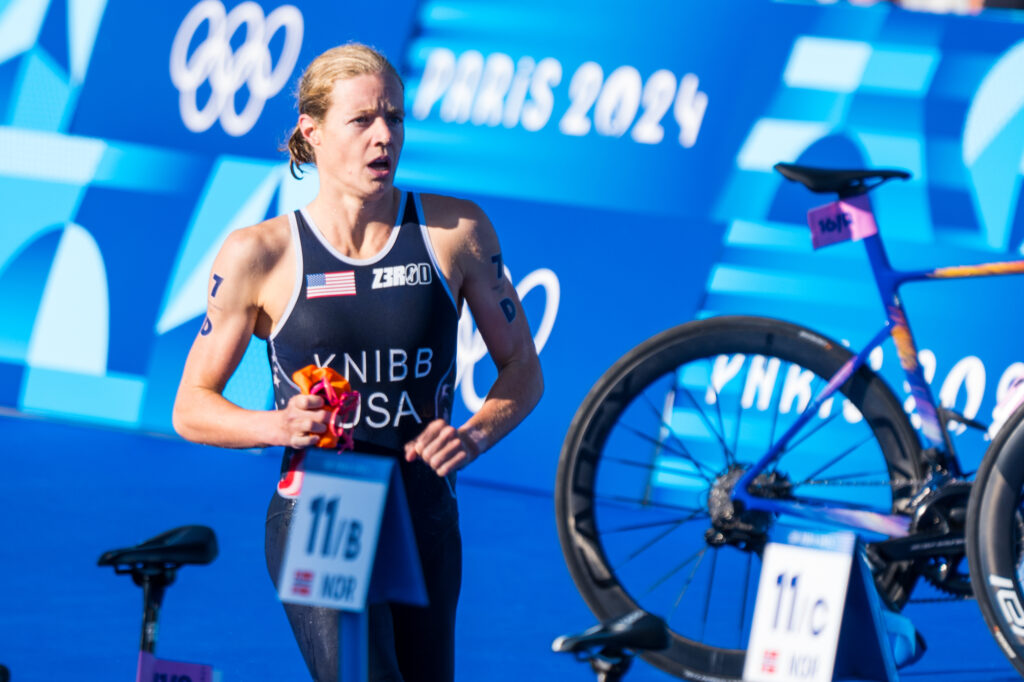
They are, based on USA Triathlon’s policy document, mutually exclusive from one another, meaning an athlete like Taylor Knibb who would want to repeat her 2024 racing cycle would likely need to hold two different licenses in order to race a mix of WTCS, T100, and IRONMAN professional events.
The Qualification Standards
As one might expect, given USA Triathlon’s emphasis as the national governing body and development body for the next generation for Olympic athletes, the standards for the draft-legal license are quite high. Within the draft-legal license status, there’s two roads to follow: one for U23/Junior/Collegiate athletes, and one for everybody else.
For the former category, there are six possible results that will earn an elite license:
- Finish Top 10 at any of the following:
- World Triathlon U23 World Championships
- World Triathlon Junior World Championship
- Youth Olympic Games
- World Triathlon Continental Championships: Top 3 in the U23 categories, overall winner in the Junior category
- Overall Junior winner at any World Triathlon Junior Continental Cup
- Top 3 finish at USA Triathlon Junior Nationals (draft-legal) in the 16–19 age category
- Top 5 and within 5% of the winner’s time at the Women’s Collegiate National Championship (all divisions combined)
- Top 3 and within 5% of the winner’s time at the USA Triathlon Collegiate Club Draft-Legal National Championship
For those athletes who don’t fall into the above bucket, the standard is higher:
- Top 5 in a World Triathlon Continental Cup with at least three athletes starting who are ranked in the Top 125 of the World Triathlon Rankings
- Top 10 in a World Triathlon Continental Championship (Elite field) with at least three athletes starting who are ranked in the Top 125 of the World Triathlon Rankings
As for non-draft athletes, things get a bit messier. There are five different pathways to an elite license; some are intended for renewing athletes, and some are intended for first-time license holders (or those who previously held an elite license, lost it, and are seeking to regain it).
Those criteria break down as follows:
World-Class Qualification
- Competed in one of the two most recent Olympic Games
- Started a World Triathlon Championship Series (WTCS) race within the 24 months preceding the Elite License application date
- Started a T100 race (elite field) within 24 months preceding the Elite License application date
Championship Pathway
This path requires a race finish within 12% of the elite or overall winner’s time (by gender) at any of the following championship and/or prominent events:
- IRONMAN World Championship
- IRONMAN 70.3 World Championship
- World Triathlon Long Distance Triathlon World Championships
- Challenge Roth
- Challenge The Championship
- U.S IRONMAN Pro Series Events. For 2026, those were/are:
- IRONMAN 70.3 Oceanside
- IRONMAN Texas North American Championship
- IRONMAN 70.3 Pennsylvania Happy Valley North American Championship
- IRONMAN Lake Placid
- IRONMAN 70.3 Boise
Elite Performance Pathway
This bucket of results requires a race result within 8% of the elite winner (by gender) at a USA Triathlon-sanctioned event within the United States that has an elite prize pool exceeding $10,000 per gender. As an example, non-IRONMAN Pro Series events that have professional fields would count for this standard.
Elite Development Pathway
Intended for athletes who are attempting to qualify exclusively on the back of age-group results, athletes must finish within 4% of the overall winner’s time (by gender) at one of the following events.
- World Triathlon Age Group Olympic Distance World Championships
- USA Triathlon Age Group Olympic Distance National Championship
- USA Triathlon Age Group Non-Draft Sprint Distance National Championship
- USA Triathlon Collegiate Club National Championship
- USA Triathlon Long Course National Championship
- USA Triathlon Ultra Distance National Championship
USAT Race Score Pathway
Intended for athletes who fail to qualify via the above head-to-head comparisons, the race score pathway requires three USAT Ranking scores within the same calendar year above minimum thresholds in sanctioned events with at least 300 finishers. For men, the race score threshold is 115 points. For women, it’s 105 points. If you thought the Kona Qualification Standard math was difficult, well, you’ve got another thing coming; the math is extremely complex for Race Score.
The More Things Change, the More They Stay the Same
Ultimately these standards remain attainable for those athletes who wish to wind up pursuing a professional license. It may require a bit more cherry-picking, for instance, of the “right” race in order for it to occur; for example, one woman (Samantha Skold) would have earned a pro license based on her result at the IRONMAN World Championship this past year, based on a retroactive application of the 12% rule against Solveig Løvseth’s winning time.
What this doesn’t address is that line where an elite license ends and the very fast end of amateur racing begins. Or, for instance, the somewhat classic problem of athletes who frequently meet the criteria for an elite license, but do not wind up taking it. The onus remains on the athlete to both want to upgrade and meet the criteria for the upgrade. We’re still likely going to see plenty of instances where fast age groupers have times in front of a decent number of pro fields. And yes, some of this is down to differences in race rules; more of it is likely down to differences of race tactics that happen when you’re racing for a paycheck.
And, again, it still takes just a single result for all but the Race Score pathway for a non-draft license; a single good day at the office at the right race can see you push forward. In the end, it’s the same result, just a slightly different set of hoops to jump through.
Tags:
IRONMANRulesUSA TriathlonRelated Articles:



Continue the discussion at forum.slowtwitch.com
16 more replies



I’m really intrigued by the foreign athletes being forced to pay USAT for a license to race in the U.S. At $150/year, that could low key make usat a decent amount of money. In that same idea, I don’t read the rules the same that you are reading it. IE- knibb won’t need 2 license I think DL covers all but non draft won’t cover DL. That’s how I read it or understand it If they are forcing their own members to have 2 license (and pay 2 x $150) yeah that money grab would be shorty sighted imo,
Will be interesting to see how the non-elite Conti Cups now goes with potentially more (or less?) athletes getting on that draft legal grind.
“Same as it ever was …”
C’mon now, you can’t just drop that out there like that!!!
“Time isn’t holding us; Time isn’t after us
Time isn’t owning up; Time is a Pony Ride”
Interesting that they’re now calling out specific criteria for different race series.
E.g. the criteria is stronger for non-pro series races than it is for pro series races.
This obviously makes sense because the standard is going to be higher at a pro series race, so you’re going to want to allow athletes to finish within a higher % of the winner’s time. Likewise, being selected for a T100 is enough just to renew your licence.
So what happens if IM stops the pro series or T100 becomes an open series?
They just change the criteria if that happens. These criteria are always changing from year to year, there have been eras of “easy” pathways and eras of harder pathways. Everything is always going to be adaptable.
I initially had a similar read to you regarding DL vs non-draft requiring two licenses. But then the footnote specifically says those licenses only give you full access to “Multisport,” of which regular triathlon is fully excluded from. (And not to mention Paratriathlon, which has its own criteria).
Granted, it specifically calls out non-draft athletes as being classified as age groupers in draft legal races (but can only compete in “overall” standings as opposed to the real age groups, so make those logistics make sense in your head).
But yes, I do think it’s a way to wind up picking up some additional “easy” cash from other federation license holders (and should put all of these athletes under the USAT supplemental insurance policy for sanctioned events, which might have been a weird gap in prior coverage…)
If they are truly going to force essentially their national team members to pay for another license just to race some non-draft, I think that will be the bottom of the barrel for me in terms of federations doing federation things (and not in a good way). Sighs
Gosh, an annual tariff on foreign athletes. Do any other nations do that or is this a bit of Make Tri-ath-a-lon Great Again?
I don’t believe it is a normal thing, seems like money grabbing bullshit.
world triathlon considers conti cups elite events and athetles need to have a medical screening for it to be allowed to race.
I would say Ryan is correct a draft legal license does not cover non drafting races
the foreign elite license to race in usa is interesting to say the least.
I have never come across this.
From the policy (aligns but just pasting that here):
"5. FOREIGN ELITE LICENSE:
“The Foreign Elite License is required for non-U.S. athletes competing in USA Triathlon-sanctioned elite events — both Draft-Legal and Non-Draft — including World Triathlon, IRONMAN, and T100 races held in the USA.”
wef 10 April 2026.
So all non-USAT license holders (including the many foreigners on the start list of IM Texas, for example) will need to apply for this license or not be allowed to start.
And every non-American who races Kona?
And every non-USA athlete racing in the LA test event next summer. I think World Tri is likely to “have a wee word”.
Tariffs anyone?
I certainly hope someone can get some clarification on these couple of new policies because they are definitely major changes that need some clarification on them.
The only clarification would be that it’s every non-American elite/pro athlete in your post above.
FWIW, foreign age group athletes in the US would have been required to pick up a license to race here, too. Which leads me back to the “this might have been instituted to close the gap on pros and supplemental insurance” from above.
Otherwise, no notes.
I ran the analysis on this – 7 Americans (5 men, 2 women) would have qualified for their pro card last year with this criteria. 4ish men (including 1 from above criteria) and 1 woman (including 1 from above) would have qualified with the points criteria since the points are so high. I don’t have exact numbers compared to last year, but with 3 spots going to top amateurs at any Ironman race with a pro field in US, you can imagine that it would be closer to 25 men + 25 women that would have gotten their card last year.
On average, 33% of elite men/women racing at non pro series races would qualify at each race (if there were 30 in a field, 10 athletes would have qualified for their pro card at that specific race) and 52% would qualify at a pro series field (obviously Pro Series fields are deeper, so this makes sense).
The USAT Nationals pathway is easier, so one would assume USAT is pushing to get more folks to USAT nationals - especially Long Course + Ultra Nationals. AG Nationals would have qualified 18 men and 15 women in the last 3 years with the new 4% criteria, where it would have bene 15 men and 15 women with the old (top 5 OA at AGNC) criteria.
I don’t disagree with toughening up the standards. I qualified for my pro card 3 years in a row before taking it, since I didn’t just want to be pack fodder when I got there. But like I said in the Oceanside Amateur post, these changes hurt women more. We’re looking at women’s fields for races like Texas being under 20 in the future - and it’s already 1/3 of the size of the men’s field.
I think I just am curious what USAT is trying to solve for here. BOP Men influencing women? Just add 5 minutes more to the gap. We give Ironman a lot of money to race - they can figure out a way to get road closures for another 5 minutes. And sure, tighten up the men qualification! I also hear people say “only people who are competing to win should be racing pro.” What? Is that how elite fields work at any other event? Does the US Open for Tennis have 8 athletes? The Masters will be great this year with 2 foursomes playing! We need a pathway for athletes to get to that top stage. Again - not saying we need 82 male pros on the IMTX start list. But in trying to fix one problem, USAT is eliminating women’s fields down to 15 people.
It’s already more difficult to race Triathlon as a woman. Why are we giving these young women athletes less pathways to do the sport? The split is 80/20 at most races nowadays.. and eliminating half of the women’s pro field will have a trickle down effect. Less women will we racing pro, so less high level womenathletes will want to start/keep doing triathlon as a sport, which will mean less overall women follow in their footsteps and sign up for any 70.3/IM event.
Sorry for the ramble. I just think it’s incredibly shortsighted for USAT to make these changes without any thought for the future of the sport.
ok but overall this is completely breaking with the current norm in triathlon , ie while there is no specific rule, by and large, in the past , once you had a world tri fed associated license you could race around the world with that license.
I am aware that since covid this has become a bit watered down at age group level , but I have never heard of an elite athlete needing another elite license to race in another country.
ie if every nation is going to do that its going to make racing a lot more complicated as in the worst case you might have to apply for like 8 elite licenses a year , thats causing a lot of overheads to athletes and feds.