
Beginner Training: How You Can Use Bands for a Better Swim
If you’re new to triathlon and swimming, you may have noticed your fellow athletes at the pool or at races using bands to warm up and wondered if that’s something you should try. The short answer is: yes, bands are are a great way to get your shoulders, back and other muscles warm before jumping into the water. You can also use bands for full-on workouts if you cannot get to the pool. Slowtwitch spoke with former collegiate swimmer and current swim coach Ben Russell to get his take on band warmups, band swim workout alternatives and more for triathletes.
The Importance of Warming up
Russell swam at NYU and, after graduation, he stayed in New York City, where he now coaches the Red Tide masters swim club. The club has more than 200 members who can swim together up to seven times each week, with Russell (who is the club’s head coach), or one of the other Red Tide coaches as the on-deck lead.
Like any good coach, Russell highlights the importance of doing a good warmup before each workout. When it comes to bands, he says you don’t have to do all that much to get your body ready before diving into the pool.
“It can be a very quick five- or 10-minute thing,” he says. “You’re just trying to get some blood flow to your arms and through your shoulders to get ready to swim.”
Russell adds that hitting your lats in this band warmup is a good idea, too, especially if you’re swimming freestyle (which is, of course, the stroke of choice for most triathletes).
“Warming up is important no matter where you’re swimming, but especially if you’re doing open water, [because] you might take an awkward stroke or something, which could tweak or pull a muscle,” he says.

Bands and Other Warmup Tools
Russell says that bands are great to use for warmups, but he has a different tool that he uses first up before his swims.
“I get a PVC pipe and take it from in front of my body to behind my body,” he says. “As I do that and my shoulders start loosening up a little more, I start moving my hands closer and closer together along the pipe, just to kind of loosen up my shoulders a little bit before starting anything else.”
If you’re having trouble picturing that move, it’s quite simple. Your arms are in front with your hands spread out wide on the pipe, then you lift straight up, over your head and then slightly behind you. Don’t force your arms back, just go far enough so you feel a stretch in your shoulders.
With that move done, Russell says it’s time to move on to your bands. But what kind should you get? There are a lot of options on the market, and they are available in many different tensions. Russell says you want a band that is “pretty loose” for the purpose of warmups.
“You want to feel some strain, but it’s not like you’re trying to build muscle,” he says. “It’s just waking things up a little bit.”
With that low-tension band, Russell first starts by taking it in both hands and holding his arms out straight so that “it’s like you’re making a T with your body.”
From there, you bend at one elbow until your arm is at 90 degrees. Next, keeping your arm out straight from shoulder to elbow, rotate down so your hand goes from pointing up to pointing forward, than rotate back up. Do this movement 10 or so times, then repeat on the other arm.
Russell’s next recommendation is the same move (arm bent at 90 degrees and rotating down and back up), but with a repositioned stationary arm. For this move, instead of holding your one arm out straight, you’ll keep it down at your side so that the band crosses your body from one hip up to the opposite shoulder.
“This is working down your arm a little bit,” Russell says. “It’s more of an activation through your whole arm.”
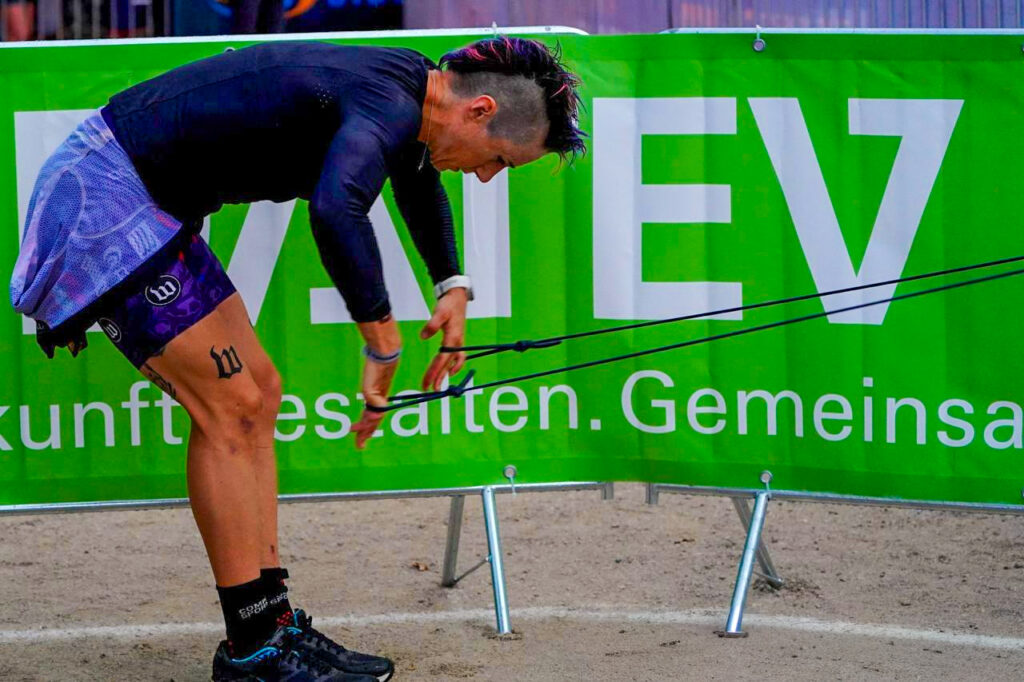
Russell’s last suggestion for this banded warmup requires a pole. (The pole that holds the flags at the end of the lane works well for this.) Start by putting the band around the pole, then hold it on either side. Russell says to bend at your waist to about 120 degrees (down but not all the way to 90), then pull the band down to your sides.
“It’s almost like the butterfly stroke when you’re underwater,” he says. This will help activate your lats before you hop into the pool.
Your upper body may be warmed up at this point, but Russell notes that you can’t neglect your legs. He says simply doing some leg swings while on the deck can help to “loosen up the hips” and get you ready to go.
Finally, he adds that this is only the first part of your warmup and that it doesn’t mean you’re ready to swim at full speed as soon as you hit the water. The first chunk of your swim should still be dedicated to slower pacing, drills, kick and whatever else you use to ease into your workouts.
Dry-Land Training
Sometimes your life will get busy and for whatever reason, you won’t be able to get to the pool for your swim sessions. If you have a band, however, you can still fit in an alternative workout that will at least keep you in swimming fitness.
For these workouts, you’ll want something with a bit more tension than the bands you’ll use in warmups. There are also bands you can buy that have handles, which make it easier to use for swim-specific training and moves.
As Russell says, these workouts will mainly focus on the catch section (when you’re pulling the water) of your stroke. You can certainly go through the motion of doing your full stroke, but the emphasis and most of the focus should be put on the catch.
“You can go back to that lat activation I mentioned for a warmup, just with a slightly stronger band,” Russell says. If you have a pole you can use at home our outside (for example, the post of a basketball hoop), this will work great. You can also get bands that can be anchored to doors, which will allow you to do these at home, at hotels or wherever else you’re trying to fit a workout in.
Russell says you can do one of two movements here. First is one arm at a time (like freestyle) or two arms at once (like butterfly). You can also focus on one arm for however many reps, then move to the other arm, or you can simulate your regular freestyle stroke motion and go from one arm right into the next continuously.
While this is a swimming alternative, you’re not going to get the exact same benefits of a swim. Russell says not to go into this trying to get any sort of cardio done, but rather to look at it solely as a strength routine.
“If you did six to 10 45-second to one-minute sets where you’re really intentional with each pull, that’ll keep you in a good place,” Russell says. That’s quite a quick workout, but it will still help to maintain and even develop more strength in your arms and back, helping you prevent too much loss of fitness during your time away from the pool. Don’t expect to swim well if you never touch the water and only do at-home band workouts, but when you’re in a pinch, this is a great alternative.

Start the discussion at forum.slowtwitch.com