
Specialized, Giant Targeted By Lawsuits Over Online Purchase Junk Fees

Two of the biggest brands in bikes have been targeted by separate lawsuits, claiming that customers were charged so-called “junk fees” in the process of purchasing items on their respective websites.
Both Specialized Bicycle and Giant Bicycle were sued in U.S. federal court over the fees, which the separate suits claim are a violation of a 2024 California law that eliminates “junk” or “drip” fees. Specialized settled its case out of court this week, whereas Giant’s case continues.
Known colloquially as the “Honest Pricing Law” or “Hidden Fees Statute,” SB 478 “makes it illegal for most businesses to advertise or list a price for a good or service that does not include all required fees or charges other than certain government taxes and shipping costs.” Those fees exempted include those from restaurants, state or local sales tax, and/or a “reasonable” shipping cost for physical goods.
Plaintiff Christopher Rossow sued Specialized in February 2026, alleging that the Specialized e-commerce website did not show all of the fees that he would be charged for a purchase until after he had submitted his credit card information and address.
Instead, according to Rossow’s claim, “consumers are quoted an artificially low price, only for Defendant to sneak in a mandatory “Shipping & Handling” fee (the “Fee”) regardless of whether the consumer selects the “Ship to Home” or “Pickup from Store” option. For e-bike purchases, Defendant additionally charges a $15.00 “Environmental Recycling Fee” (the “Recycling Fee”) after consumers input all their shipping and credit card information. This cheap trick has enabled Defendant to swindle substantial sums of money from its customers.”
Similarly, Bronson Thomas sued Giant in February for a purchase made through Giant’s e-commerce website. Thomas claimed that he had bought a Giant bike and accessories through the website, and that in the process Giant “subtly added a ‘Destination fee’ of $75.00 to the checkout screen. The fee was mandatory because Plaintiff could not purchase the products from Defendant’s Website without paying the fee. Plaintiff was charged this fee even though he selected to pick up his items from the store.”
Both suits were filed in California federal district courts, and both plaintiffs were represented by the same attorney: Stefan Bogdanovich of Bursor & Fisher, a firm that specializes in class-action lawsuits. Both claims against Specialized and Giant had been filed as class-action suits. Specialized settled before the class could be certified. The Giant case, meanwhile, continues; in an order dated May 18th, Giant is required to respond to the complaint by June 17th.
Neither Specialized nor Giant have commented on the cases.
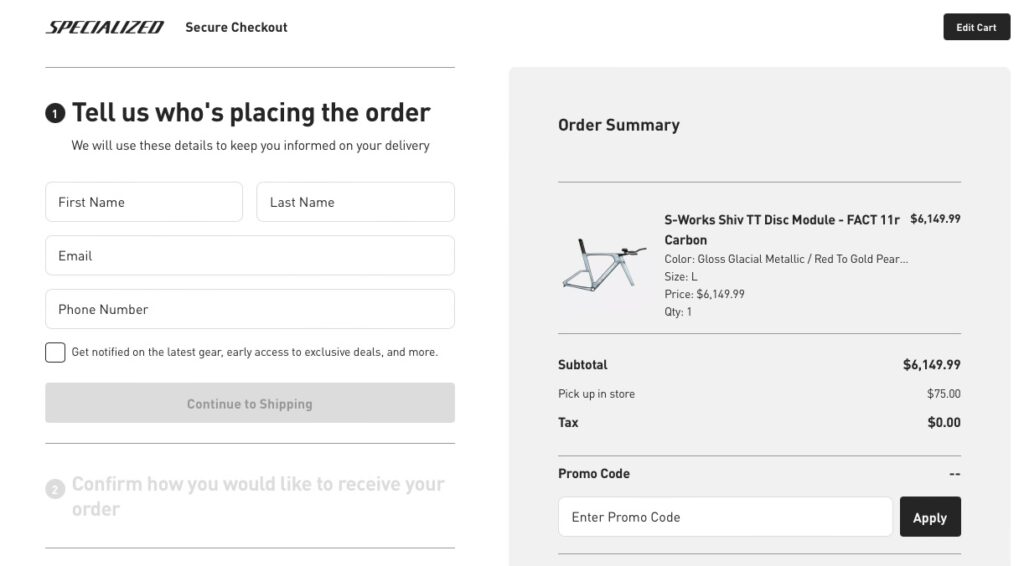
Attempting to re-create the conditions claimed in the suits had surprising results. On both websites, I attempted to purchase either a Shiv or Trinity. On Specialized’s site, I could only purchase a Shiv as a frame. The listed price of the frame is $6,149. Regardless of whether I chose to have the bike shipped to my home, or to pick it up in a store, a $75 fee was added to the purchase.
Similarly, on Giant’s site, I went to purchase an MSRP Trinity Advanced SL 2 for $9,900. Yet after you’ve added the item to your cart, then go to make your purchase, there’s a surprise $75 fee awaiting you. It is labelled as a shipping fee, with the explanation that the “Shipping Fee reflects costs incurred in transportation, logistics, and other associated fees. The shipping fee is non-refundable or negotiable.”







I suspect this is how they have attempted to recoup the various tariffs as well as wild swings in inbound ocean freight and just don’t want to all it a tariff fee which would have overtly political tones to some.
My guess is, as dumb as the law is, it would seem to apply in this case that they are in violation. The law itself actually seems designed not to protect consumers but to stifle how companies choose to communicate what they are charging.
If everyone started seeing environmental handling fees and tariff fees clearly spelled out on their invoice, voters are more likely to redirect some of their ire about the increased taxation. If it just gets hidden in the product cost, it’s just high price gouging businesses sticking it to the man.
So with that thought, putting my internet armchair lawyer hat on, I would suggest there is a legitimate first amendment claim here that businesses surely have a right to communicate how and why their price is what it is, that supersedes the state’s right to dictate how a a receipt ought to look.
In fact, I’m not even sure what a hidden fee is. It would seem the state is actually asking the business to hide the fee they are paying from the consumer inside the product price. Wouldn’t that be more hidden than clearly seeing the fee on the website before you click pay? Or even checkout as it is in the case of specialized – see screen shot on the product page:
I would hope at a minimum any business would able to communicate the possibility of additional fees by adding in small print under the price, “additional fees may apply” or something like it. We may not like how they communicate, and the extra fees that get tacked on everywhere (hello Frontier airlines) are annoying, but it’s a greater threat to speech if governments presume to dictate how and why prices as a result of government policy are communicated.
Essentially: you are supposed to show the all in price before you add something to the cart, with extremely limited exceptions.
Taking the Giant example: you would put very clearly that your total cart cost would be $9,975 before you get to checkout, and you may happily say that the price includes a $75 fee that encompasses tariff or some other policy. But it’s meant to prevent what both the state and federal government declare to be false advertising: showing one price before the bait and switch of additional fees are included. And there’s a whole lot of case law showing that false advertising / deceptive pricing do not have First Amendment protection.
(There’s a limited exception for “reasonable” shipping fees and mandatory taxes, as mentioned in the article).
Daily reminder that I am not a lawyer, I just went to law school and did not sleep in a Holiday Inn Express last night.
If only restaurants in California were held to this standard. Also $75 sounds cheap for bike shipping.
From one of the links in the article: “Mandatory fees charged by restaurants, bars, and other select food vendors are exempted from SB 478’s requirements so long as the fee is clearly and conspicuously displayed wherever prices are shown (see SB 1524).”
Yeah, but this is why I’m tipping much less when I eat in California. Change your menu if you got beef.
That makes no sense. It’s a requirement about listing products for what they actually cost. It’s not a ban of providing additional information to consumers what ‘fees’ are included in that prize.