
Clash Endurance Expands to Find Its Niche
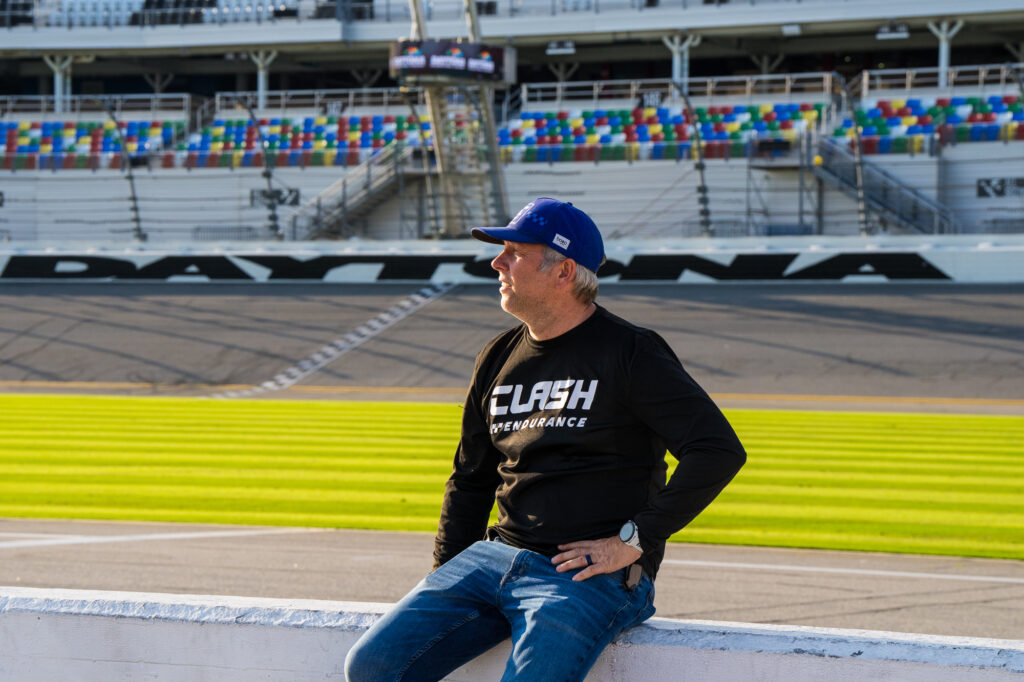
Andre Lapar. Photo: Kevin Mackinnon
They call it the “World Center of Racing” and, every February, it is the site of one of the motor racing’s most prestigious events – the Daytona 500. Before the cars take to the track next year, though, triathletes get to experience riding around the famous track. Since 2018 the Daytona International Speedway has been hosting a triathlon event. It began as Challenge Daytona, but since 2022, when organizers rebranded from Challenge North America to Clash Endurance, the race has been known as Clash Daytona.
Full disclosure: I’m announcing at the event here in Daytona this weekend, as I have for every one of the races held at the speedway. Since I figured I should get some of my regular work done, I managed to steal the chief operating officer of Clash, Andre Lapar, away for a quick interview.
“Daytona is our crown jewel … this venue is unbelievable,” Lapar says from trackside. “We’re able to accommodate so many athletes across a variety of swim, bike and run events here at Daytona International Speedway, which if you haven’t been, is a breathtaking venue.”
Lapar is quick to credit the fact that triathletes even get to race on the famous track to the owner and president of Clash Endurance, Bill Christy, who is married to Lesa France Kennedy, the executive vice-chair of NASCAR and the president and CEO of the International Speedway Corporation. Lapar also credits Christy with the vibe you’ll feel at a Clash event – the races always feel like they are “punching about their weight” in terms of production value vs the size of the fields.
“Part of it is our owner, Bill Christy, is passionate about the sport,” Lapar says. “He’s done some of the biggest races around the world and he knows what things work. He hired me on – I spent 14 years working at IRONMAN. I know how to produce large events. So, we try to do it right, do right by the athletes and put on the highest quality events that we’re capable of producing.”

Bill Christy competes in a relay at the 2023 Clash Daytona race. Photo: Kevin Mackinnon
“Without Bill we’re not here, right?” Lapar continues, pointing at the huge grandstand that seats over 101,000 people. “That connection to NASCAR that he has, and the passion for the sport … Every time he goes to an event somewhere I get texts or photos saying ‘hey we should do this at our event,’ or ‘hey, what do you think if we do this?’ I think that’s part of the reason why you come and it’s a big production, why our events have that “big show” feel, like all the other big events and major championships. He keeps driving us to try to be better and to do what the big guys do – he just leaves it to us to figure out how to do it cheaper, because we just don’t have the same budget.”

Photo: Kevin Mackinnon
Over the last few years Clash has moved away from putting on and televising pro endurance races, but remains committed to elite racing on a different front.
“We’ve kind of found a niche on the elite side of things with the last two years in Miami doing draft-legal racing with the America’s Triathlon Cup,” Lapar says. “We had the America’s Triathlon Championship in 2024 in Miami. Our Miami event is relocating to coastal Mississippi – we found some great hosts there – but we’re still hosting a Continental Cup. We’re also hosting Collegiate Club Nationals, which is so important for the development of our sport. Elite draft legal racing in the U.S. isn’t really on anybody’s radar. IRONMAN, T100, Super League, they’re doing some of their own things on the pro side, which is great, but there’s a big gap there on the draft-legal, Olympic-development, pipeline. We don’t have the budgets of IRONMAN or T100, so we have turned to that as a way we can support elite level racing and try to make a difference on that side of the sport.”
“The landscape of the sport is changing a little bit, and for that middle- to long-distance, you have to get the big names there to get the media coverage and to get the television product you want,” Lapar continues. “Organizations have to spend money for appearance fees to get the pros there, and you have to have a sizable prize purse. Now, especially with the IRONMAN Pro Series and T100 with their series, I mean, as a small company, we’re not going to outspend them. It’s not a viable model for us. It’s more impactful for us to help grow the age-group side of the sport and, as I said, finding that niche with the
draft-legal elite side of things is where we can be impactful and continue to grow and elevate the sport without having to compete against these multi-million dollar prize purses.”
While Clash Endurance is expanding to other venues and sports (there’s a half marathon in Daytona in February, the new Mississippi event that replaces the Miami race in March, and a new gravel race that’s held in November), the event at Daytona International Speedway isn’t going anywhere.
“That’s part of our DNA and our roots and kind of our history,” Lapar says. “The speedways solve a lot of the issues for endurance sports. You have parking galore, you have places you can host expos. There are easy accommodations close by, RV camping is part of it, and you can really just take over a large space venue, which is sometimes difficult in downtown areas and big cities and major markets, so the track model solves some things. But, we know, moving forward, we cannot be just pigeonholed into race tracks.”

Photo: Kevin Mackinnon
As it is with any series starting up, the biggest challenge has been getting the word out to athletes about the Clash events.
“You can’t just put an ad on facebook and you’re gonna have thousands of people signing up for your event,” Lapar says. “Those days are long gone. That hasn’t worked for 15 years. You have to get people there, they have to have a good experience. And it’s more than just the race course … Did you enjoy the whole aspect of the weekend? Were there some great vendors you were able to interact with in an expo? Did you have a good meal post event? Did you come out and meet some like-minded people?”
“Where the sport needs to lean to continue to grow and evolve is to get new people in the door, and that’s the niche we found with the Collegiate Club Nationals,” Lapar continues. “It is such a welcome change. Everybody’s there cheering each other on. And the competition level is unreal. These are kids that will be on our Olympic team in the next four to eight years, and then a bunch of them on the other side of that spectrum are just out having fun with their friends doing a triathlon. We have four short years to get that hook in them and hope that they become lifelong triathletes.”
Another race-concept that Clash has been pushing for a few years is the innovative “Redline Relay.”

Athletes compete at last year’s Redline Relay at Daytona International Speedway. Photo: Jonny Nomad/ Clash Endurance.
“We have got 24 teams here, teams of eight riders,” Lapar says. “You’re on pit road at the World Center of Racing – I mean, it’s an iconic backdrop. It’s a fun format for racing a bicycle – you have your team there with you at the pit stall, you’ve got two of your riders out on the track at any given time, then you have to pull into the pits to do the relay baton exchange – we have the timing chips inside of a water bottle, so you’re only as fast as your slowest team member because you got to keep those two athletes together. It’s just the camaraderie along pit road between the different teams, and the smack talking, and it’s just a cool, different way to ride and race a bicycle.”
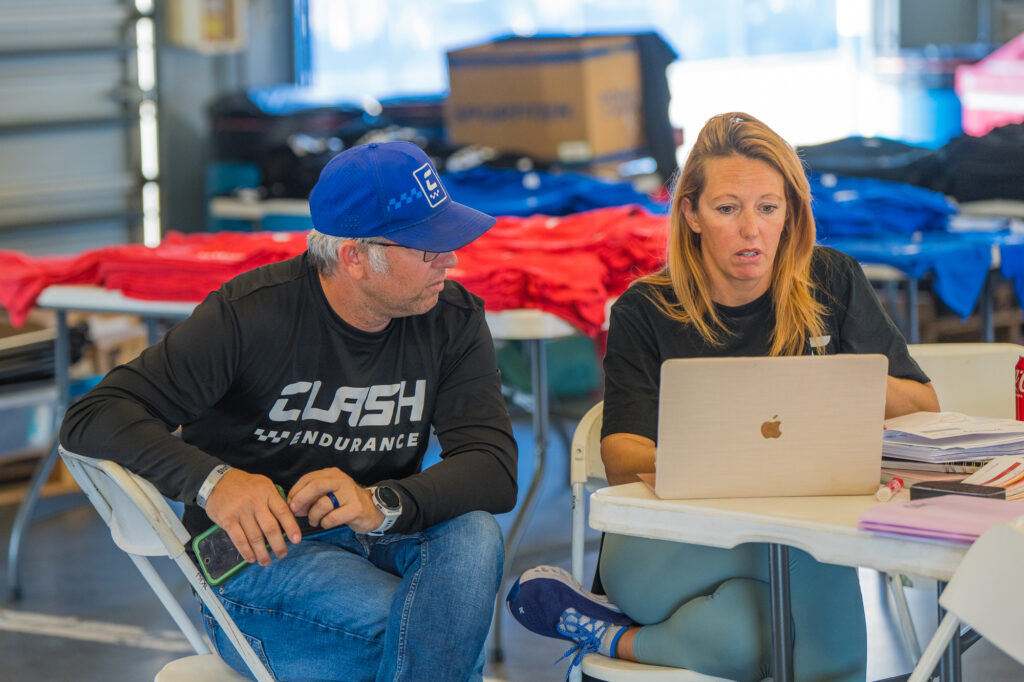
Lapar and Cassie Miller, the director of event operations and partnerships at Clash Endurance. Photo: Kevin Mackinnon
Lapar, who helped IRONMAN develop a number of events during his time with the company, is eager to continue to help Clash Endurance grow, but also determined to help the triathlon community. While fewer and fewer events are offering kids races, he’s determined to maintain that aspect of the Clash races. I ask what his vision and goals are for the company over the next few years.
“I’d like to see us grow our footprint a little bit larger with some events,” he says. “I’d like to see some of our other niche events become marquee events on people’s calendars. And I’d like to continue to see us help the U.S. development on the elite side of things as we have. The Olympics are on home soil in just a few years time. So I’m passionate about it. I think it’s important for those athletes to be able to race on home soil for their morale, for their sponsors, for their families and then also for the exposure for the sport.”
“The one thing that I think sometimes we miss in the US is how attainable triathlon can be,” Lapar continues. “I spent 14 years working at IRONMAN, I finished a full and a multiple halves. It’s a great goal, but it doesn’t have to be the be-all end-all of triathlon, right? It can be an enjoyable addition to your life without completely taking over.”



I have enjoyed Clash Daytona for 4 years in a row although I passed this year because of the distance change. After so many years of progression I wouldn’t have been able to compare times. Unfortunately, I think the distance change sent Clash loyal athletes to Ironman 70.3 Haines City the following weekend.
How did Daytona compare to Haines City? I have done Haines City several times. The lake is not appealing and the run is too hilly for Florida. I am thinking of trying Daytona.