
From Speed Skating to Triathlon: A Look At the Innovative Cádomotus 4E Aero Cycling Shoe
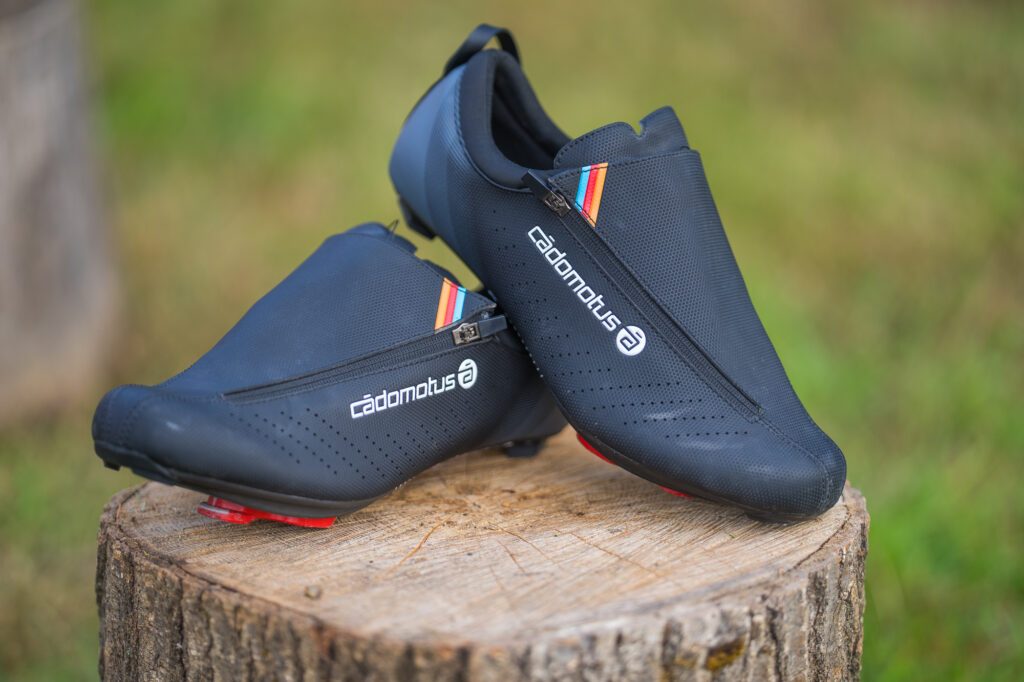
Photo: Kevin Mackinnon
Founded in 2006 by Diederik Hol, Cádomotus began as a company focused on speed and inline skates. Hol developed a special “clap” skate design while studying industrial design at the Delft Technical University in the Netherlands during the 90s, and he used that knowledge to develop his own brand of skates a little over a decade later.
Hol had long been an avid cyclist, so it wasn’t much of a stretch for him to branch out into cycling and triathlon – especially as global warming has decimated the outdoor skating world in the Netherlands. (Outdoor skating marathons, once incredibly popular in the Netherlands, have mostly moved indoors or to other countries.) By 2020 Cádomotus had its first cycling shoes on the market, and the company has been pushing hard over the last few years to make inroads into the triathlon market, with large booths at various IRONMAN and other major triathlon expos.
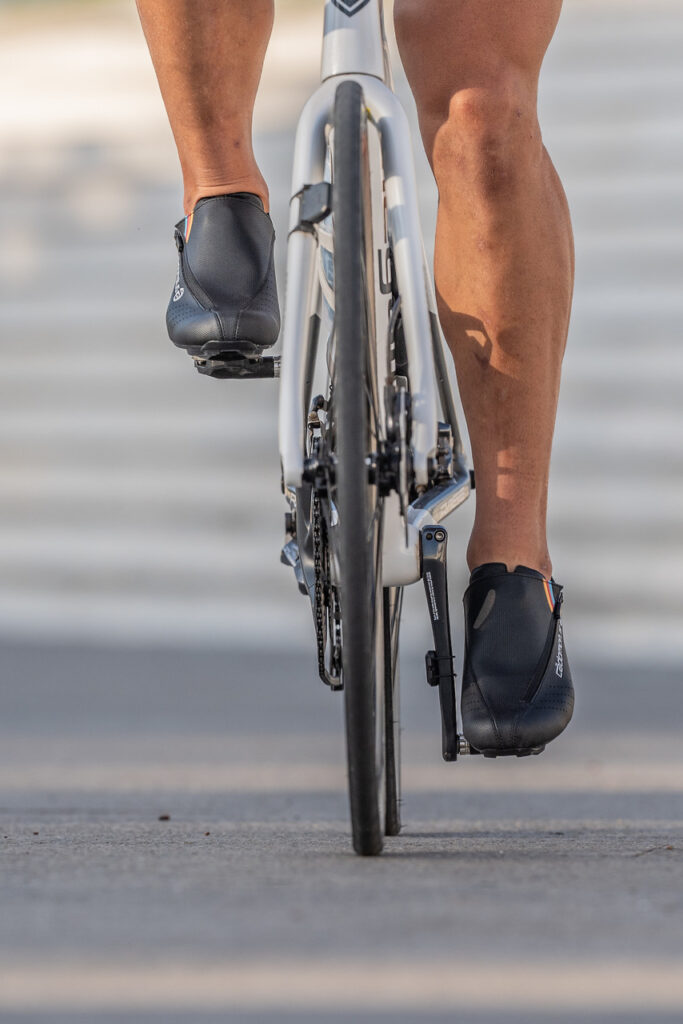
Photo: Cádomotus
Developing fast cycling shoes was an easy next-step for a company that specialized in high-end skates. Speed skates, like cycling shoes, need to be stiff enough to be able to transfer huge amounts of power – in one instance to a blade, in the other to the pedals. The other thing that Hol was bringing to the party was aerodynamic know how. We all know how much speed skaters care about aerodynamic performance – they were decked out in aerodynamic suits long before Greg Lemond won the Tour de France on a set of Boone Lennon’s Scott DH aerobars.
It’s not hard to see the speed skating roots of the Cádomotus triathlon cycling shoes. The unique design features a wraparound upper with a Boa closure system that allows you to literally dial in the perfect fit. Once you’ve done that, you zipper up the top flap to streamline the whole shoe. Cádomotus claims that the aerodynamic design of the flagship Aero model can save up to 10 watts.
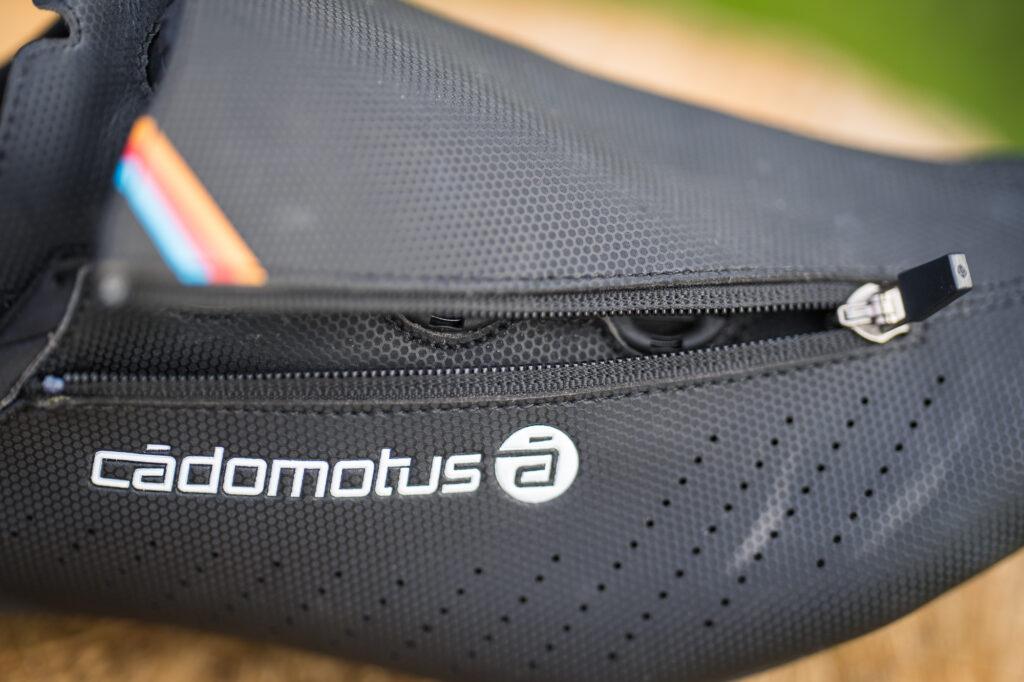
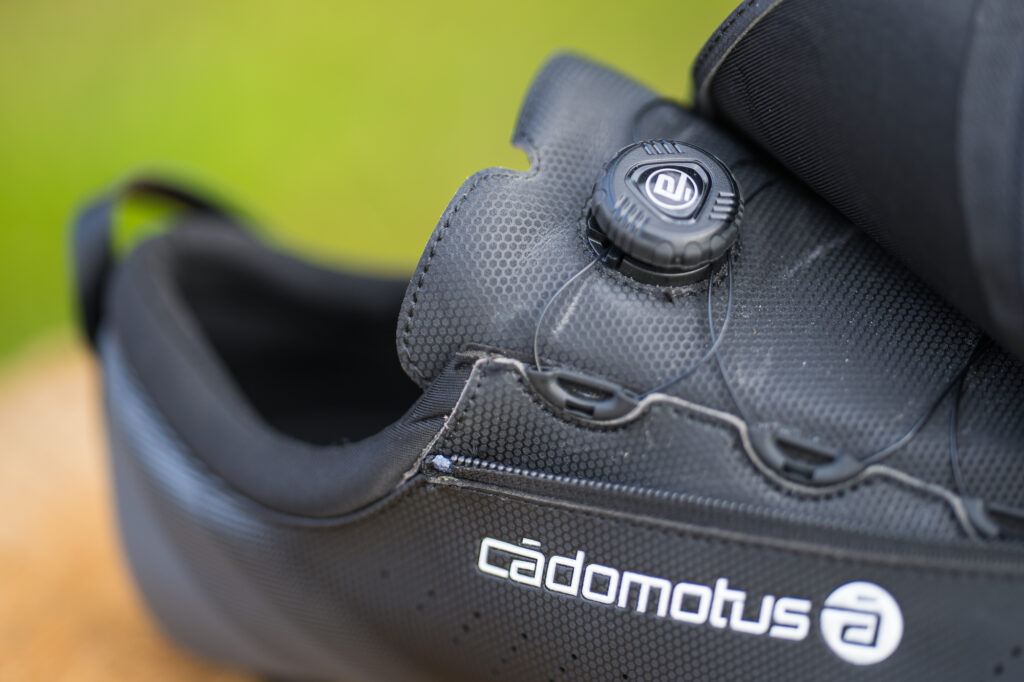
The aero design hides the Boa dial from the wind. Photos: Kevin Mackinnon
Which is no-doubt why you’ll see these on the feet of many pro triathletes looking for any edge they can find. The company’s website proudly lists some big names including former 70.3 world champ Rico Bogen, last weekend’s IRONMAN Arizona champ Menno Koolhaas, Justus Nieschlag and Marlene de Boer. We also noticed that American Ben Kanute was wearing the Cádomotus shoes on the bike at the IRONMAN 70.3 World Championship in Marbella the week before he took third in Arizona.
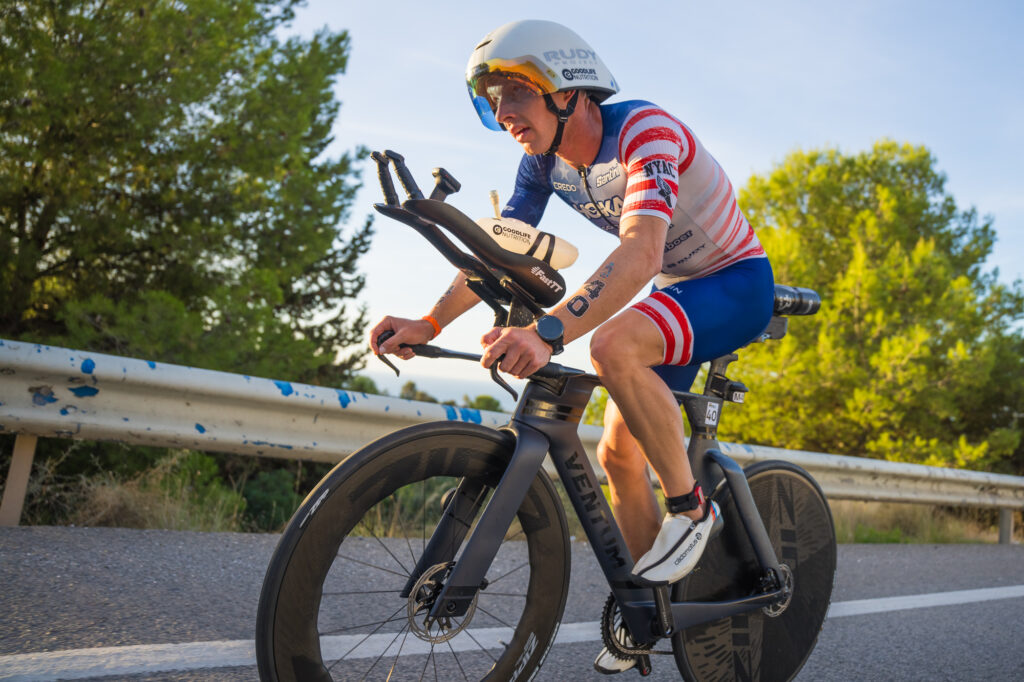
Ben Kanute on the bike in Marbella. Photo: Kevin Mackinnon
I met with Hol at one of those expos at Challenge Roth last summer, where he introduced me to his innovative shoes and sent me off with a pair to review. I had hoped to try out the flagship Chronos Aero shoe, but the sizing they had available didn’t quite match my foot, so Hol sent me off with the Chronos 4E. While the Aero features a heat-moldable carbon shell that wraps around your foot, the 4E has a more traditional carbon sole.
In the end I was really happy Hol sent me off with the 4E – I think it made more sense for me to review this model. The 4E is likely to be a much more popular Cádomotus model for most triathletes, retailing for 274 Euros versus the 471 Euros you will have to dish out for the Aero model, all while providing excellent comfort, support and performance. (I do still want to try the Chronos Bianco model with its Wahoo/ Speedplay direct mount, but that will have to wait!) While the Aero’s wrap-around carbon sole is said to provide decent power transfer even without being fastened (due to that snug-fitting heat-moldable carbon shell), reports are that they’re not as ventilated, which, as you’ll read below, was important for me based on where I was planning to test the shoes.
Comfort
While it’s tempting to begin with the aero benefits of the Cádomotus shoes first (they kind of look like aero booties, right?), I can’t help but start with the sheer comfort. The shoe somehow manages to provide excellent support without feeling particularly snug. I kept feeling like my foot should be moving around and wondering when I’d notice some loss of power as I pulled up and through the pedal stroke, especially while climbing, and it just never happened. I have really narrow feet, so I was really surprised that even though my foot never felt compressed, the shoe really did feel like it was wrapped around my foot, providing excellent support.
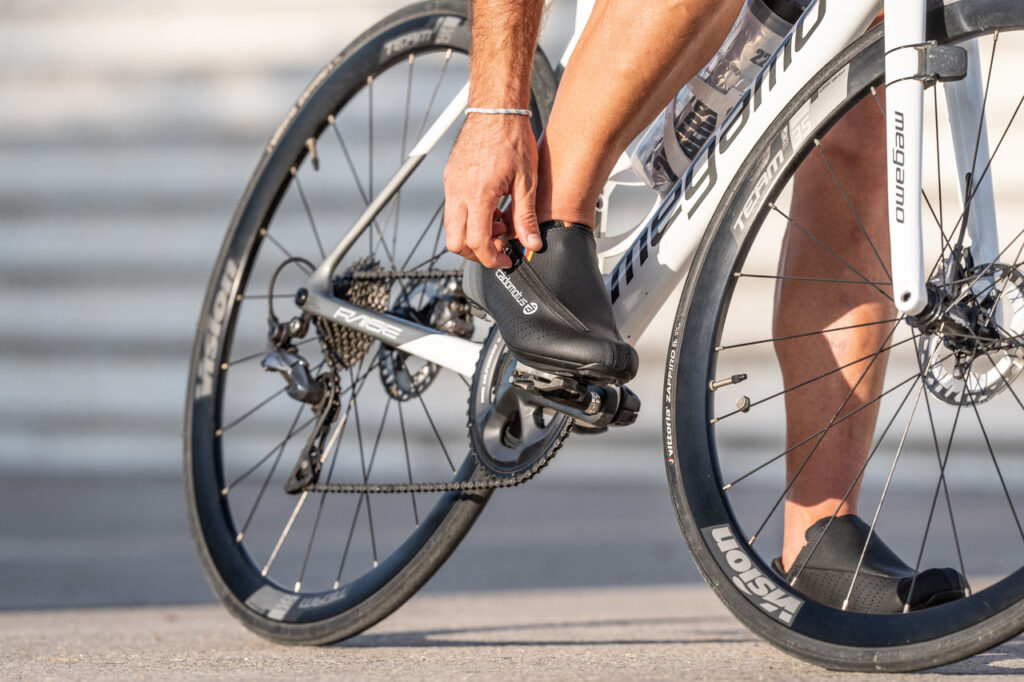
Photo: Cádomotus
The carbon sole is certainly extremely stiff, so you can push down on the pedals with confidence knowing that your effort is sending all the energy into moving you forward.
Ventilation
I felt certain that the shoes would end up feeling hot (remember that bootie comment?), and was prepared for that as I took them out for some hot summer rides here in Canada and even over to Kona for the IRONMAN World Championship. Somehow that just never happened. There’s excellent ventilation through a couple of strategically placed vents in that stiff carbon sole, and the upper is extremely breathable. I’ve even been pleasantly surprised to not feel like my feet are overheating during indoor rides.
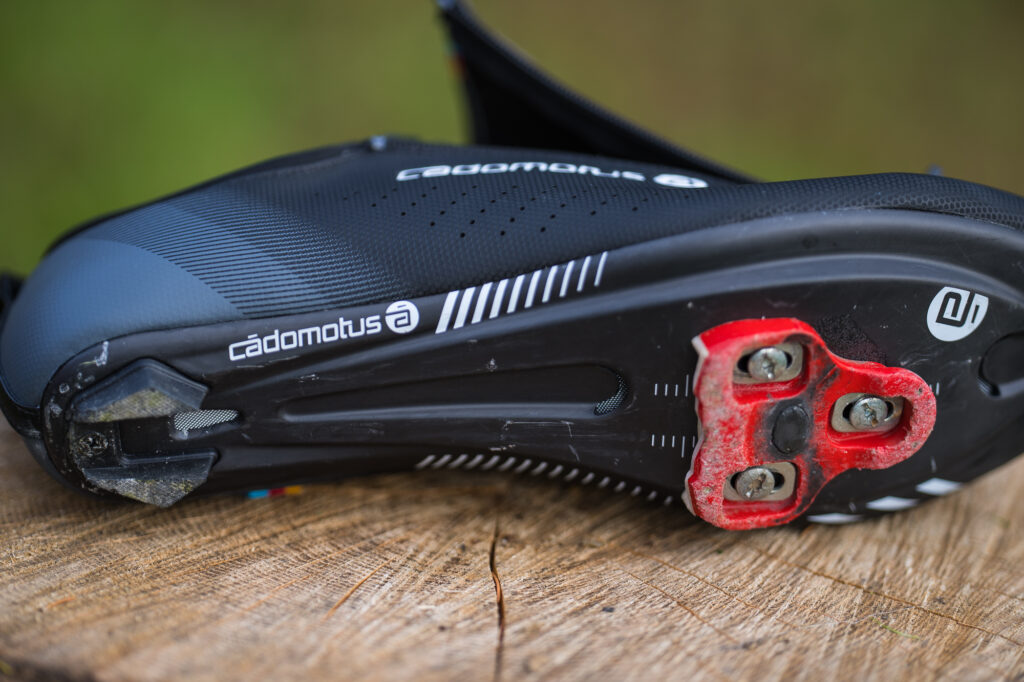
(Please excuse my beaten-up cleats and the muddy terrain I walked through.)
While I haven’t put the 4Es through nearly enough indoor riding to get to this point, I have been told that one of the downsides to these shoes is that all the sweat that gets generated during indoor rides tends to rust the zipper long before you’re ready to replace the rest of the shoes.
Distance-Oriented
Cádomotus does market the 4E for long-distance racing, and that probably makes sense. Despite the heel strap at the back, they are not the easiest shoes to get on, tightened up and then zippered up while you’re moving. (Hence the attraction of that wraparound Aero model for those who just want to get their foot into the shoe and worry about doing things up once you’re moving.) The 4E is probably a better shoe for those doing longer distance races than for elite athletes competing in a sprint- or Olympic-distance event where those extra couple of seconds in transition are critical. That strap is easy to grab and pull up when you’re sitting down or standing still, so you can still get the shoe on in a hurry, which will be more than enough for most folks doing a long-distance tri.
Final Thoughts
If you’ve struggled to find a cycling shoe that remains comfortable for even the longest rides, the Cádomotus 4E is well worth the look. Comfort is the name of the game with this shoe, but you’re not giving up on performance in any way, shape or form.
I do wonder if the zipper and extra material to cover up the Boa dial and laces adds some weight – at 270 g the 4Es are heavier than, for example, Shimano’s TR9 (230 g). I’m really not sure if that added weight will make or break your decision, and you certainly have to factor in the aero properties of the Cádomotus shoes as an upside.
At this point, buying the shoes in some countries will be a bit more complicated as the Cádomotus warehouse is in Europe, so you might get dinged with import duty if you order them and get them delivered. American customers can now purchase Cádomotus products from Oomph Sports, so there is no international shipping or customs fees. More information can be found here.





Wonder if @RowToTri wants to put these in the tunnel against the Velovetta Peregrines. Zipper has to add drag you’d think.
@marcag and I had our aerocamp in April this year and among the testers there were 5 that brought these and also their normal road bike shoes and/or tri shoes with boa or velcro like style closure.
There was in none of them any real difference, all were in the 1-2W difference range which just falls under the margin of error. We did multiple test runs on them as we were also a bit surprised as the claim is they would be something like 7-8 watts faster. We didn’t found that number on any of the riders.
I think these claims are very hard to prove and very individual, more in the range of calf sleeves. What works for one doesn’t work at all for the other or is at best similar. So there might be a rider that benefits from them but I feel 7-8 watts claim is a hard one to justify as a general claim.
But if they fit you well that is worth something at least.
Jeroen
I did test the Crono last years against my Specialized Torch’s:
I didn’t see a big drag savings but the shoes fit much better as they have a custom insert mold. The way the upper can be tightened with the Boa and then the upper flap is zippered up, it’s the best feeling and fitted shoe I have ever used. I feel like the power transfer is much better than I had with the Torch.
It can be difficult to predict results based on looks or inclusion of a zipper. I have not seen any tunnel test results with the Cadomotus shoes. There have been a number of pro triathletes and cyclists that have shared their testing with me - usually from the tunnel in Silverstone - but I cannot recall this one ever being in the mix. Covering the BOA with a flap is a strategy used by some other shoes and results I have seen for those have not been super awesome. My best guess is that construction can make the shoe a bit wider, increasing the frontal area a bit. It is true that getting reliable results is very difficult. I think even in a tunnel it requires a very good rider, good technician and a tunnel with excellent tools for helping the rider maintain position (Silverstone I think is the gold standard on that) to have results good enough to make decisions on. Outdoor testing for something in the realm of a few watts is more difficult.
Hi everyone — Diederik here, founder of Cádomotus. Really appreciate the honest discussion and the real-world data points. This is exactly the kind of community feedback that keeps us sharp.
@Jeroen, your 1-2W finding is consistent with what we’ve seen in several tests too, so I won’t argue with it. Some context on where our higher claims come from: our original 2023 tunnel test (full report here: Testing aerodynamics of new triathlon cycling shoes – cadomotus.com ) was conducted with elite athletes, including Diede Diederiks and Emmanuel Lejeune. The ~9W figure was measured against a Specialized Trivent — a short-distance shoe with a fairly open upper, which is probably not the most aerodynamic benchmark. Compared with a standard road cycling shoe, our data show something closer to 1-3W, which aligns well with what you found.
Since 2023, we’ve done a lot more testing — wind tunnels, velodromes, and outdoor with an AeroPod — and the honest conclusion is that results vary. Position, leg shape, sock height, speed… it all interacts. What I can say is that across all those tests, our shoes have never been measured as slower. That feels like a meaningful floor even if the ceiling is hard to pin down.
@RowToTri raises a fair point about the zipper flap. It’s a genuine engineering trade-off: the exposed BOA dial creates real turbulence, and covering it trades that for slightly more width. The net result is rider-dependent, which is part of why tunnel results vary.
But honestly — and this is something I probably don’t say loudly enough — the bigger story isn’t the aerodynamics. It’s the CarbonShell sole. Track cyclists have used comparable carbon-shell technology for years, precisely because it transfers power more efficiently by structurally supporting the foot. We see athletes hitting 20-30W higher peak sprint power in our shoes than with conventional options. It’s harder to quantify over a 180km ride, but the principle is the same: less energy lost to foot deformation means more watts to the pedals — and fresher legs at T2.
We’re actually heading to Norway soon for a formal exercise physiology study to put more concrete numbers on exactly this. Will share the results here when we have them.
Thanks again for the thoughtful thread — this kind of honest back-and-forth is valuable.
When I ride, it seems like all the force is through the balls of my feet, which lie (more or less) directly over the cleats. Do people exert force on some other part of their foot such that the stiffness of the sole transfers said power to the pedal? In my naive view, the sole (pun intended) purpose of the shoe behind the cleat is to keep the shoe firmly and comfortably connected to the foot.
I’m having a hard time picturing this power transfer, so any help would be appreciated.
My experience in working with track cyclists is that especially during standing starts they are throwing so much power into the pedals at the very limit of their considerable physical abilities that they can feel like they are pushing their foot sideways off the shoe and so they want the shoe to feel like it is really holding them centered over the cleat. For those of us who have never come close to exceeding 2000W, this is a feeling we have likely not encountered. But for many track cyclists, that feeling of lateral stability is important.
Hi Diederik - Just wanting to clarify that I was not trying to make any definitive statement about Cadomotus in particular. Designing and marketing an aerodynamic product is very tricky. Good testing is so hard to do, results, as you an others have pointed out, will vary from rider to rider even with excellent test protocols, and if your product has any success, other people will test it, some will do a good job. Many will not. Some people will report adverse results that may be fair or not fair. In the end, making a science-based effort in design and testing and reporting results as clearly and honestly as possible and allowing people to make the best decision they can off of inevitably imperfect information is the best any of us can do!
oh, also, answering another part of your question, bending of a cycling shoe sole is mostly from the fact that the part of your foot that is applying pressure to the pedal is larger than the cleat. So the sole can bend around the cleat a little. Here are 2 images of some simulations we did on our soles - the first shows stress which is bordering around the cleat. That’s where in this situation that sole stiffness is most important. The second shows displacement, greatly exaggerated. The outer edge has the maximum displacement because it is furthest way from the bending point. Like on a see-saw, the rotation happens at the hinge in the middle, but the seat at the end is that has moved the farthest. In this case, with the equivalent of a 1000W input, the maximum displacement is 0.29mm
Great question from @klehner, and a useful observation from @RowToTri — both actually connect to the same underlying biomechanics.
On foot pressure distribution
The intuition that “all force goes through the ball of the foot, directly over the cleat” is understandable, but pressure mapping data tells a more complex story. Research firms like geBiomized in Germany, which have now mapped over 50,000 feet in cycling shoes using 32-sensor insoles, consistently show that foot loading during the power phase is distributed across a much larger area of the foot than just the metatarsal heads (ball of the foot). Pressure is applied both anterior to the pedal axle and posterior to it, meaning the arch, midfoot, and even heel are loaded to varying degrees depending on cleat position, cadence, and power output.
This is exactly why sole stiffness matters beyond the cleat area. When the foot applies load over a broad surface, any flex in the sole — particularly behind the cleat — allows the foot to deform into that flex, dissipating energy that should go into the pedal. A stiffer shell that spans the full length of the foot eliminates that flex path. Athletes typically describe this as a more “direct” or “immediate” feeling underfoot. You can view some of Niek Heldoorn’s geBiomized foot-pressure data from our collaboration here.
On lateral force — the RowToTri point
This is the less-discussed dimension of power transfer. @RowToTri is right that track cyclists in particular feel significant lateral loading, especially during standing starts at 2000W+. But this isn’t exclusive to track. Any time you’re accelerating hard — out of a corner, on a climb, at the start of a race — the pedal stroke is no longer purely radial to the pedal axle. There’s a lateral component, and the shoe needs to resist that force and keep your foot centered over the cleat. This is where a rigid, full-length shell (as opposed to a flexible upper bonded to a carbon plate) makes a structural difference: the entire shell acts as a brace, not just the sole underneath the cleat.
This is part of what our CarbonShell design inherits from 25 years of speed skating: skaters cornering at 60 km/h on 1.1mm blades generate enormous lateral forces, and the boot must transfer those without any structural compliance. The same principle — a fully rigid shell that locks the foot in three dimensions — applies in the bike shoe context, just with different magnitudes.
Based on some early experiences with long rides in soft street shoes, I’m pretty sure that fore/aft stiffness and a supportive upper take some load off the connective tissues of the foot that would otherwise be responsible for transmitting force from the ankle to wherever the cleat is at.
Reminiscent of Bont, which I like quite a bit.