
Vasco Vilaça Wants to Win a World Championship
If you look at the list of World Triathlon Championship Series (WTCS — also known as the ITU World Triathlon Series before 2021) winners and year-end podium finishers since 2009, there aren’t many countries represented. There are a lot of Spanish flags, a bunch for France and many Union Jacks from Great Britain.
There are a few extra countries thrown into the mix, breaking up the Spain-France-Great Britain dominance. A couple of Norwegian flags grace the count, as well as a pair from Australia and three from New Zealand. Portugal appears twice on the list — both times thanks to 26-year-old Vasco Vilaça.
Vilaça burst onto the WTCS scene in 2020 when he raced to a surprise silver medal at the standalone world championship event in Hamburg, Germany. (After multiple race cancellations that year due to the COVID-19 pandemic, the series was shortened to a single, winner-take-all race.) Since then, Vilaça has steadily climbed the WTCS ranks, developing into one of the world’s best triathletes.
After securing his first overall series podium last year, Vilaça came into 2026 as a man on a mission — a mission he has so far executed to near-perfection. With two wins already this year, Vilaça sits atop the WTCS ranks and, while there is still plenty of racing left to go, he is in a position no Portuguese man has ever been in before with a very real chance to fight for a world title.
Stumbling into Triathlon
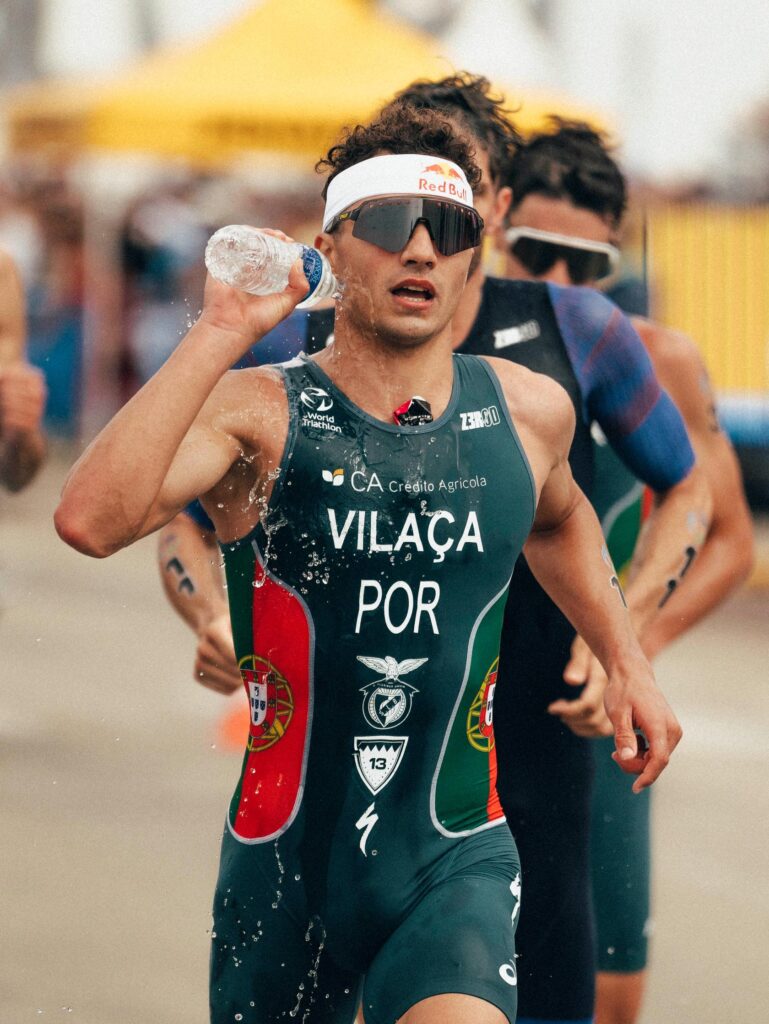
Football is the sport that stands above the rest in Portugal. When Vilaça was a child, though, he wasn’t inspired to follow in the steps of football stars such as Cristiano Ronaldo like so many other kids. Instead, he looked up to Vanessa Fernandes, the Portuguese triathlon star who won the ITU world title in 2007 and Olympic silver a year later in 2008. (It should be noted that, like any proud Portuguese citizen, Vilaça was still a big fan of Ronaldo.)
“Vanessa was very big in Portugal,” Vilaça says. “Football is always so big, but outside of that, she became one of our biggest stars. People talked a lot about her back then.”
Right around the time Fernandes was making a name for herself in Portugal and in the broader world of triathlon, Vilaça’s parents were looking into swimming lessons for him and his sister. When a neighbour of the family’s suggested triathlon, they bought in. Vilaça’s parents signed him and his sister up for a triathlon club (one that just so happened to be frequented by Fernandes), setting him on the path he is still riding to this day.
Vilaça says he wasn’t always great at the sport, and his first season or two of racing were rough. However, it didn’t take too long for his struggles to turn into successes. He earned a podium finish near the end of his second season of racing and, from there, things picked up quite quickly for him. He started winning more and more, soon enough flying to multiple national youth age group titles from the ages of eight to 12. Despite so much early success, he says that he was “never too obsessive” about winning.
“When the race was on, of course I wanted to win,” he says. “But I wasn’t too focused on it outside of that.”
Instead, he says he was more keen to train with his friends and travel to races with the club. It wasn’t the winning that kept him wanting to show up, but rather the camaraderie he found every day in training. This is a mindset he says he has maintained all throughout his triathlon career, whether he was racing youth championships, chasing junior or U23 titles, or fighting for WTCS wins and top world rankings.
“That’s where my love for the sport comes from,” he says. “From the team and people around me.”
Finding Success
It is by no means easy to win races as a child, but there is a big difference between being Portugal’s top 12-year-old and an elite junior competing on the international stage. Vilaça began racing at different events around Europe in 2014, and while he secured several impressive results in those early years of ITU racing, a pair of breakthrough performances came a bit down the road in 2017.
First, he won the European junior title in Kitzbühel, Austria, in June, which he says “came as a surprise” at the time.
“I wasn’t expecting to win it,” he says of the sprint-finish victory. “After that, I became a bit more confident.”
A few months later, he raced to a silver medal at the junior world champs in Rotterdam, Netherlands, finishing behind a young man Vilaça would come to know well: none other than the eventual 2025 WTCS champion Matthew Hauser of Australia.
“That was definitely my first big breakthrough,” he says. He told himself he was “at the right spot” and that he simply had to “keep growing” if he wanted the chance to compete with the world’s best at the senior level. Little did he know, he wasn’t too far off from doing that.
WTCS Racing
The next few years following his breakout performances in 2017 saw Vilaça racing world cup events around the globe. He notched several solid results, but his biggest came in 2020, when the Portuguese federation came to him and said they had a spot for him at the Grand Final in Hamburg.
“I wasn’t supposed to race, but another Portuguese athlete had to pull out and the team said they could swap my name with his,” Vilaça says.
With just one world series start on his resume at that point (he finished 15th in Edmonton, Canada, in 2019), just the opportunity to compete in the senior men’s world championship was exciting for someone in then-20-year-old Vilaça’s position. What came next was “a really big surprise” for him, as he flew to second place in Germany, finishing just two seconds behind world champion Vincent Luis of France.
In the years since, Vilaça has seen a relatively consistent upward trajectory on the world stage. In 2022, he earned a top-10 ranking in the WTCS standings. In 2023, he made it into the top five. The 2024 season saw him run to fifth at his debut Olympics, and last year he managed to grab his first-ever WTCS year-end podium, finishing third.
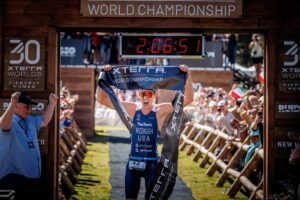
That all led him to this season, which has been a career year for Vilaça. He has raced on the WTCS circuit three times, laying down two wins and a second-place finish. His opening win of the year came at WTCS Samarkand in Uzbekistan, which was the first WTCS victory on his resume. He broke the tape with what seemed to be a look of relief on his face, although he says now that it was more likely just one of pure exhaustion.
“When I first crossed the line, I was just tired after pushing myself so hard to get the win,” he says. “But when I eventually laid down on the blue carpet, I did think to myself, ‘Finally,’ because this is something I’ve been thinking about for a long time.”
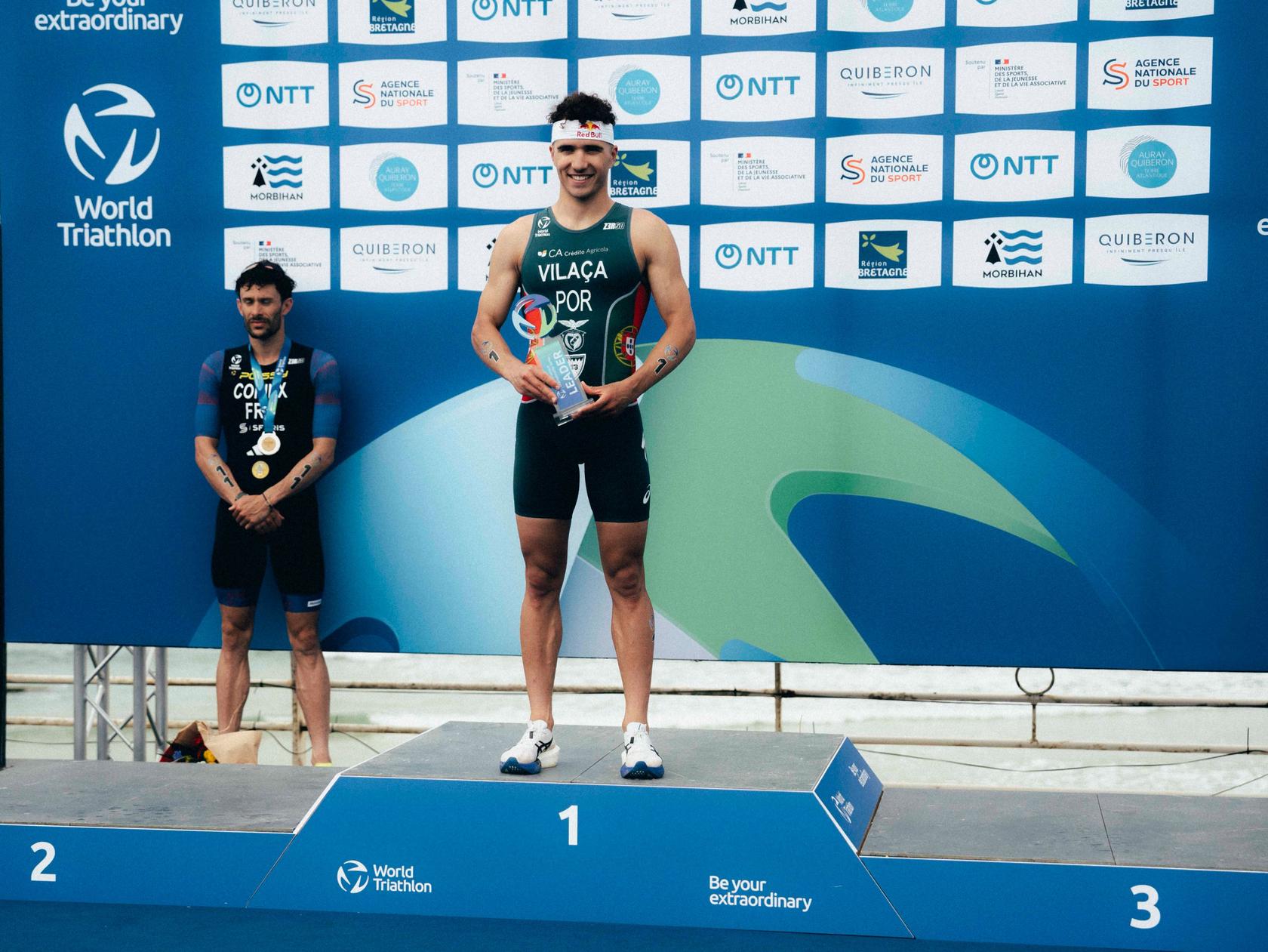
He didn’t have to think about his next win for too long, as it came right on the heels of Samarkand at WTCS Alghero in Italy. Less than a month later, he toed the line once again, this time in France at WTCS Quiberon. He came extremely close to a third straight WTCS win, but he had to settle for second, finishing just behind hometown favourite Dorian Coninx.
With at least five WTCS races left on the season (World Triathlon has yet to solidify plans for or against a sixth in Abu Dhabi, which was postponed in March following the start of the war in the Middle East), Vilaça has a long way to go before he can be crowned world champion, but thanks to his two wins and a third podium in three races, he is firmly in the driver’s seat at the moment and holding onto first place in the series rankings.
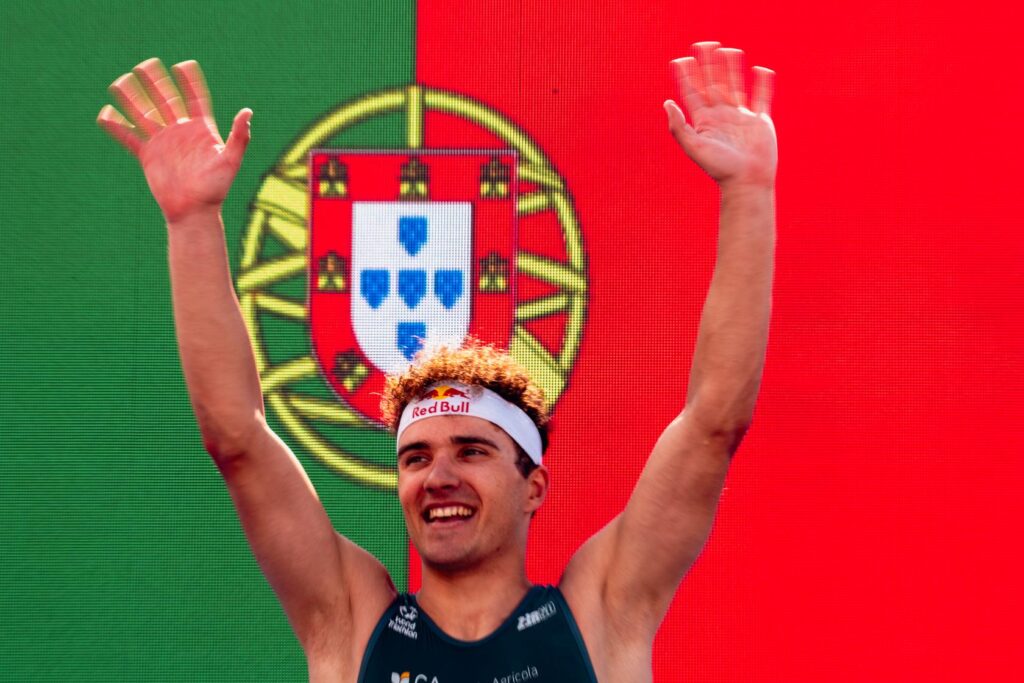
Even with all eyes on him, Vilaça says he “doesn’t think about it too much” and instead opts to focus on the task at hand in training and racing.
“If I’m first or if I’m second, there are still 60 guys behind me chasing me, so it doesn’t make much of a difference,” he says. “Also, going into the Grand Final, you don’t have to be in first to win. So I don’t put too much pressure on myself to hold onto number one.”
That being said, he does say it is “cool” to be the top-ranked man on tour, adding that he doesn’t take it for granted. He points to early 2023, when a pair of podium finishes led to him being the top-ranked man for a short stint.
“At that time, I thought this was just the start for me,” he says. “I thought I’d be back in that spot again soon.”
Up until this year, however, Vilaça had not regained the top ranking. Three years older and wiser, he says he is now able to appreciate just how special that title is.
“I just tell myself that I don’t know how long this will last, so I need to enjoy it in the moment,” he says. “But I of course want to make it last as long as possible.”
It won’t be an easy task, but Vilaça says he is ready for it. He has been dreaming about and working toward this moment for many years. Now, the moment is here, and he is going to do his best to hang onto it.

Start the discussion at forum.slowtwitch.com