
PTO CEO Sam Renouf on the Challenge Acquisition, the Future of the Sport and Profitable T100 Races
It’s hardly news to any triathlon fans that the triathlon world has undergone major change over the last decade. Since the Professional Triathletes Organisation (PTO) started putting on events, though, there’s never been a better time to be a professional long-distance triathlete. The PTO’s series forced IRONMAN to create the IRONMAN Pro Series, which has been a resounding success with large numbers of pro athletes clamouring to get into the various races.
The PTO’s T100 Triathlon World Tour has been constantly evolving, too. Last year we saw the implementation of separate men’s and women’s races (except for the Grand Final) to streamline the event coverage, and this year the series won’t be offering pro contracts. Age group racing is becoming more and more important to the T100 series, too. Last year, across the nine T100 races, almost 30,000 athletes took part in the various triathlon and “shoulder” events.
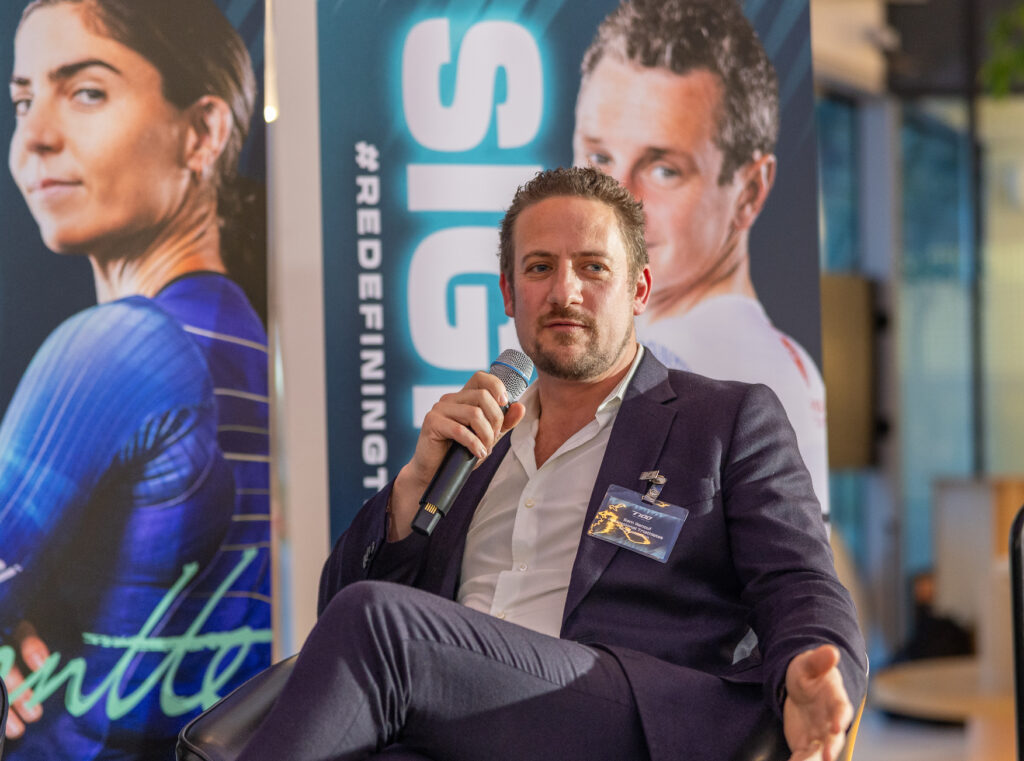
The acquisition of Challenge Family emphasizes the importance of age group racing to the PTO. We caught up with PTO CEO Sam Renouf to get more detail on the addition of Challenge Family events to the Triathlon World Tour (set to start in 2027) and how the PTO looks to grow the sport globally.
It will come as no surprise that Renouf’s comments present a very optimistic picture of both the current scene and future possibilities for the tour.
What did the PTO acquire?
The majority of Challenge Family races are independent entities that are licensed by the series. So, what does that mean for the PTO?
“Many of the events are licensed, but not all of them are,” Renouf explained. “Some events are directly operated, while many others operate under licenses.”
“The licensing structure is actually similar to how World Triathlon operates many of its events,” Renouf continued. “And, actually, it’s very similar to what exists with the World Triathlon deal that we’ve already announced. So, in fact, World Triathlon is even more extreme in that almost all of those events are delivered through, basically, a license. So, it’s just bringing together more races under the consistent banner of the Triathlon World Tour when it launches.”
What the acquisition actually includes
The acquisition wasn’t just about races—it included several key assets.
“What do we get with the acquisition? We get a brand, we get a database, we get IP that’s existed for 23 years that’s related to Challenge Family,” Renouf said. “There’s a very capable team with some wonderful people … that have worked all the way around the world that are either employees or very long-term contractors.”
The strategy behind the move
The acquisition fits into the PTO’s broader strategy to build a large global race calendar.
“For us, from a strategic perspective, I’m sure it was probably fairly obvious to most people in the industry that it was coming when we announced in December that we were going to 100 events and we’re going to create a Challenger Series,” Renouf said.
“I think it’s excitement overall about bringing the community together,” Renouf continued. “If you’re a licensee, sort of the strength of your brand or your event is based on what the licensor has given you. We have a lot more resources by nature of all of the investment we’ve raised and the team that we’ve built.”
A key requirement: broadcast coverage
A major pillar of the new system is media coverage – the vision includes three core components.
“All Triathlon World Tour events will be broadcast,” Renouf said. “You will have pro racing, you will have age group racing, and you will have broadcast. Those three pieces are very fundamental, and that’s what we will be working on getting into all of the events. That creates a massive marketing platform for us to promote the sport, and then, ultimately, to promote the athletes and the story line.”
Where the money comes from
A natural question arises about how all of this will be funded.
“What will really surprise people to hear is that the T100 is actually very close to being break even already,” Renouf said. “It’s a combination of age group racing, corporate sponsorship and hosting fees.”
While I expressed skepticism on that front (the PTO has been on an ongoing fundraising drive over the years and, despite the pro changes – split races and no contracts this year – still seems a ways from being able to generate profits), Renouf argues that the economics of live coverage have changed dramatically over the years.
“The difference in technology on broadcast that exists today, and is continuing to change on an almost a daily basis, is worlds ahead,” he said. “The cost of doing this is dramatically lower even than when we started.”
Bringing fragmented rights together
The PTO believes triathlon has been too fragmented.
“Triathlon’s an amazing sport with an incredibly valuable audience … but it’s totally fragmented from a rights perspective,” Renouf said. “By bringing those rights together… selling 100 events is a much stronger commercial proposition.”
How the Triathlon World Tour differs from IRONMAN
Eventually, the conversation turns to the obvious comparison.
“For a start, this is bringing short course racing and long course racing together into a product,” Renouf said. “We love the fact that IRONMAN has created the Pro Series. We’re saying 17 races is great — we’re going to do that with 100.”
Ultimately, the PTO doesn’t see IRONMAN as the main competitor.
“We’re competing with people’s disposable time,” Renouf said. “We’re competing with golf and tennis and Formula One. Triathlon can go mainstream. If triathlon focuses on competing with each other as a sport…triathlon will stay small as a little niche sport. We’re not doing this to stay as a niche sport.”
“We’re going from essentially what will probably be 10 races this year to the best part of 80, maybe even 85 next year,” Renouf concluded. “It’s a big lift that we’re all going through, but an exciting time to be doing it.”
Tags:
Challenge FamilyPTOT100Triathlon World TourRelated Articles:

Continue the discussion at forum.slowtwitch.com
9 more replies





So, wasn’t there another article that inferred that the Challenge Brand will be wound down after this year? Or am I misremembering this @rrheisler ?
I agree with Sam that Ironman is not a competitor, rather PTO and Ironman are comp-llaborators (lack of better word, on the surface compeitors, but really collaborators) in making a bigger pie globally.
What is working against both is the degree of suspense involved in watching anything 3-8 hrs long. Pro baseball, you can have a 4 hrs game and there is not much going on most of the time, but you have suspense. In cricket, at T20 format, you have something going on all the time and suspense as you do in NFL, or NHL, or NBA or Golf. In triathlon you have nothing really going on most of the time, and there is almost no suspense particularly once into the second half of the run. So you end up having the only people caring being people who do the sport. Marathons largely have the same problem.
So my pet peeve is that they acquired the Challenge brand, not the events, and there you go, it’s the first question! Without further ado! Thanks. Now I’m wondering this: if they consider the Challenge brand valuable (as he seems to be intimating), will they axe it, as it was assumed?
Renouf certainly reveals something (unless he’s making it up) when he says broadcast costs are down dramatically (it wasn’t the relief from paying @JackKelly-TTH’s wages that made the difference though, was it?) and the PTO is close to breaking even (I assume, being the asshole I am, that it’s on some contrived financial metric basis like marginal income on an event less prize money or something to that effect).
There is no way that they’re close to breaking even if they’re doing GAAP.
GAAP is specific to the country they report in. PTO COMMERCIAL LIMITED is the operating company in the UK presumably. The Parent Company is registered in Delaware so no information is publicly available. The parent company is where all the funding is accounted for.
PTO COMMERCIAL LTD is required by law to produce micro entity accounts but not required by law in the UK to produce audited accounts. The last filed accounts are from 2024 which is a Balance Sheet however one can decipher from all previous BS published that they most likely have accumulated losses of circa STG16m which is financed by long term creditors i.e STG16m which is the funding form the parent. Is there any other info on company structure etc other than T100 op co and then the parent in Delaware?
PTO COMMERCIAL LTD was incorporated on 21 February 2020 i.e. the STG 16m losses are from then and 2024 losses are STG 5.2m for 2024.
I wonder if they could put on a race in Kona. If not, what do we call someone in the same field that prevents you from using their distribution channel?
Highly unlikely that Hawai’i County would permit another long course race, remember, there is heartache every year with just IMWC.
(I assume, being the asshole I am, that it’s on some contrived financial metric basis like marginal income on an event less prize money or something to that effect)
Its EBITA
That was a rhetorical question. Ironman has contracts that prevents competitors in the same city.
Would pto want to see what an AG race would look like in Kona? Would it even be 50% the numbers that the 70.3 gets each summer which isn’t a ton. Kona only has allure if it’s the actual IM WC, a race in Kona itself outside of that wouldn’t do much for actual numbers.
That’s irrelevant. Pick any city that Ironman has deliberately excluded competition from gaining a foothold. T100 is competition for age groupers dollars, sponsors dollars, and professional talent/influence. They are competition for venues. Competition for race directors. We can probably keep going down the list…
You’re missing the point. Pto would have embarrassing numbers if it went to the “Mecca” of LC Triathlon- Kona
Would have nothing to do with IM’s biz practices. No one cares about Kona unless it’s the WC and all the hoopla that comes with. The 70.3 already proves that. So going to Kona if your pto would be idiotic, hell they could literally get the Hawi 70.3 weekend from IM and they’d get 1/2 of ~1k total that the 70.3 gets now. You would be losing so much money, it would be idiotic to even suggest.
I’m glad you think Ironman is a bunch of idiots for locking down their “distribution” contracts against competitors. In any case, 700 people in a nearby, or the same city start racing a competitor to Ironman, that likely means some percent won’t race the Ironman. Which ends up being 100% or more of that race’s profit for Ironman. A competitor doesn’t have to have “more customers” to cause real problems to your business.
lol where did I call IM idiots? Seriously lurker, wtf. Suggesting pto should show up on the islands at this point is huge money lose for them. They don’t need to win Kona to be successful. They don’t need to compete directly against IM just to do it. They need successful places that are easily traveable and last I checked that ain’t Kona. That’s tough on 90% of your customers. Come on dude don’t make shit up that I’m saying, do better.
This pretty nonsensical.