
Does the Timing of The IRONMAN 70.3 World Championship Help or Hurt the Sport?
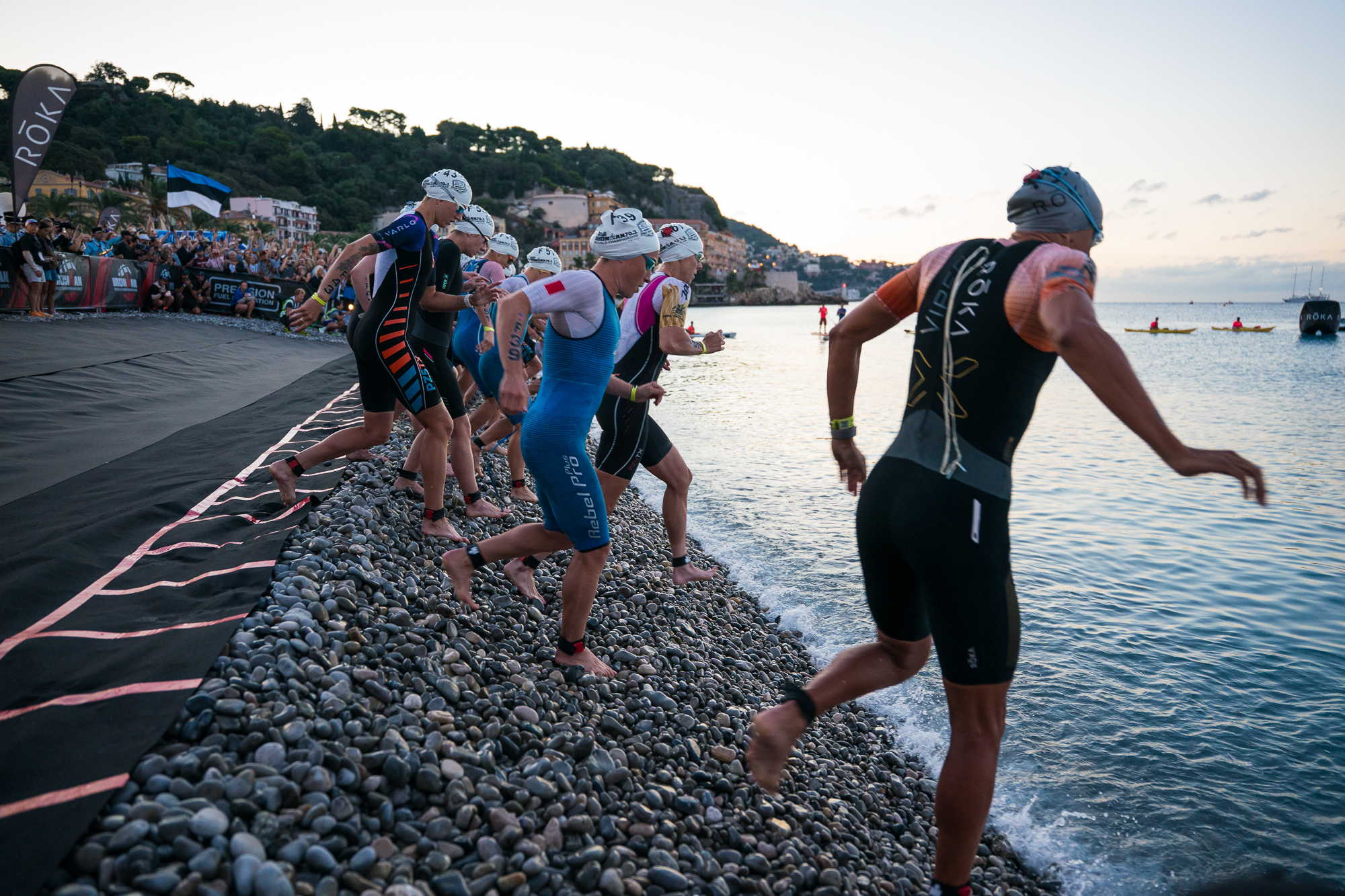
While this year’s IRONMAN 70.3 World Championship certainly offered spectacular fields, there were certainly some big names missing from the list. In the weeks leading up to the race a few pros (most notably Lucy Charles-Barclay) made it known that they wouldn’t be racing along the Promenade des Anglais in order to focus on the IRONMAN World Championship in Kona.
Kona has always been the biggest race of the season but, in recent years, the 70.3 World Championship has carved out more space for itself, more prestige and a deeper field of competitors. Part of that growth stemmed from the venue change that began in 2014. After five years in Clearwater, Florida, then three years in Henderson, Nevada (basically Las Vegas), the 2014 race took place in Mont-Tremblant, and it’s moved venues every year since. It’s also moved around in the calendar, often coming before Kona instead of after as it did in its inaugural years, based on the region. So, two years ago, the race took place in December in Taupo, New Zealand.
This season, there are just 27 days between the two championship races. The tight timeline was what had a few pros – in addition to Charles-Barclay, Americans Sam Long, Rudy Von Berg and Trevor Foley scratched their names from the start list, while Sam Laidlow chose the lower-key Challenge Samarkand rather than the competitive Nice field. Heading into the race even Kristian Blummenfelt threatened to “skip it and go straight to Hawaii.”
Is forcing athletes to choose between two world championship events a good thing for the sport?
The 27 Day Gap Changes the Equation
The 70.3 World Championship was in Nice, France, on September 12 and 13, while Kona is slated for October 10, in Hawaii. There are a mere 27 days between events. Even if you travelled straight from Nice to Kona, it takes an average of 24 hours and at least two flights to get between the two venues. On top of that, there is a whopping twelve-hour time difference, heat acclimation to consider, a tricky training and recovery schedule, hefty financial cost and, of course, carrying in extra fatigue which, for the big names, is the dealbreaker.
Pros are used to handling these kinds of logistics and it’s not like they aren’t used to racing on a similar time schedule, but adding it all up in the frame of the two biggest races, for those targeting Kona, Nice carries an opportunity cost that 70.3 worlds didn’t have before. Historically, there has been four to seven weeks between events and, whenever it has been less, Kona has come first.
The smallest gap was actually in 2006, where there was only 21 days between the two races. The most successful athlete in combined results that year was Lisa Bentley, who finished third in Kona and then second at 70.3 Worlds. In 2022, the gap was the same, and this time it was Blummenfelt who had the best combined results, finishing third in Kona and then going on to win the 70.3 title. However, in both cases, Kona was first on the calendar, followed by the 70.3 world championship.
70.3 World Championship Timing Relative to Kona
Men’s race dates used for chart
| Year | 70.3 Worlds Date | Kona Date | Relative | Gap (days) |
| 2006 | Nov. 11 | Oct. 21 | After | 21 |
| 2007 | Nov. 10 | Oct. 13 | After | 28 |
| 2008 | Nov. 8 | Oct. 11 | After | 28 |
| 2009 | Nov. 14 | Oct. 10 | After | 35 |
| 2010 | Nov. 13 | Oct. 9 | After | 35 |
| 2011 | Sep. 11 | Oct. 15 | Before | 34 |
| 2012 | Sep. 9 | Oct. 13 | Before | 34 |
| 2013 | Sep. 8 | Oct. 12 | Before | 34 |
| 2014 | Sep. 7 | Oct. 11 | Before | 34 |
| 2015 | Aug. 30 | Oct. 10 | Before | 41 |
| 2016 | Sep. 4 | Oct. 8 | Before | 34 |
| 2017 | Sep. 10 | Oct. 14 | Before | 34 |
| 2018 | Sep 2 | Oct. 13 | Before | 41 |
| 2019 | Sep 8 | Oct. 12 | Before | 34 |
| 2020 | Cancelled | Cancelled | — | — |
| 2021 | Sep. 18 | Postponed | — | — |
| 2022 | Oct. 29 | Oct 8 | After | 21 |
| 2023 | Aug. 27 | Oct. 14 | Before | 48 |
| 2024 | Dec. 14 | Oct. 26 | After | 49 |
| 2025 | Nov 8 | Oct. 11 | After | 28 |
| 2026 | Sep. 13 | Oct. 10 | Before | 27 |
Never before has the gap been so small between the events where the 70.3 Worlds came before Kona. We’re only talking about one week, but the pros appear to be telling us that matters.
Charles-Barclay, the defending 70.3 world champion, said on social media:
“Ultimately, I don’t want to reach a hard moment in Kona and wonder whether I left part of my best performance in Nice. Once I looked at it like that, the risk versus reward became clear. Choosing not to defend a world title carries real weight. But Kona is the race I’ve built my whole season around, and sometimes being all in means having the patience not to race. I want to arrive on the Big Island knowing I did everything I could to be ready.”
Charles-Barclay’s concerns were repeated by many of the athletes who chose to skip Nice, and their concern is warranted. Jan Frodeno won the 70.3 world title in 2018 and a week later was diagnosed with a hip fracture and withdrew from Kona. He might not have thought it was a risk, since he had previously won both in 2015 with the same 41-day gap to Kona–but we all remember the heartbreak. Craig Alexander did the double in 2011 with 34 days and Sebastian Kienle finished second at both in 2016 where he also had 34 days before Kona. The double can be done successfully, but racing, as Frodeno demonstrates, always carries risk, and when the time frame is reduced to 27 days before most athlete’s biggest race of the season, that risk becomes greater and too great for some.
Perhaps IRONMAN didn’t have the best choice of dates. Perhaps they thought it was enough time, maybe they didn’t even notice, or they intended to create some racing tension. Perhaps they should’ve consulted a few athletes. Regardless, the calendar presents athletes with tough choices every year, but it’s never pitted one championship event against the other.
The Hierarchy Is in Play
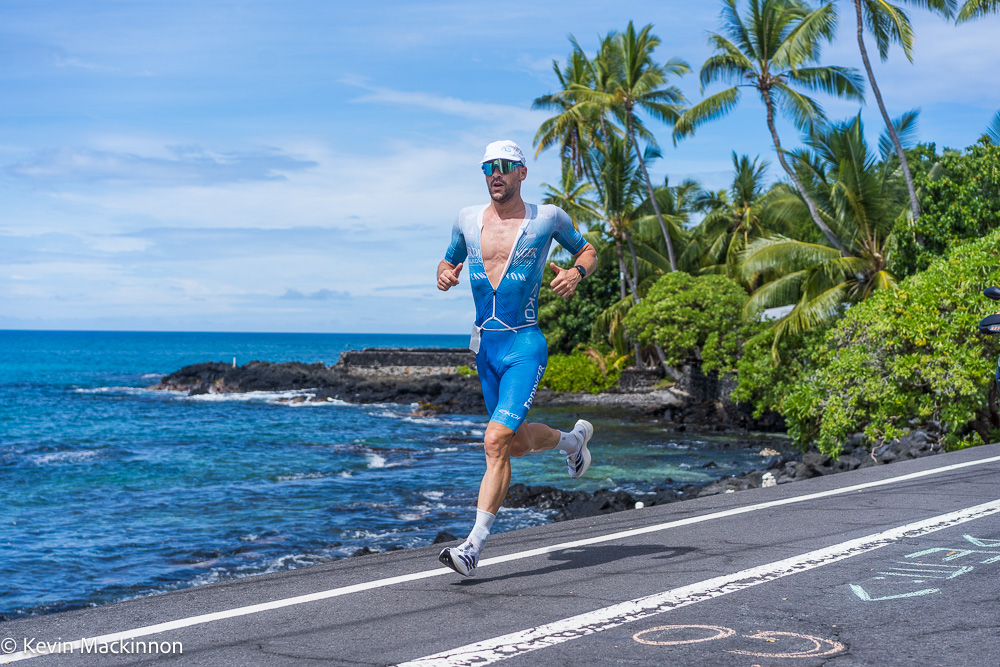
Kona is, and will always be, the crown jewel of long distance triathlon and the 70.3 Worlds has never remotely challenged that–until now. Looking back, when the half distance first got its own championship in 2006, it was after Kona. It later moved to before, but, as mentioned above, it was early enough in the calendar (typically a five to seven week gap) so there wasn’t a direct challenge to Kona. In fact, many used it as a way to “sharpen up” before heading to the Big Island. Over the past few years, however, 70.3 worlds has grown in depth (attracting more short-course and middle distance specialists), and has become an increasingly prestigious title in its own right.
We’ve seen a growing depth of professional middle distance racing with specialists emerging and coming across from short course racing more regularly. Jelle Geens, last year’s men’s 70.3 world champion (who was third this year), is a prime example. Traditionally, there was a separation between the short course and long distance world, but today we see athletes moving more fluidly between WTCS, T100, 70.3 and full IRONMAN racing. The result has been a growing field in numbers and depth across middle distance racing–with sponsorship contracts, obligations and incentives to match–pushing the 70.3 World Championships to a higher level in all senses.
The increase in prize money supports this idea. Ten years ago, the 70.3 Worlds prize purse was $250,000 and Kona was $650,000. Today, the split is $500,000 and $750,000, showing a 100% increase for 70.3 Worlds compared to a 15% increase for Kona. That said, the winner of Kona this year is walking away with $125,000, while Hayden Wilde and Taylor Knibb earned $75,000 for their efforts in Nice. The important concept here is not the difference in racing distance (work put in), but the increased opportunity and narrowing gap. Kona still carries greater prestige and economic value, but middle distance racing has been given considerable stage as well.
Likewise, with the advent of the Pro Series, there is another metric at play: points. Kona has a maximum of 6,000 points while 70.3 Worlds has a maximum of 3,000 points. Since an athlete’s five best results count, with a maximum of three full-distance races, depending on an athlete’s standings and how many qualifying races they have, they could be incentivized to either skip, or race in Nice. For example, Foley is sitting second in the overall standings and already has his five qualifying races, so it’s understandable from a points perspective that he could skip Nice and focus on maximizing his performance in Kona.
But the Pro Series doesn’t just bring points into the mix. The timing of 70.3 worlds in the Pro Series calendar positions it as a precursor to Kona. IRONMAN is signaling, once again, that their flagship event is the be-all-end-all. While it seems that the IRONMAN 70.3 World Championship is growing into its own stand-alone event with athletes specializing in the distance, the IRONMAN calendar is maintaining the traditional hierarchy, and subsequently athletes are self-selecting.
Age Groupers
While the same dynamics are in play for age group athletes, there’s not nearly as much at stake for them – a huge pay check isn’t their motivation for competing. We’ll see a number of athletes compete at both Nice and Kona this year, and that’s been the same when the 70.3 worlds have come after Kona, too.
But what about age group athletes who are only aiming for one of the two races? Is there any benefit for a race to be at the end of the Northern Hemisphere summer? Regardless of whether or not the 70.3 championship comes before or after Kona, the half-distance race has enjoyed some impressive growth, especially since the race moved to a two-day format in 2017.
| Year | Host Location | Total Finishers | Men | Women | Notes |
| 2015 | Zell am See-Kaprun, Austria | 2,738 | Approx. figure | ||
| 2016 | Mooloolaba, Australia | 2,721 | Approx. figure | ||
| 2017 | Chattanooga, Tennessee, USA | 3,895 | 2,429 | 1,466 | First year with separate men’s/women’s race days |
| 2018 | Nelson Mandela Bay, South Africa | 3,765 | 2,392 | 1,373 | |
| 2019 | Nice, France | 5,208 | 3,345 | 1,863 | |
| 2021 | St. George, Utah, USA | 3,561 | Postponed from 2020 due to COVID-19 | ||
| 2022 | St. George, Utah, USA | 5,484 | 3,599 | 1,885 | |
| 2023 | Lahti, Finland | 5,464 | 3,426 | 2,038 | Out of 6,000+ registered athletes |
| 2024 | Taupō, New Zealand | 5,234 | 3,132 | 2,102 | |
| 2025 | Marbella, Spain | 5,800 | 3,399 | 2,401 | Out of 6,300 registered athletes |
| 2026 | Nice, France | 5,729 | 3,091 | 2,638 | Out of 6,500 registered athletes |
It’s worth noting from the chart above that there were roughly 200 more athletes registered for this year’s race in Nice compared to Marbella, but slightly fewer finishers. That might have been due to the tougher Nice course.
The Real Cost
The 27 day timeline for this year’s race forced some athletes (especially pros) to choose. The IRONMAN calendar is working in many ways precisely because it invites and allows for differentiation and evolution, but that came at the cost of having the strongest possible 70.3 World Championship professional field. Allowing for the development of the 70.3 discipline, and subsequently its own world championship event, doesn’t need to come with such a price tag. As we have seen in every previous year, there is ample room to have both.
Whether IRONMAN thought it would be an issue or not, at the end of the day, I (and hopefully every other triathlon fan) wants to see the best of the best at each world championship, but the reality of regional racing will always make that a challenge. And, as the numbers above show, it’s not affecting IRONMAN’s bottom line, as more and more athletes are looking to compete at the 70.3 worlds.


Join the discussion at forum.slowtwitch.com