
From the Hockey Rink to Kona: The Engineer Who’s Solving Triathlon One IRONMAN Race at a Time
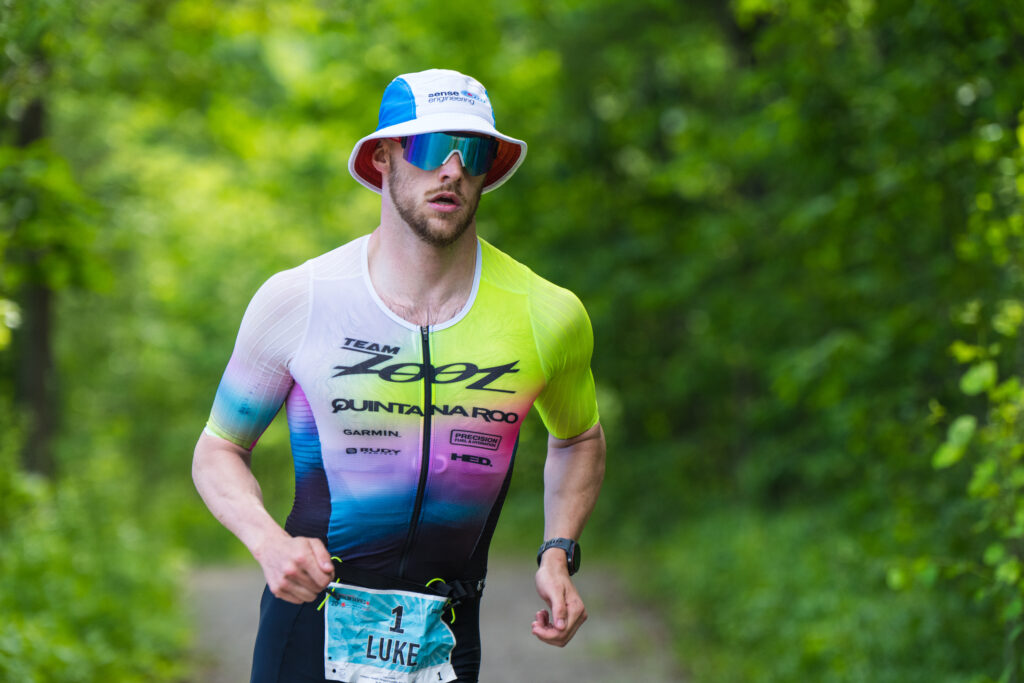
For many it seemed as though Canada’s Luke Evans burst onto the long-distance triathlon scene when he was the first person to cross the line at IRONMAN Canada-Ottawa last year. In fact, his 8:40 finishing time in the Canadian capital was another predictable PB – he would go 8:19 later in the year to be the fastest age-grouper at IRONMAN Arizona.
As the 29-year-old prepares for the upcoming Challenge Quebec full-distance race this weekend, we caught up with Evans to learn about his background, training and goals.
You didn’t really start in triathlon until about five years ago. What was your sports background before that?
My main sport growing up was hockey. I was never an excellent player — I wasn’t going anywhere — but it was my true joy and love. In high school, my mom, who was a high-level swimmer and competed at Canadian nationals as a child, suggested I join the swim team to stay in shape for hockey. I did that in Grade 7, swimming for the local middle school and high school team rather than a competitive club.
Swimming in high school is only a four-month sport, and our high school had a water polo team, so I joined that to stay in shape for swimming. I turned out to be good enough that I was able to join the varsity water polo team at Carleton University, even without any club background, and I played there for four years. That’s where the swimming came from.
I had no background in running or cycling. I did one centurion ride in Collingwood as a 16-year-old with my parents, but that was it.
Before COVID, I was playing hockey four or five times a week — pickup and beer league. When COVID hit and I needed an outlet, I tried weightlifting with my brother for about three weeks, but that seemed pointless to me. I knew triathlon existed because I could swim, and my parents had done some Multisport Canada races when I was five or six. So I decided my goal for the end of the year was to do an Olympic-distance race … back when we all thought the shutdown would be two or four weeks.
Once I started training and researching, I learned more about IRONMAN. Halfway through that process, when it became clear Wasaga Beach 2020 (the Olympic-distance race he’d signed up for) wasn’t happening, I signed up for Wisconsin in 2021 with twelve months of planning and prep. So, my first real triathlon ended up being IRONMAN Wisconsin.
How did Wisconsin go?
It was adventurous. I swam around 56 or 57 minutes, which was fine. The major time improvements (since then) have always come on the bike and run. I finished in around 10 hours 50 minutes, with roughly a six-hour bike and a four-hour run. I was training about nine or ten hours a week at the time. Since then it’s been steady, consistent training, with the only real difference being a slow increase in volume over the years.
Last year felt like a breakthrough — 8:40 at IRONMAN Canada and then 8:19 at Arizona. But you’d already been to Kona before that, right?
Yes, I went to Kona in 2022. After Wisconsin, I realized you could qualify for Kona and it was an outside shot at that race, but I came third in my age group and there was only one slot — the person ahead took it. So I signed up for Lake Placid in 2022, came through my age group again, and qualified on the first rolldown. The first person in my age group was Matthew Marquardt, who had already taken his Kona slot at a different race earlier that year. (Marquardt would go on to be the fastest age-grouper in Kona that year.) So I got that slot and went.
If you look at my progression, those two times last year might have seemed like they came out of nowhere, but to me they were just the continuation of a steady trend. Canada was my seventh IRONMAN and Arizona was my eighth. Each race I’ve knocked off roughly 20 to 30 minutes. It’s been consistent the whole way through.
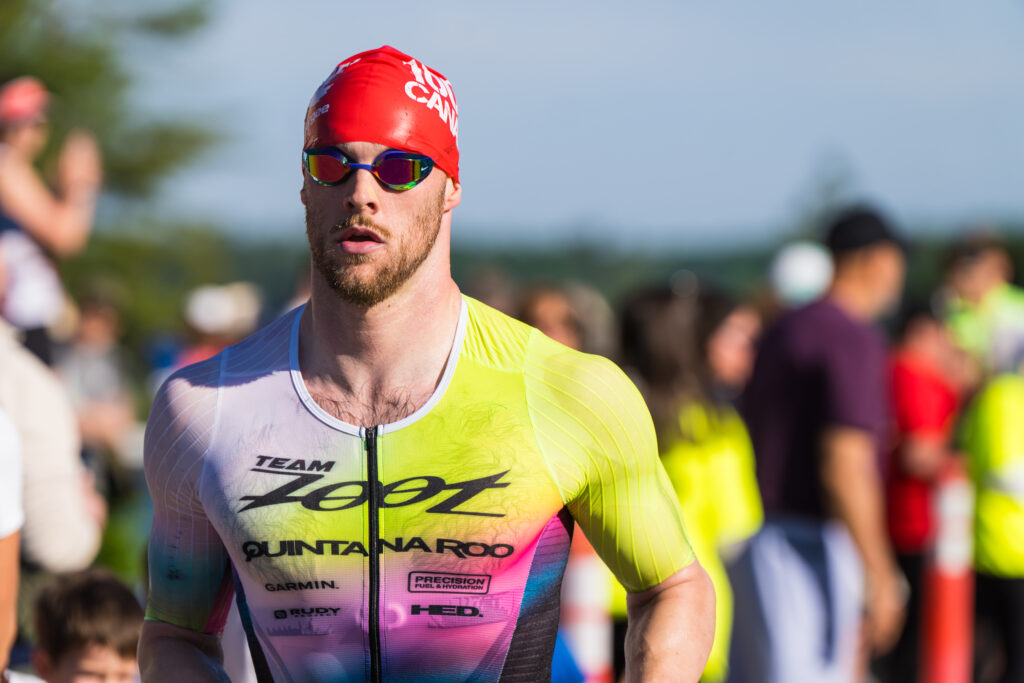
You mentioned 8:40 in Ottawa should have been 8:20. What happened there?
Digestive issues. The swim and bike were fine, but I made six porta-potty stops on the run, which added up to about a 3:20 marathon.
And then Arizona — that’s where the big run improvement showed up?
The big change between those two races was that after Canada, I started working directly with Paul Lawson, who owns the Athletica AI coaching platform. The focus shifted to learning how to use fat as a fuel source and figuring out how to do an IRONMAN on the least amount of carbohydrates possible, because carbs were causing my GI issues.
In Ottawa, I was running on maple syrup almost exclusively — a 750ml bottle of straight maple syrup on the bike, roughly 140 to 150 grams of carbs per hour. I thought natural sources would be better, but clearly that wasn’t working.
The plan for Arizona was to test the other extreme: how little can I eat while still completing an IRONMAN, and will the GI issues go away? I was at around 50 grams of carbs per hour on the bike and 20 to 25 on the run — intentionally low. I bonked around the seven-hour mark, which was expected, but the goal was to confirm I could get through a race without GI problems. And I did.
What’s the nutrition approach for Challenge Cap Québec, then?
I’ve been scaling it back up gradually. I use UCAN most of the time now — the slower-processing carbs sit better for me. Honestly, I’m also cheap, so for regular training I’ve been using a lot of cornstarch from Costco. For key sessions and races I’ll use UCAN, even though it’s expensive.
For Québec, I’m targeting around 80 grams of carbs per hour on the bike and 50 to 60 on the run. I’ve tested up to 100 or 110 grams of UCAN and that doesn’t sit well after about seven or eight hours of training, so I’m staying below that threshold. We’ll see if it works.
How many hours a week are you training?
My 2026 average is 18 hours and 50 minutes, but that includes a week-long ski trip, a family trip to Turkey where I only ran, and a few weeks off running early in the year with plantar fasciitis. When I’m fully healthy and on plan, it’s a little over 20 hours a week.
You work full-time as an engineer on top of all this.
I took civil engineering at Carleton and I’m a licensed professional engineer. Right now I work as a project manager at Sense Engineering. I’m in the office in Markham every Thursday, and two or three weeks of the month I’m doing site visits in downtown Toronto. Otherwise I work from home, which gives me flexibility to schedule training around my day. I train in the mornings and evenings — if my training runs until 9 am or I need to be on the bike at 4:30, it’s not a big deal as long as I’m reachable and getting the work done. I’ll often be working at 9 or 10 at night to make up the time.
It’s also become a bit of a marketing opportunity for the company — they’ve posted about it on LinkedIn. Being able to work at the company while competing at world championships is a good way to show that even in a demanding industry, you can have reasonable work-life balance.
What keeps driving you? You’ve already done the thing most people consider a bucket list item.
Continuous improvement, honestly. I love watching the metrics trend upward over time. You don’t see it day to day — there are massive ups and downs week to week — but you can look back over months and years and see a steady upward line. The power and pace numbers, the heart rate responses, all of it just slowly getting better.
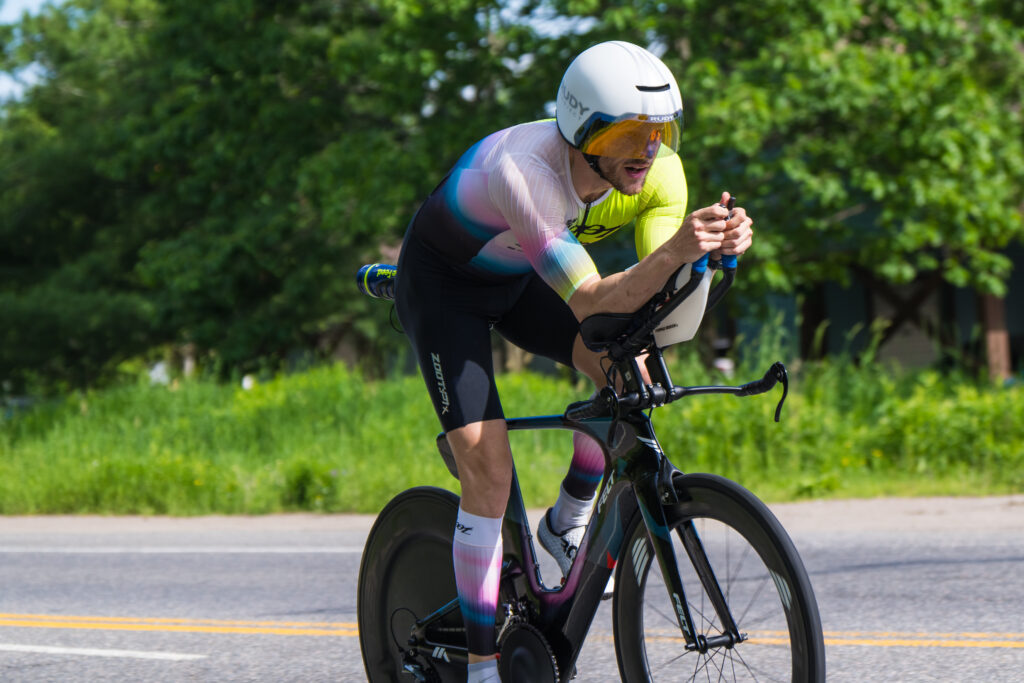
And it’s problem-solving. That’s what I do in my day job. Whether it’s the GI issues, the pacing strategy, or something completely unexpected — like cracking my frame two weeks before Gravenhurst — you identify the problem, work through the variables, and find a solution. I drove to Montreal and back in a day to pick up a replacement frame. Had it back in Toronto in under 24 hours. Stressful, sure, but once you’re in problem-solving mode, it doesn’t feel like a crisis.
Do you think the engineering mindset helps you as an athlete?
One hundred percent. It helps me not overreact mid-race when things go sideways. I stay fairly even-keeled even under pressure.
It also means I approach the training in a very calculated way. I’ve worked out, using my CDA and power data, the exact number of kilojoules I’ll burn during the bike split at race pace. So, for every long ride, no matter what the workout is, I make sure I’m burning at least that many kilojoules — and then run off it. I used to fade around the 2 to 2.5 hour mark early on, then around 3.5 hours in Ottawa and Arizona. Now I’m training to go well beyond that load so that when I hit that point in a race, my body is used to it.
I also ride using average power and kilojoules rather than just instantaneous output. I can see exactly where I am against my pacing strategy in real time while I’m racing.
What’s the goal for Kona?
Kona is the big goal this year. This will likely be my last time there for the foreseeable future — I’ve gone three times in five years and it’s expensive, so my wife and I will probably shift focus after this.
I’m hesitant to name a specific time because Kona is so weather-dependent. I’ve done it twice — once in brutal heat, once in serious wind — and the conditions completely change what’s possible on the day. In other races I’m fairly accurate: I predicted 9 hours in Texas and went 8:58, predicted 8:40 in Ottawa and hit 8:40, predicted 8:20 in Arizona and went 8:19. Kona is a different animal.
The goal is to do well in my age group and have a strong overall placing — top three or top five would be great. And honestly, I want to know what I’m truly capable of when everything comes together on that course.
You’re also considering going pro. Where does that stand?
It’s a consideration. My coach thinks I have the ability and could do it now — I’ve already qualified to submit the application to Triathlon Canada. But I don’t want to do it unless I can theoretically be competitive: top ten in a professional IRONMAN, somewhere near the money. Not that this is going to be my full-time job, but I want to be racing at the front, not finishing an hour back from the leaders.
I’ve told my coach that if I can go sub-8 hours in age group, which I think is realistic in the next year, that’s probably when I’d make the move. Kona will factor into that decision.



Man, how this sport has evolved.
i’d like to see this guy’s winter indoor cycling setup!