
The Fourth Frontier X3 Offers Live ECG HR Measurement During Exercise. Do You Need It?
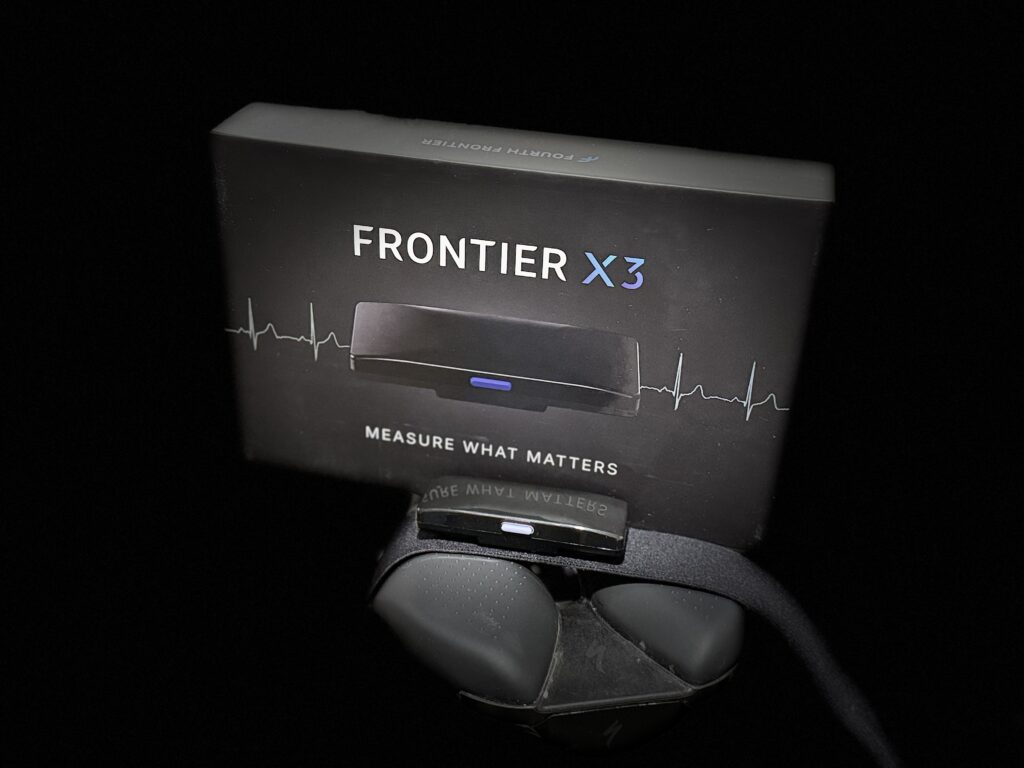
When the folks at Fourth Frontier asked if I would be interested in trying out the company’s new heart-rate monitor – the X3 – I thought it would be an interesting product to review. As many of my peers have hit their 50s and 60s, there have been more than a few scary stories of some of my super-fit friends having heart issues, so I figured it would be interesting to test out a product designed to provide deeper insights based on chest-based heart rate measurement.
To be clear, the Frontier X3 is not a medical device – Fourth Frontier does offer a prescription-only device, the Frontier X Plus, which provides FDA cleared rhythm classification of AFib and other heart issues. The Frontier X3 is billed by the company as its “most advanced heart and performance monitor … built for deeper insights, longer wear, and more focused training.”
So, does the Frontier X3, which retails for US$649 (although you can get it for 30% off that price through Black Friday sales), live up to that billing?
Set Up and Comfort
Fitting the strap was a breeze and I didn’t have any issues having to juggle placement on my chest at all, so kudos go to the crew at Fourth Frontier for the design of the strap. The device that clips on the strap is relatively slim and flat, although it is noticeably thicker than the heart rate monitor straps that I’ve used during Garmin or Wahoo reviews. At just 23 g, the unit is light enough that you really don’t notice it.
Considering how much is in the device, it’s impressive that it is a thin and light as it is – the unit includes an advanced single-lead ECG sensor, a 3-axis accelerometer and a vibration monitor, along with the long-lasting battery and the rest of the electronics. The unit came pretty much fully charged, so it only required a few minutes of charging to reach capacity. Fourth Frontier promotes up to four months of battery life based on about an hour a day of use, or 14 days of continuous use. I didn’t try wearing the monitor for long periods of time, but my experience using it for workouts seemed to confirm the expected battery life of the unit.
Pairing the strap to Fourth Frontier’s phone app was a breeze, and it was equally easy to pair it to my Apple Watch and my Hammerhead bike computer. The unit features Bluetooth 6.0 and can pair with an additional two devices along with the phone app.
Heart Rate Accuracy and Other Readings
It has been interesting for me, over the last 10 years or so, to see just how accurate wrist-based heart rate sensors have become. In fact, with the release of the Apple Watch Ultra 4 (and Series 12, for that matter), Apple utilized new optical and electrical heart rate sensors that, based on the company’s research, provided incredibly accurate heart rate data. Apple is hardly the only company that has improved wrist-based HR measurement, either – I’ve seen the same accuracy in the Garmin and Wahoo watches I’ve reviewed, too.
I do know some people who don’t have the same luck with wrist-based monitors, though, so a heart rate strap is a go-to for them. I really liked the fact that I could easily pair the Frontier X3 with my Karoo bike computer and watch, enabling me to be able to see my HR during workouts, and then get the added data the Frontier X3 can provide from the app after the workout.
Fourth Frontier cites Cleveland Clinic research that indicates wrist-based optical heart rate measurement isn’t nearly as accurate as chest-based electrical devices, but in practice I saw very little difference between the X3 heart rate measurements and those I saw from a few different watches. Average and max heart rates were almost always within one to two beats per minute. (My guess is that the strap data was probably more accurate, but the wrist data seems accurate enough for most purposes.)
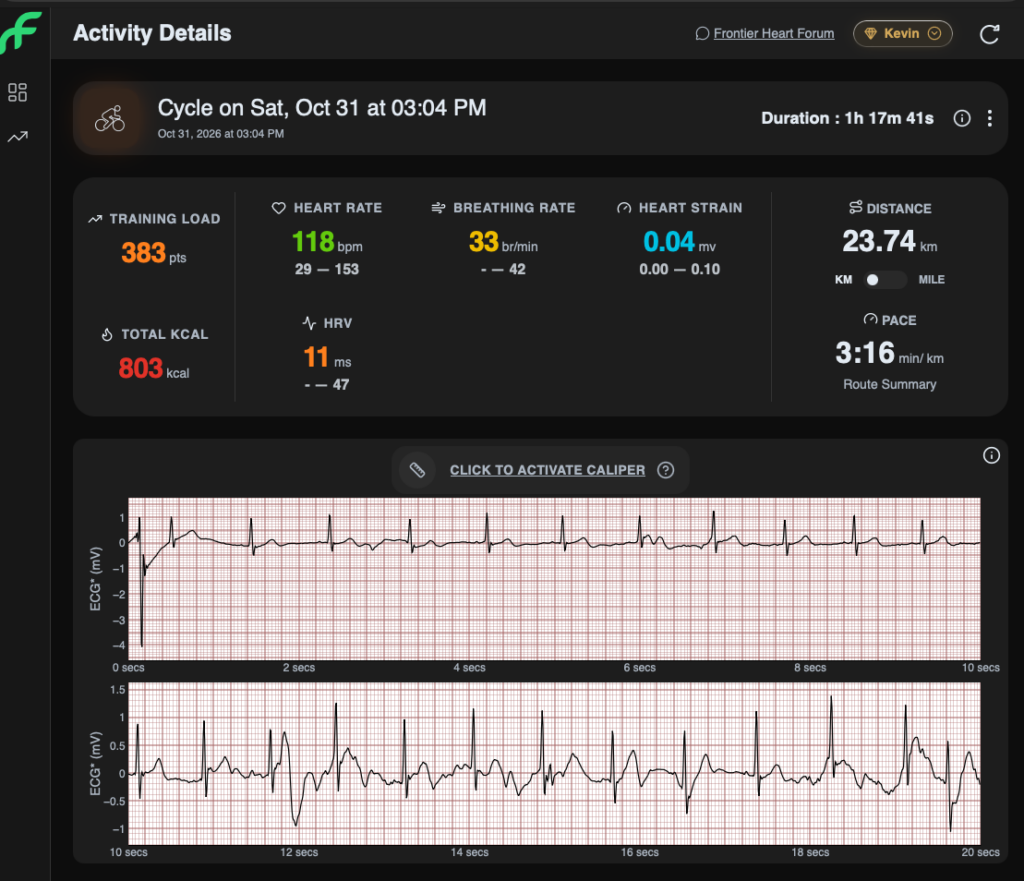
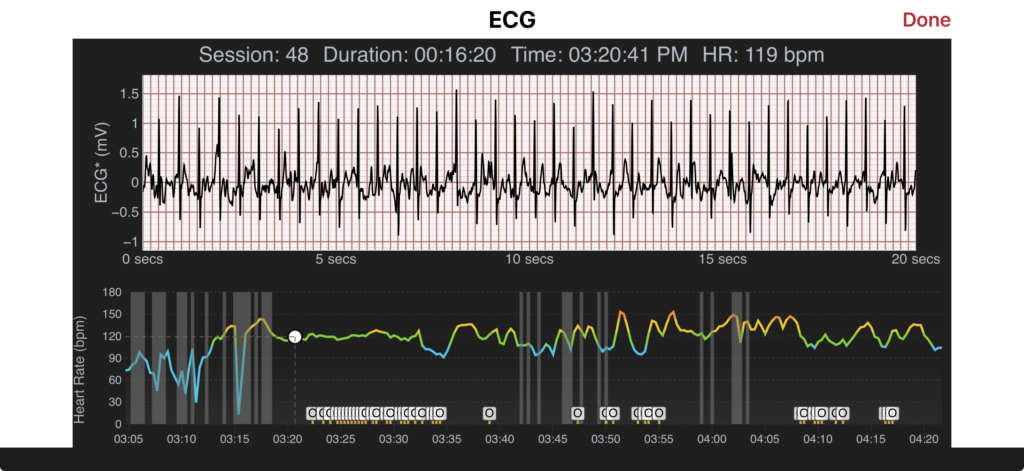
Where the Frontier X3 truly differentiates itself from other heart rate monitors is with the added insights it can provide after a session. The device can monitor your breathing rate and also measures “strain” – basically a measure of how hard your cardiovascular system is working compared to what’s normal for you. You can set up the X3 to vibrate when your heart rate, breathing rate or strain hits a certain threshold to ensure you’re keeping things under control with your workouts. The device also measures heart rate variability (HRV), training load and live ECG reporting (you can see an example below), or continuous ECG monitoring if you want to wear the device continuously for a few days. (The device also measures “body shock” during run workouts – unfortunately a hip injury has kept me away from running of late, so I can’t provide any insight on that measurement.)
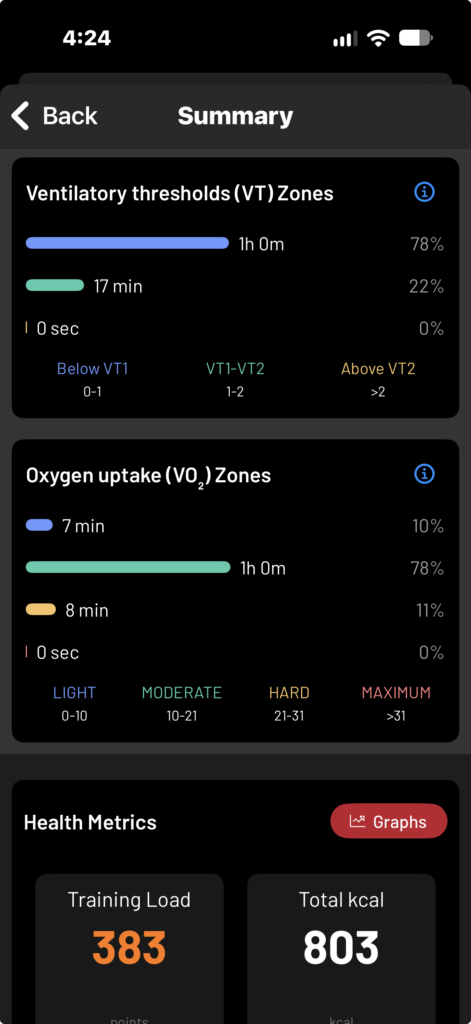
Fourth Frontier also offers a premium membership that adds sleep stages, a readiness score, VO2 max trends and estimates (including oxygen uptake), ventilatory threshold zones and Garmin Connect sync. That added information will set you back US$14.99 a month or $119.99 a year. (You can see some of that information from one of my workouts below.)
Pros and Cons
The Frontier X3 is a great device for those looking for accurate heart rate data, including recovery and strain information that could be helpful for both health and fitness tracking. It’s also really useful for those who want to work within specific heart rate zones and don’t want to be glued to a watch – the vibration alerts can be really handy. It’s also nice to pair to a bike computer (or a watch, for that matter) to provide real-time data and more detailed post-workout analysis. The impressive battery life makes for infrequent charging, which is always welcome considering how many gadgets we typically have to charge these days.
In addition to the added HR information, the X3 also allows you to set up some training zones based on ventilatory threshold zones – basically training by breathing patterns vs just heart rate percentages.
I fear, though, that there are a limited number of athletes who really need all the precise data the X3 provides. As noted, the accuracy might be excellent, but you can get very close to the same numbers from many watches (with wrist-based monitors) and other heart rate straps. (Garmin’s HRM 200 retails for $79.99, while the high-end HRM 600 will set you back $169.99. The Wahoo TRACKR sits in the middle at $99.99.)
Because it is not a medical device, paying the extra money for the X3 isn’t going to give you any insight on rhythm status such as atrial fibrillation – if you have heart issues, you’re going to need the prescription-only X Plus as opposed to the X3.
Then there’s the simple issue that many of the insights the X3 provides are available through the watch (or ring) you’re likely already wearing. Garmin has been building out its post-workout metrics for years and offers excellent data on recovery heart rate, recovery time and training effect that have all been validated by years of use. Apple’s data isn’t as detailed, but is catching up. Garmin’s has been providing Training Readiness scores since the Forerunner 955 launched in 2022, while Apple is now providing a similar score on the Series 12 and Ultra 4. Ditto for sleep scores and stages. The X3 differentiates itself with its strain and body shock measurements, along with the ability to set up zones based on ventilatory thresholds, but I’m not sure that’s enough of a selling point to justify the additional spend.
For those who are looking to do a truly deep dive into their HR data, though, the Frontier X3 will certainly provide pretty much everything you could ever want on that front. It’s comfortable, offers excellent battery life and certainly offers lots of training information – for those looking for all that extra info, it is worth a look.



Start the discussion at forum.slowtwitch.com