
Are Kettlebells a Hack for Triathlon Strength Training?
Strength work is such an important part of triathlon training, but so many of us are guilty of skipping it every week. Maybe that’s because it’s hard to find motivation to get out to the gym after you’ve already gone swimming, biking and running every other day of the week, or perhaps it’s because you feel like your home gym setup is lacking.
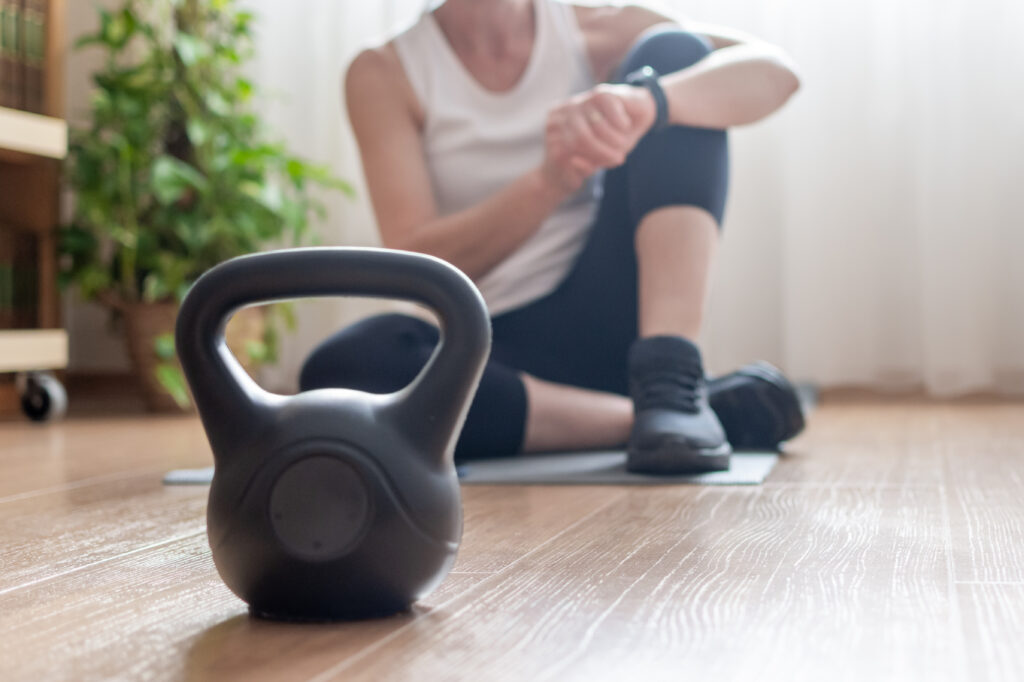
An easy and relatively affordable way to fix the latter issue is with a kettlebell or two. Kettlebells are a great tool that can revolutionize the way you do strength training, whether that’s in the gym, at home or wherever else you bring yours with you. Not convinced? We spoke with Jenna-Caer Seefried, head coach at Endurance Fit in Calgary, Canada, who loves a kettlebell workout—and thinks you will, too.
Seefried’s Thoughts on Strength Training
Seefried got her start as a strength and conditioning coach in 2011, a year before she raced her first triathlon. In the years that followed, she would dive headfirst into the world of multi-sport racing, reaching IRONMAN podiums around the globe, winning gold in her age group at the ITU Long Distance Triathlon World Championships and eventually adding the title of triathlon coach to her job description. Today, she works with athletes of all ages and all levels to help them reach their triathlon and fitness goals.
A huge reason people reach or fall short of these goals, she says, is in their strength training routines. If someone is committed to checking off every prescribed strength session, they will have much more success in training and racing, as well as fewer injuries (on average). The issue for so many triathletes, however, is that the main focus is swim, bike, run, leaving the gym and weights as a bit of an afterthought.
“Strength is always the first session to go when the season starts to ramp up,” Seefried says. She has her athletes doing strength work two to three times per week, with the focus of each session depending on the time of year.
“During the off-season, it’s about base-building,” she says. “It’s definitely more towards that kind of heavier load focus and just building a really strong foundation that we can play off of as the season gets going.”
Early-season training, Seefried says, is split between building strength and activation work. Once you’re in the thick of the season, the workouts aren’t as intense, but Seefried is quick to note that this doesn’t mean they are any less important.
“These sessions are more about maintaining what you built earlier in the year,” she says. “They should focus a lot on the movement pattern activation. A lot of single-leg work, a lot of core work and just keeping your body balanced more than building muscle.”
She says your body will already be fatigued and stressed from your swim, bike and run training, so “we don’t need too much extra stress” from weights and the gym.
“We just want to make sure you’re moving well so you can support the training you’re doing,” she says.
Kettlebell Training
Seefried doesn’t just recommend using kettlebells—she herself works out with “a collection” of them in her basement gym.
“They’re such a great tool when it comes to strength training,” she says. “They give you a lot of options, especially around more dynamic movements.”
Seefried points to machines you would find at a gym, most of which will only work one muscle group at a time. With a kettlebell, you can hit multiple muscles and parts of your body with a single exercise.
“There are so many movements you can do that allow you to work on trunk rotation on top of strength training on top of balance,” she says. “That makes a really big difference.”
Further, Seefried says she is a “massive fan of single-side work,” which kettlebells are perfect for.
“When you’re running or cycling, you’re doing thousands and thousands of strides and pedal strokes,” she says. “If you’re out of balance on one side or one side is stronger, that’s just going to get exacerbated as you keep going.”
Focusing on single-side exercises can combat that and even out those imbalances. Seefried notes that many people will only have access to lighter kettlebells, making those one-sided exercises imperative (as the kettlebell will likely be too light for full-body movements).
If you can only afford one kettlebell, that is no problem at all, but Seefried recommends getting two if possible. One can be on the heavier or “mid-range” side for lower-body movements, while the other should be a bit lighter for your upper-body exercises.
Exercises to Try
There are several exercises that Seefried says are great for a full-body kettlebell workout. She is quick to mention that, while kettlebell swings are a classic, they should be approached with care.
“They are very good for a dynamic building as you get into it, but just being cautious with those in the beginning, because it’s so easy to hurt yourself doing them,” she says. If you want to add swings to your workout plan, start with a lower weight and work up rather than jumping into the heaviest option right away.
The first movement Seefried recommends is a single-leg split lunge. This is “a little bit simpler,” she says, but it can be very effective. To do it, you lunge as you normally would while holding the kettlebell in the arm opposite from the leg you’re bending.
“That will help give you a little bit more trunk control,” she says.
Next up is a Bulgarian split squat. Just like the split lunge, you will hold the kettlebell in the opposite hand, then perform the movement as you normally would (bending one leg to 90 degrees while the other rests on a raised platform like a bench or step).
Moving to upper-body, Seefried says she loves a kneeling shoulder press. To perform this exercise, you rest on one knee and bend the other leg to 90 degrees while keeping that foot planted in front of you. From there, perform the shoulder press as you normally would, once again lifting the weight in the arm that is opposite the planted foot.
“Doing it on the ground like this forces you to really engage your core at the same time as you do the press” Seefried says. “Kettlebells really shine in movements like these because you have to counterbalance and hold your core while also doing a strength movement.”
Sticking to the upper-body, Seefried says kettlebells are great to use like dumbbells. She says a bent-over row” is always good, once again doing one side at a time.
“As with the others, this one-side work will show you if you have any imbalances,” she says.
For core, she suggests “anything with rotation,” such as Russian twists.
“If you think about when you’re swimming or when you’re running, there is a lot of that rotational movement,” she says. “But when you see people working their core, they often do crunches or situps or other movements that don’t have any rotation.”
Another core exercise that will engage your entire body starts in a high-plank with the kettlebell near one of your hands. Reach across with the opposite hand, engaging your core, back and legs to stay upright, then lift the kettlebell to the other side. Repeat with the other hand and return the weight to its starting point before carrying on for more reps.
For all of these exercises, Seefried recommends lifting eight to 10 reps with 60 seconds of rest in between each round. (If you have a lighter kettlebell or if it gets easier as you progress, you can increase the number of reps for each movement as needed.)







FWIW, I’m 58 and have been involved in endurance sports since my teens. I also enjoy lifting, too, for all around fitness, but my time in the weight room has decreased so I want things to be very effective and efficient. I’ve found kettlebells, along with the barbell landmine, to provide an excellent workout that can hit strength, core, power, and flexibility all at the same time. Very useful, and you can be very creative with the exercises.
KB Swings are a solid accessory around strengthening your chassis. Are they a hack? No. Well maybe if you’re doing 500 per day or something. I do like 375 KB Swings at 30# per week.
When COVID locked us down, and we had no gym access for a while, we were left with body-weight exercises for a while
I fashioned my own “kettle bells” out of one-gallon Arizona Green Tea jugs filled with water - “a pint’s a pound the world around” right? So those were 8 lbs each
Not much, but they did the trick
There is no way I would get all this done without my home gym. I have kettlebells up to 65 pounds of various sizes, landmine with barbell, cable machine, pull-up/dip/step up tower, adjustable bench, and some 90lb adjustable dumbbells. But the kettlebells are definitely the centerpiece.
I started kettlebells a few weeks ago as there is no gym within an hour of here and the gym at the school is closed for holidays. I have to say I am enjoying it and can confirm it isn’t as easy as it sounds/looks!
It’s kind of funny, as these are two of my staple running strength lifts (also single leg rdls). But you don’t need kettle bells for any of these lifts, so it’s kind of quirky the top two go to movements are something you can do with a dumbbell.
Methinks Big Kettlebell™ is behind this?