
Paddles Make Stronger Swimmers, But Only When Used Properly
Like any sport in triathlon, swimming can come with a lot of gear and tools to help you improve and get faster. Hand paddles are a popular tool you may have seen others using at the pool. Paddles are an excellent training aid that can elevate your swimming level tremendously. If used wrong, however, paddles can exaggerate flaws in your stroke and potentially even lead to injury. That shouldn’t be a deterrent for adding them to your swimming arsenal — you just need to learn how to use them properly for best results.
To help you find out more about paddles, Slowtwitch spoke with David Peters, a former member of the German national swim team. In his college years, Peters moved to the Phoenix area, where he competed as a member of the Arizona State University swim team. He stuck around after graduating, transitioning from athlete to coach. After winning multiple state championships as a coach, he now leads a masters swim group in Gilbert (a suburb of Phoenix), helping swimmers of all levels reach their goals in the water.
Peters is a big proponent of paddles, but he is against new swimmers using them right away. While they are great for strengthening your pull in the water, he says that the very resistance that can help strengthen one swimmer’s stroke can be what leads another athlete to injury. He took Slowtwitch on a deep-dive into this specific tool to help you figure out just how (and when) to use them.
Trying out Paddles
The first thing Peters brings up when discussing the use of paddles is your “line” as a swimmer.
“Your line is the path that you and your arms take through the water,” he says. If you have a line that is off-centre or askew, it can lead to added stress on your shoulders and, if you repeat this incorrect motion enough, it will likely result in you getting injured. Adding paddles to your training if you have a “bad line” is only going to speed that process up, as the extra resistance will put even more load on your shoulders.
“There are all kinds of mistakes people make with their line,” Peters says. “Their hand goes out to the side after entering the water. Bad. Their hand enters the water and then goes inward and across their body. Bad. They do short strokes. Bad.”
This is why it is so important to become a proficient, efficient and mechanically sound swimmer before adding paddles into the mix. You need to give yourself time to work out the kinks and bad habits in your stroke before putting even more strain on your shoulders.
Another mistake Peters says he sees athletes making comes down to whether or not they are relaxed. Far too many swimmers will “muscle through” paddle sets, trying to go as hard and as fast as they would in a regular workout without paddles. There is a time and place for sprinting with paddles (and a specific type you should be using), but in general, Peters says this is a bad call for most swimmers.
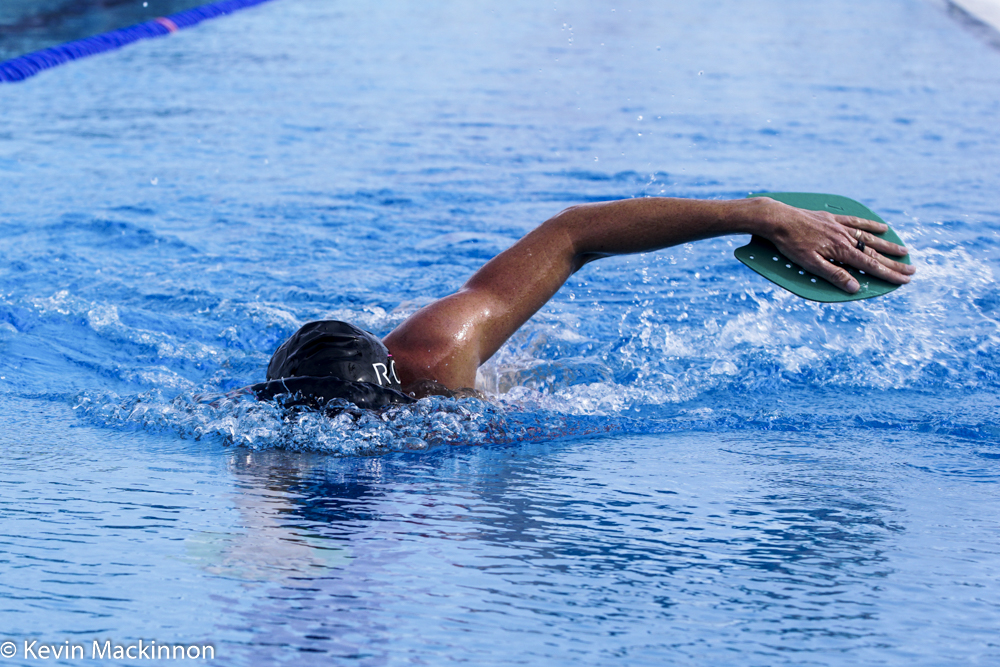
Instead, paddles should be used with care and during sets when the goal is to focus on proper technique. Remember your high elbow, be sure to pull all the way through your stroke, engage more than just your shoulders (remember that your core and back are huge parts of freestyle) and keep your line nice and straight (minimize your hands’ journeys out wide or across your body’s centre line).
“Paddle sets that I give athletes, especially for masters, always involve counting strokes and doing distance-per-stroke,” Peters says. “This is for work where you’re you’re trying to get your strokes down while adding the resistance.”
When Should You Get Paddles?
If you shouldn’t be using paddles from the first moment you hop into a pool, when is the right time to use them? Peters says he prescribes them to “intermediate swimmers” who have “good stroke mechanics and are in what I would call basic swimming shape.”
An intermediate swimmer to Peters means a few things.
“They have to be able to swim build sets, descending sets, slow interval sets, fast interval sets,” he says. “They need to be familiar with all of the nuances of swimming before you introduce paddles.”
This doesn’t mean that once you’ve completed all of the above types of sets you’re suddenly ready to wear paddles for your next workout. Peters says you need to be completing these workouts in good form on a consistent basis. After that, you’ll be looking to get stronger (not just more efficient) in the water, which is the perfect time to “add resistance training” into the fold.
Picking Right
As Peters says, there are “a bazillion different types of paddles” on the market, but that doesn’t mean any pair you pick will be right for you. The two main factors he points to when making your selection are size and the connection points.
For size, smaller is better when you’re just starting out.
“An advanced swimmer is going to use paddles that are one and a half times or even two times the area of their hands,” he says. “They’re quite large, but you have to grow into that, you don’t do it right away.”
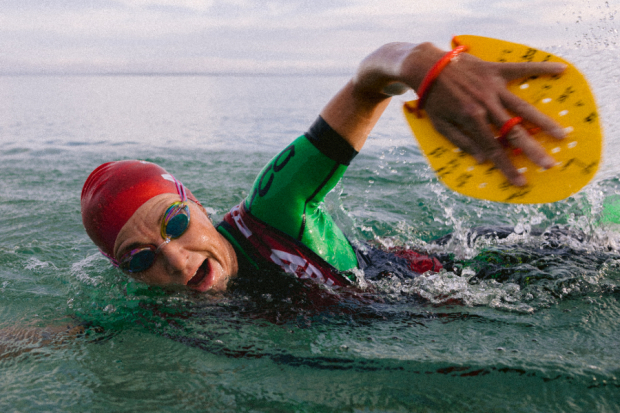
The bigger the paddle, the more water you’ll pull with each stroke, meaning your shoulders will be put under more strain. That’s why it’s a good idea to start small and build up slowly.
On the note of size, Peters adds that, as you get stronger in the water, you can introduce paddle sprint sessions to your training, but he emphasizes that you have to be very careful with these. Even the best swimmers should avoid using their biggest paddles for sprint sessions.
The other variable is connection points.
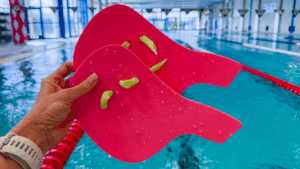
“These are where you’re strapped to the paddle,” Peters says. “Some have two connection points — one for your finger or fingers and another that goes across your wrist.”
Many fins are adjustable and allow you to move the connections points as you please. Peters says he will have athletes make changes to their connection points as they progress, eventually removing the wrist strap when a swimmer reaches a certain level. For paddle beginners, however, the two connection points are a great starting point.
Workout Inspiration
You’ll want to adjust the distance in this workout depending on your level and strength as a swimmer, but Peters recommends a paddle set based on breathing and technique.
“These repeats are not fast, they’re not best average,” he says.
Try 8×50 up to 8×200 (again, depending on your level) following a 3-5-7-9 breathing pattern for each 50. This means you’ll breathe after three strokes to start, then after five, then seven and, finally, after nine. If you haven’t reached the wall by the time you finish the ninth stroke at the end, restart at three and work back up from there.
“This is a hypoxic set,” he says. “They need to focus on their breath while also counting strokes and paying attention to form.”
Remember not to muscle through any of these laps, but rather to employ a long, smooth stroke. Peters says distance per stroke is much better in this workout (and with all paddle sessions) rather than anything fast or hard.
Tags:
swimTrainingRelated Articles:
Continue the discussion at forum.slowtwitch.com
4 more replies



For those that use paddles, what percentage of distance is done with them. For me this 90% (small ones)
So how good does form have to be to constitute good form?
If you get a shoulder injury you have bad form.

And if I don’t, does that make my form good?


Anyways, I think it’s a legit question. Peters makes us jump a hurdle (to find out if we can/should use paddles) but we can’t see the hurdle or know if we’ve cleared it. It’s like the war objectives of the U.S. under MAGA rule.
It’s a good article that leaves a question unanswered
I use a TYR Catalyst paddle, size small, for about 35-40% of my total swimming.
Adding a little bit of trivia and tying into David Peters’ background, the TYR Catalyst paddle was invented by World Record Masters swimmer, elite AGer triathlete, and former Arizona State University (ASU) head swim coach and Swim Devils Masters swim group coach & founder, Ron Johnson. He was a great coach and person.
I’ve done a lot of paddle sets recently, but not sprinting.
I’ve found that paddles that are exactly the size of my hand give me next to no speed benefit or intensity increase.
The larger the paddle, the faster I go, and the more load gets shifted from cardio to muscular (arm pull).
I do think you can strain your arm/shoulder if you jump into big paddle sets prematurely, but once you’ve spent some time with them over a couple of sessions, it doesn’t seem to be an issue.
I’m still on the fence as to whether they actually make ME faster, so far my results haven’t showed any compelling gains from paddle training. I do however love how fast they make me go - even medium sized paddles are a good 7sec/100 faster for me.
In the same. My feeling is they introduce more fatigue (strengthening) to the arms so I use them. Not saying it’s better than swim an extra 30% of the distance I’d normally do, but if given the choice between swimming 15-20 minutes less or using paddles I feel paddles is generally better.
Do you find this translates to improved endurance race day?
I hope so. It’s not really ideal, but between family, work, XC/track coaching, and training I only have so much time available to train and I prioritize bike/run. So any pool time I feel paddles just helps offset that a little.
One thing I’ve wondered, my stroke rate is slower with paddles and I worry this will become ingrained, probably silly thinking though.
Actually worry exactly this. My stroke rate is already low (and I’m Def not fast) so I suspect I should actually be training for higher stroke rates rather than lower with paddles.
My stroke rate is usually in the mid 60’s, when I use the paddles it drops to around 60 but I’m going faster, much better DPS. I swim on a 1:25-1:30 base SCY
I actually can swim 1:25-1:30s SCY for 1000 with medium paddles at moderate but stiff pace, but I’m closer to 1:37-1:42 without them. I’ve only tried big paddles once, and they were even faster!
Per my Garmin, in my most recent open water swim Oly race where I swam pretty much where I expected to, I was 37 strokes per minute. Gawd, that sounds so slow, but it actually sounds right when I simulate my stroke right now using my stopwatch. I think I need to crank up my stroke rate!
Yeah pick up that giddy up! With the paddles I come in around 1:15-1:18/100, without I’m 1:20-1:23. My OWS stroke rate is also around 38, I think sighting slows it down.