
Maximize Your Potential with Simple (But Necessary) Open Water Mechanics
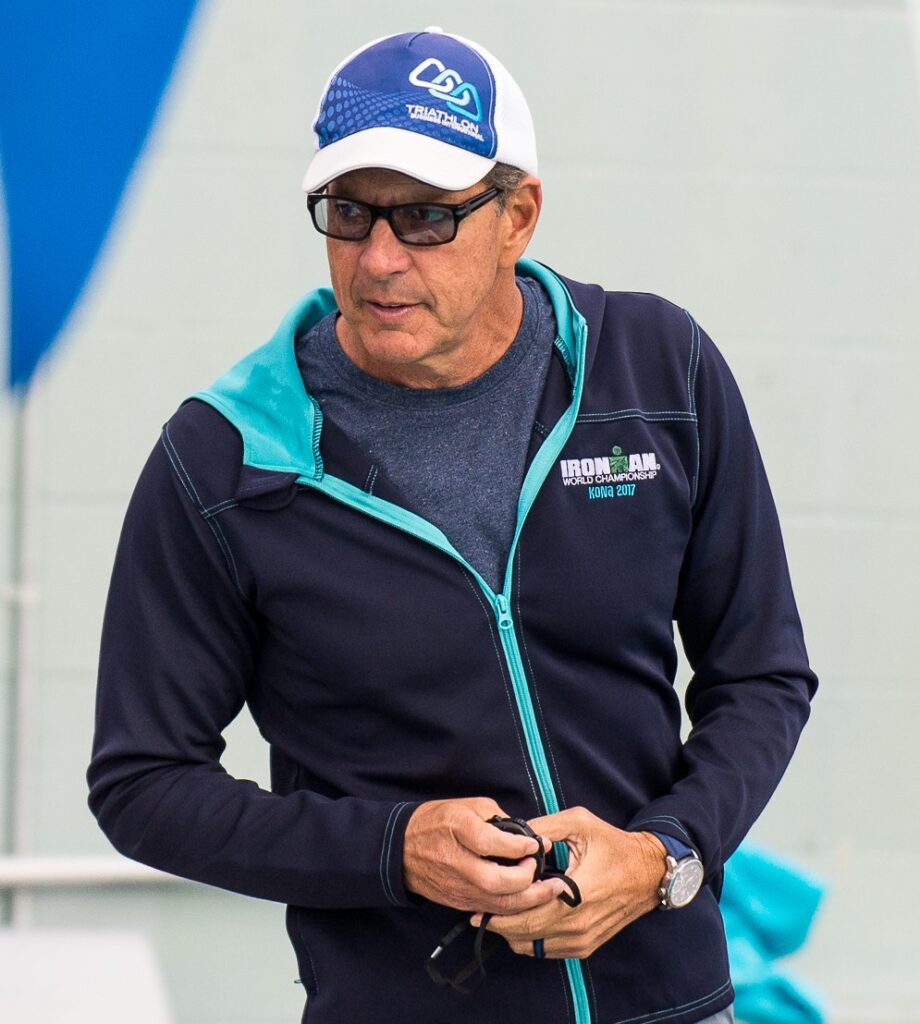
You can be the fastest swimmer at your local pool, but that doesn’t mean you’re automatically set to perform at the same level in open water. Open-water swimming comes with an entirely new set of challenges compared to what you’re used to in the pool, and it can take time and practice to get good at this discipline. Slowtwitch spoke with Gerry Rodrigues — an open-water swimming champion, coach and founder the triathlon community Tower 26 — to get his take on what triathletes should be doing in open water to produce their best possible swims on race day.
Going from the Pool to Open water
Rodrigues says there is often a world of difference between the static environment of a pool and the dynamic one of outdoor bodies of water. There are even differences between the various types of bodies of water, as he notes that lakes and reservoirs can simply have wind-chop, while beach and ocean swims can have legitimate waves and currents. Whether you’re dealing with just chop or full-on waves, it’s going to be a much different experience than your time in the pool.
“In the pool, you’ve got those big, juicy lane lines to follow,” Rodrigues says with a laugh. “You’ve got constant water temperature, it’s always calm.”
Open-water swims can be static and calm, Rodrigues notes, but they will “generally be much more dynamic,” which he says is “a challenge for some” swimmers. While that can be tough to get used to, he says that the biggest issue for many people transitioning from the pool is water temperature.
“That’s a big one, and it can be dangerous if not managed well by a race,” he says, adding that it’s not just when water is too cold that can be problematic, but also if it’s too warm. “You can easily get hyperthermia in warm water and hypothermia in cold.”
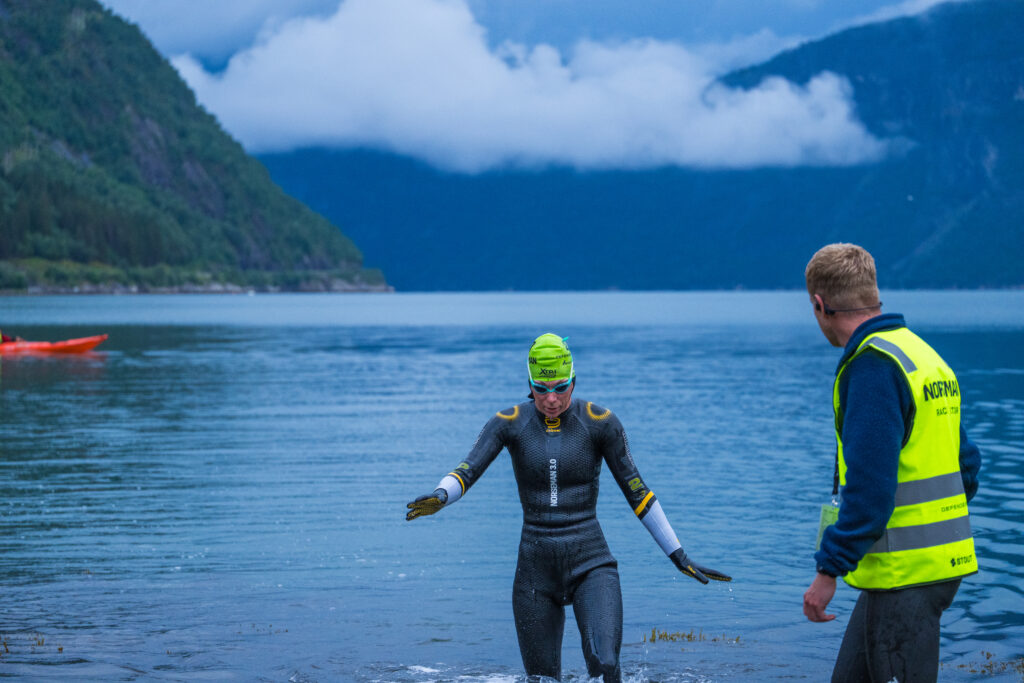
If you’re getting ready for a cold-water race, you will of course need a wet suit. If you can get out and swim in temperatures similar to those you will see on race day, Rodrigues says that is a great way to prepare.
He adds that on the actual race day, it is imperative that you go into the water and warm up beforehand instead of waiting until the starting gun to feel the water temperature. It may not be pleasant to wait in the cold water for the race to start, but it can make your day so much more enjoyable (and safer).
Aside from that, he has a very basic recommendation.
“Some athletes take cold showers or sit in their bathtubs in cold water,” he says. “Anything to get your body acquainted with what it’s gonna be doing in the race.”
For warm-water swims, he says the only real option is to get into bodies of water with higher temperatures if possible, as this will help you both physically and mentally come race day.
Sighting
Outside of the ability to swim, sighting is one of the most important skills that you need for open-water racing. If you’re not sighting properly, or frequently enough, you will almost certainly swim off-course and add time, distance and effort to the first leg of your triathlon.
“You have to practice sighting in the pool and learn how to do it really well,” Rodrigues says. To sight correctly, you need to follow what he calls the “lift, look and breathe” method. This involves lifting your head mid-stroke, looking forward, and then breathing before continuing on with your regular swimming.
Many triathletes may think that tossing a few lift, look and breaths into the mix on any given pool session will be enough to get the skill down, but Rodrigues says you have to dedicate full sets to sighting in order to really become proficient in it.
“Let’s say you decided you’re going to do a one-mile open-water swim and today your main swim set is 8×200 in the pool,” he says. “You would build sighting into those 200s by doing it two to three times for each 25.”
You read that correctly — he wants you to sight up to three times per length. Not per lap, not every 100 metres. Two to three times from one wall to the other.
“That will mean you’re sighting 16 to 24 times in each 200,” he continues. “Some people might think that’s over-indexing, but if you wan to get really good at something, that’s what you have to do.”
You don’t need to have a sighting set every week for the whole year, Rodrigues says, but he does recommend building it into your training schedule ahead of, and during, your racing season.”
Another matter is the frequency of sighting. Rodrigues says most swimmers fall well short of how often they should be looking up in the open water. He says to lift, look and breathe every six strokes.
“So many athletes go much less frequently,” he says. “But let me emphasize that they are all swimming crooked. None of us have a really good internal radar when there’s no black line at the bottom of the pool, so we need to look where we’re going a lot.”
Finally, this brings Rodrigues to one last note on sighting, but it comes before you step foot in the water. Every race is going to have buoys in the water to mark the swim course, but you cannot rely on these to guide you.
“Unless the buoys are extremely large, both in width and height, any ripple in the water can block your view of them,” he says. “I’m talking even just a six-inch ripple on foot in front of your face.”
To get ahead of this, he recommends scoping out the area beforehand and finding landmarks you can use for guidance while in the water. If there is a cell tower, use that. Perhaps there is a building with a bright roof or a playground with colourful equipment by the swim exit. Even a tree that is taller than the rest can work.
“It’s important to have these markers if they’re available,” he says.
Another technique he uses is called triangulation. For this, you need to see where you’re going, where you’ve come from and something to monitor off to the side (like a shoreline if you’re swimming along land).
“First off, you sight the buoy ahead of you,” he says. “Then you look under your armpit mid-stroke back to the last buoy.”
Then, he says to “gauge your lateral distance” from that parallel marker and ensure that it is remaining consistent. This will all help you confirm that you are, in fact, swimming in the straightest line from one point to another.
Drafting
When it comes to drafting, Rodrigues says there are a few options you can employ on race day. One way to draft is directly behind someone’s feet.
“Almost touching their toes is a good position to be,” he says. You don’t want to fade too far back, as Rodrigues notes that tests have shown that swimmers can lose almost 50 percent of the drafting benefits if they fall as little as three feet behind the athlete ahead of them.
Another ideal position for drafting is off someone’s hip.
“You want your head in line with their hip,” Rodrigues says. “That’s the ideal pocket to be in. As long as they let you stay there, it will do two things: you’ll get sucked along and you’ll be pulling them backwards.”
A key part of that statement is on the other swimmer’s intentions, as Rodrigues adds that “savvy open-water athletes will push you away” if they realize you’re riding their hip.
There is a third option that involves avoiding drafting altogether. The downside here is of course that you will receive no help from your competitors and their slipstreams, but Rodrigues says that keeping clear of other athletes may be the best move for newer, less-confident swimmers.
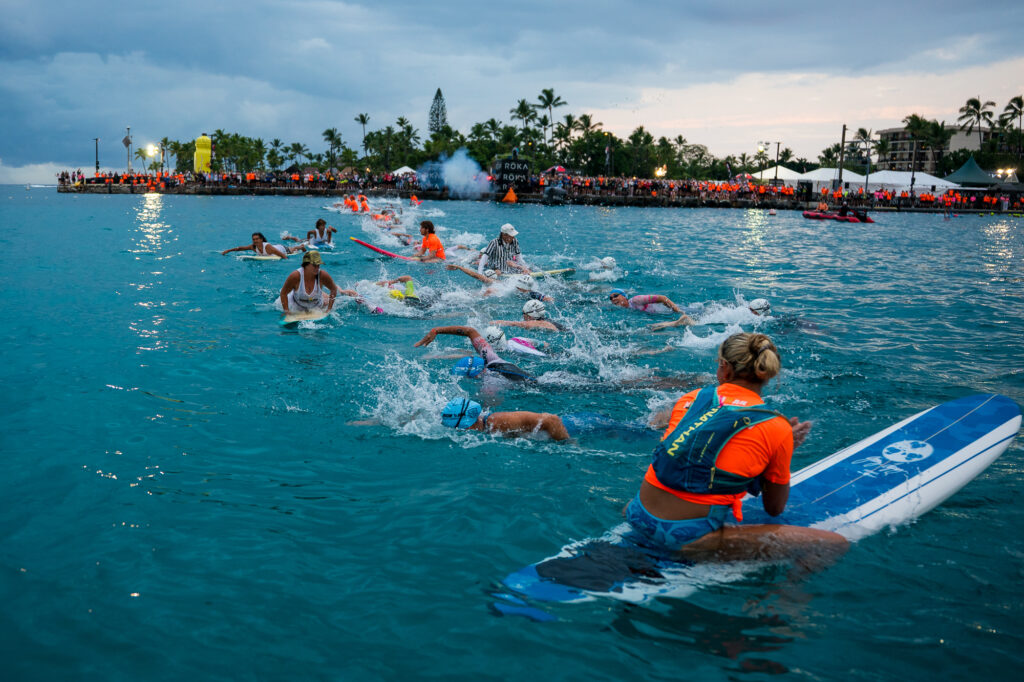
“A swimmer with no open-water experience won’t know if the person they’re drafting off is a valuable target,” he says. “They could be swimming crooked, they may swim fast and then slow and then fast again. In those cases, you’re better off doing your own thing and just trying to sight often and swim as straight as possible.”
Dealing with Chop and Waves
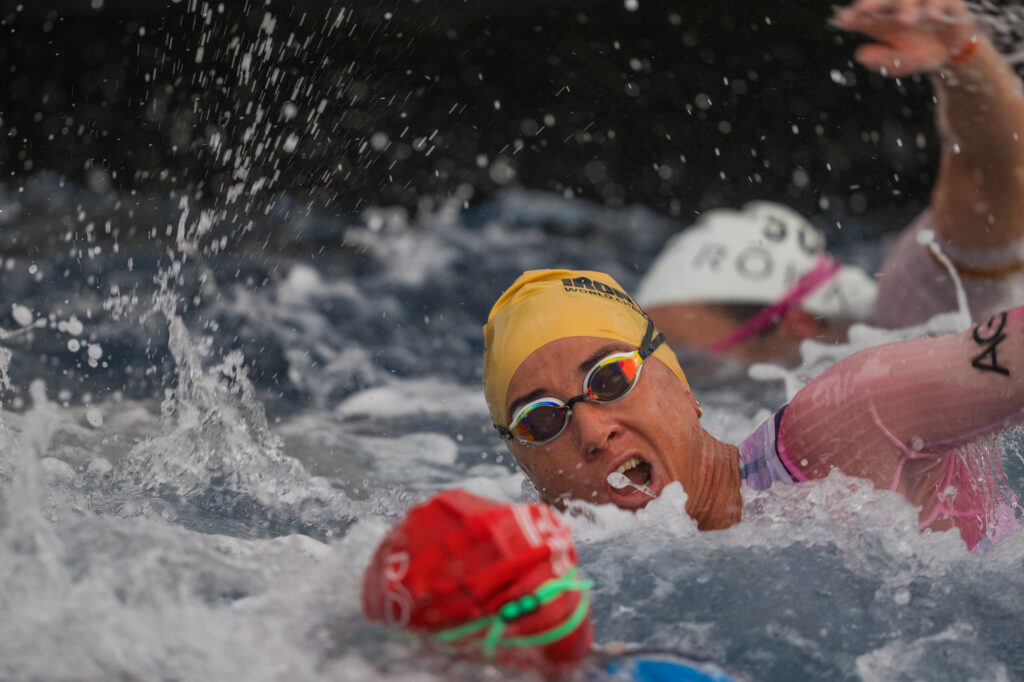
Sighting every six strokes may have seemed like overkill to some readers, but Rodrigues says you need to do it even more often when in choppy and wavy waters.
“In super choppy water, you really have no idea what direction you’re swimming in, because the chop is pushing you around,” he says. “Sometimes you may even have to stop, put your goggles up on your head and take a look around for where you’re going. It’s super difficult in high-chop.”
Most race directors will cancel or shorten swims due to unsafe water conditions, so the odds you’ll have to navigate huge waves are slim. However, some events may go ahead as planned even in wavy waters, or the conditions could change mid-race.
If you find yourself in a situation where you have to deal with big waves, Rodrigues says to breathe away from them so you don’t get hit in the face and take in a mouthful of water. That’s why he says it is a good idea to practice breathing to both sides in the pool. This way, you’ll be ready if you have to face away from the waves in any swim.
Prep for a Positive Experience
The swim is the most nerve-wracking leg of triathlon for most people. Rodrigues says that not only does it not have to be intense or scary, but that it can even be enjoyable—as long as you prepare properly for it.
That’s what all of his tips come down to. Yes, they will help you perform better and reach T1 faster, but even more important than a quick split is that you have fun.
“You have to ask, ‘What am I solving for?'” he says. “If you work on those things, you’ll generally be comfortable and have a good experience at your race.”




Any time I talk to a new triathlete, I always ask how they are in open water. I’ve had a number of newbies tell me they’re confident because they swam competitively in high school or college. I always tell them open water is a completely different animal and they need real, honest, repetitive practice in open water. Several have come back later and admitted they underestimated how different the feel is. Hell, I’ve done something like 30 triathlons and I will still get a little bit panicky in the beginning. But I’ve done enough of them now I know if I just push through that and get into a rhythm, I’ll be fine. Not fast, far from it, but fine.