
Race Prices Are Still Rising, But They Aren’t a Cash Cow
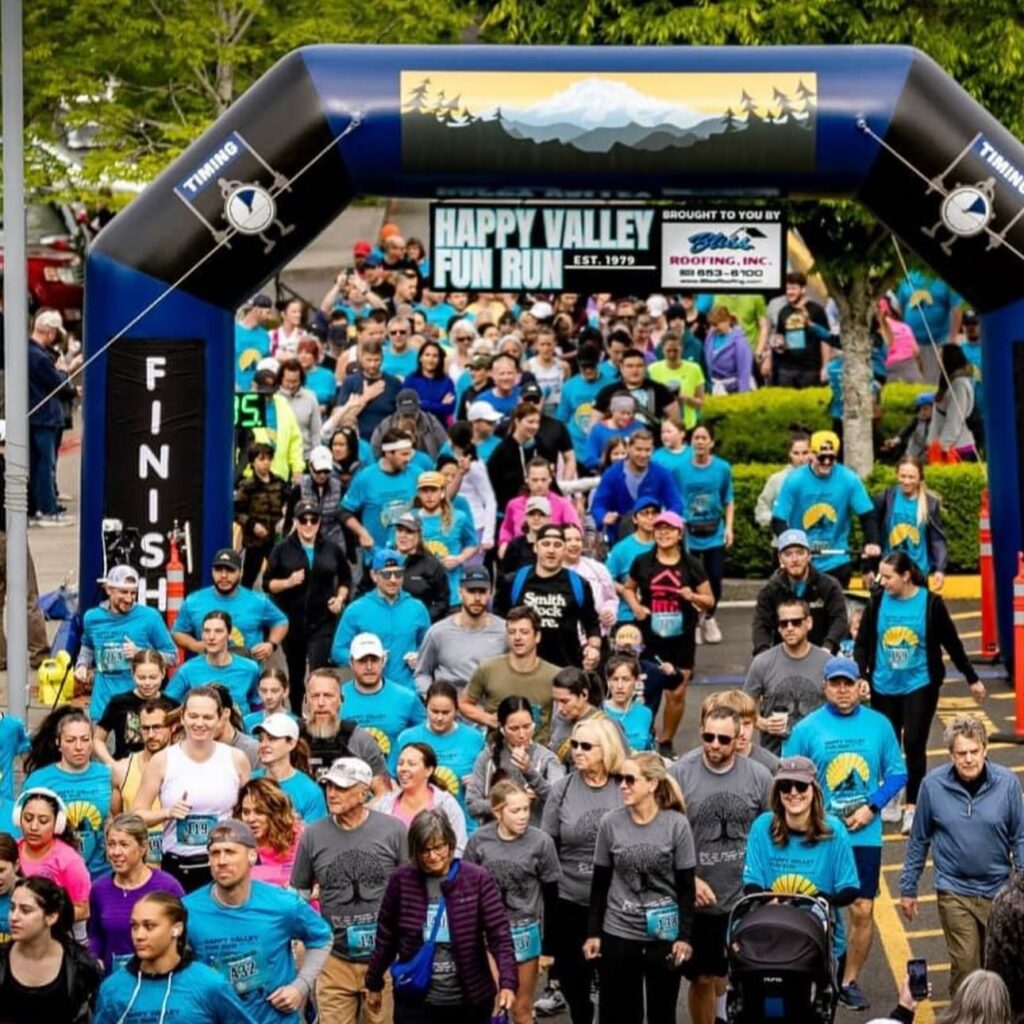
Our family decided that we would collectively run a 5K here in our still new-to-us hometown this past weekend. It’d be the first time all three of us have done an event together here in Oregon; Ivy and I ran a 5K in town at Thanksgiving, but Kelly was just a short time off of a major knee surgery and was still on crutches. It’s also the first time I’d tie on the racing shoes since my attempt to hold on for dear life at the Disney races a few months back.
That being said, there was some serious sticker shock when we went to register the three of us as a family. It was $45 per person before any transaction fees. $135! As former race directors, Kelly and I were extremely surprised, especially given that the race we were doing was a fundraiser for the local parent-teacher organization.
But we paid. We went. We found friends. We all had good results; I won my age group and finished in the top 10 overall. Ivy ran with one of her fellow Girl Scouts who had never raced before. And Kelly successfully ran a race for the first time since knee surgery. It was a good day.
We also realized that, in fact, the $45 price tag was probably spot-on given what was provided. It was also clear that they weren’t going to be making a ton of money on the race, either, despite 316 finishers in the field.
The Revenues: Registrations and Sponsors
As mentioned, this was a local event put on by the PTO for our local school district. It means limited overhead, in that everybody (well, most everybody — more on that in a second) in charge of putting the race on is volunteering. It’s a familiar position, as that’s what Kelly and I did for the better part of two decades.
The race offered two distances — a 5K and a 10K. Registration cost ranged from $35 to $50, depending on when you registered. Using our normal modeling for a race of about this size, accounting for when people are most likely to have registered for the race, the race likely brought in approximately $12,500 in registration fees.
The race had a fair number of sponsors and exhibitors. There were three different tiers of sponsorship available. From what I could tell as a participant, there wasn’t any real activation for a sponsor, outside of a name on the race shirt. Some of the sponsors were present on race day; more weren’t. There were some giveaways at the booth, and sign-ups, but my guess is that they’d all paid a small figure to be there.
All in, I’d say we’re looking at a maximum of $15,000 in total revenue.
The Costs: The Essentials and the Extras
Naturally, if you have a race, you need to have the things that make it a race. Namely, you need a course, you need bibs, and you need timing. In order to have a course in our town, you need to apply for a permit. Special event permits run $150 in town as a flat fee, and that’s really just the request to the town to have the event. It doesn’t include traffic control costs, for instance. Nor does it include facility rentals, like the elementary school. I’m assuming that the race didn’t pay to use the school, as the PTO was the beneficiary.
For this event, there were plenty of traffic control costs. First were city-owned barricades, placed at nearly every cross street the course ran through (it was the same course for both distances, with the 10K using the loop twice). And then there’s the actual traffic control: police, and lots of it. I counted no fewer than eight uniformed patrol members lining the course, starting about an hour before the run and continuing until the final finisher over two hours after the gun went off. There was also the lead patrol car. Running off of past police involvement, it is likely each one of these officers required a minimum of four hours of duty pay for their time.
That, alone, would likely set the event back a few thousand dollars.
There’s then timing and any race day logistical services. The race contracted with a local timing company, which appears to have provided:
- Custom bibs, along with the timing tag;
- Course distance measurement and certification to USATF standards;
- Start / finish timing mat;
- Start / finish inflatable arch;
- Start / finish line announcing and music;
- Course marking;
- Timing of the two events; and
- Two iPad kiosks for immediate results.
The timing company (Huber Timing) did, in my opinion, a very good job with most things. The final stretch was not as well marked as I think it probably could have been; I wound up finishing my race and wound up back down on the course directing runners as it was a little confusing. Otherwise, things worked much as you would hope they would. I received a text message about 5 minutes after finishing with my race time. I was able to quickly see how I placed in the overall and in age group standings. There weren’t many glitches to speak of.
There were a couple of things I would do differently, sure; for instance, I would have had a color coded bib for those running the 5K versus the 10K, and I would have assigned bibs pre-race as opposed to on race day. Those are choices, as opposed to hard and fast rules. But all in, again, we’re talking about a set of services that is a four figure sum at a minimum, and these are table stakes to put on an event. The PTO had also pre-purchased water bottles for participants for post-race; it’s nice to have an individual water for participants, although it’s not ideal from a sustainability pursuit to have single-use plastic out there.
And then there’s swag; yes, the race came with a t-shirt. It’s a pretty decent technical T, with laser printing instead of screen printing. The advantage of laser prints like this is that they are easier to have multi-color designs without the print getting heavy and it’s less expensive. The downside is that laser prints don’t tend to hold up to repeated washings, but then I will just wind up with a white T. If I really don’t like it, I wound up with a decent bike rag. Given the number of participants and the type of printing utilized, I’d hazard that shirts ran around $2,500.
Adding it all up, and I’d put expenditures between $8,000 and $10,000 for the race, leaving the PTO having raised somewhere between $5,000 to $7,000. Not bad for a quick non-profit event. But this calculus does make some decent assumptions; the margins are much smaller if there were no sponsors. And, outside of race shirts, you didn’t see much in athlete services like post-race food or snacks.
This is why the math gets far more complicated when you start extending distances out, and why you start seeing pricing jump significantly when you get to half marathon distance and above. And heaven forbid you’re trying to put on a triathlon, which easily triples your logistical and cost burdens. It’s just a hard environment to produce an event in.
Tags:
Race DirectorrunRelated Articles:

Continue the discussion at forum.slowtwitch.com
8 more replies



So about $8 per participant for a tshirt…. which should be axed. I have so many damn tshirts (100?) i never even used yet. How about some shorts people!? I only have 5 of those.
The thing I go back to with shirts (or medals):
For you and me, sure, we don’t need those things. For somebody else, this might be their version of an IM, or Boston Marathon, or something else. And there’s way more of them out there than there are of us.
If that shirt order goes down by 100 athletes, it’s now $12 a shirt. It’s why you just keep ordering them for everyone. Eliminate the shirt and then people wonder why they should bother doing your race.
…with all the shoes you’ve been testing and writing about, what did you race in?
HOKA Cielo X1 3.0
That was a mistake. First time wearing them. I’m still a mess. (That’s probably tomorrow’s article.)
uh oh…
Ouch, what’d you run it in under 17 minutes?!? Those shoes look pretty fast
No, the course had almost 400 feet of elevation gain in it, so slower. The downhills were cartoonishly fast. The uphills…less so. Which I think is part of what I need to write about, as I think it definitely changes how you run uphill.
The local race I’ll be doing on Memorial Day is $65 for the 5k. Well run event, but things are beyond getting steep.
It got me thinking about looking at races in terms of best value per hour.
If you go 20 minutes on a 5k, figure that race is about $200/hr.
$1000 Ironman for a 10hr guy is $100/hr.
Boston marathon becomes about $90/hr.
In the cast of the OP if the 10k was $50 thats like $65/hr.
Well this is a different type of event, pure fund raiser. I feel race package companies (active) lock you into a tshirt requirement. It maybe good though if it attracts a sponsor that pays for the shirts and part of the race cost, as that would be advertising for them
If one chooses to pay 45$ to race a 5k, one should lose their right to complain about anything being too expensive in the future
I dunno man, a number of big race organizers here in Poland (both run races and triathlons) stopped doing mandatory shirts a few years ago, and attendance is at all time highs, even though getting a shirt requires an extra “easy payment”. Just sayin’.
Next step, for me, would be to charge for finisher medals, but then the logistics would probably be too big of a hassle as they’d be loth to include those in the swag bag.
You’re pretty spot on for your cost projections. The only thing I would add is that if this were a for profit company and not a true fundraiser you’d need to add in labor, which drives the net down even further. It’s always interesting to hear how many seem to think that race directors are raking in the profits. This is definitely a labor of love for most of us. Thanks for being a voice of reason in an increasingly unreasonable world.
Oh, I know. If this had paid staff, this thing isn’t making money.
Sitting here in the States…if you don’t have at least something for swag, you might get a one-year turnout, but then people say “nah, that’s not worth it” and choose some other event.