
Our Wheels Got Wider. Should Tire Testing Follow?
When I started racing triathlon, I had no idea what made one tire faster than another. Heck, I’m not sure I knew tires made any difference at all. Then I started reading Slowtwitch, and — well, you know how this goes. I got more interested, I got more invested in gear, and on the forum’s recommendation I moved to the Continental Grand Prix 4000S. I raced that tire for a few seasons, including what is arguably my high point as an athlete in 2015, coming back from my spine injuries.
Then, lo and behold, Bicycle Rolling Resistance came along. In 2016, BRR tested the Vittoria Corsa Speed, and it came out 2.6 watts per tire faster than the GP4000S. That’s more than 5 watts of free speed, just for swapping tires. (Try finding 5 watts that easily anywhere else on a tri bike.) And away we went. That’s what a good standard does. BRR has been at it since 2014, and more than 500 tests later, its watts column is the closest thing we have to a shared reference. I doubt I’m the only one who’s picked a race tire off that list.
Notice the setup, though. Both tires were measured on BRR’s 18 mm rim and tested at the same 80 psi. Back then, a 23 or a 25 on a rim that width was a race setup. The test matched the bikes we were riding.
But a standard only earns its keep if the thing it measures still looks like what we ride. As recently as 2021, BRR itself noted that most road bikes with 25 mm tires came on rims around 15 to 18 mm wide. Today the conversation is 28s, 30s, and 32s on 21 to 25 mm internal rims — and a lot of them are now hookless (no, I’m not looking to relitigate the great hookless debate; it’s just what’s available in the marketplace).
So let me say this up front: this isn’t a knock on BRR. It’s still the best tire-testing resource we have, and I’ll keep using it. But the wheels we ride have changed, and I think it’s worth asking whether the rim we test tires on should change with them.
A Standard Only Works If It Still Looks Like the Real World
Let’s go to the fixed baseline first, because it’s a real argument — and plenty of readers may not realize it exists. Every road tire in BRR’s standard test runs on the same drum, at the same speed (about 18 mph), under the same load (about 94 pounds per tire), mounted to the same 18 mm rim, at pressures set by the same width brackets. That’s the baseline. The rules don’t change from one tire to the next, so the only thing that moves the number is the tire itself.
That’s what currently makes the list work. A watts figure on its own doesn’t tell you much about your own ride — real-world rolling resistance depends on your weight, your speed, and the road under you. But hold everything else constant and you can line up a tire tested last month against one tested in 2019 and trust the comparison. Change the rim every few years and you break that — and that archive is apparently the whole point.
It’s also worth knowing that BRR’s rim isn’t as far off the official standard as you might think, at least for tires in the 28c range. ETRTO says a 28 mm tire should measure 28 mm on a 19 mm internal rim, and a 30 mm tire should measure 30 mm on a 21 mm rim. BRR runs rolling resistance and sizing on an 18 mm rim and grip on a 19 mm rim, per its review pages. For a 28, that’s getting close to ETRTO’s standards. (There’s also a debate as to whether the ETRTO standards need updating, too — but that’s a battle for another day.)
That all said, look at where the wheel market went. Zipp’s 303 Firecrest is hookless at 25 mm internal, and ENVE’s SES 4.5 is 25 mm too. Even the ENVE Pro series wheels and their recent retreat to 23 mm race rims with microhooks lands well above 18. And as riders move to 30s and 32s, an 18 mm rim falls below even ETRTO’s reference rim for those sizes.
And here’s the part most miss: BRR doesn’t test every tire at the same pressure. Each tire runs at several pressures, from high to low, but the number you see on the overview list comes from the “High” pressure — and what counts as “High” depends on how wide the tire measures. A tire that measures 25 to 27 mm gets tested at 80 psi. One that measures 28 to 30 mm gets 72 psi. Go wider and the pressure drops again.
The logic makes sense. Riders drop pressure as tires get wider, and the test follows suit. But that width is measured on the 18 mm rim. So the rim doesn’t just shape the tire — it decides which pressure the tire gets tested at. A tire that measures a millimeter narrower on that rim can land in a higher-pressure bracket and post a faster number.
None of this makes the numbers wrong. It just means they answer a question that fewer of us are asking. Consistency is valuable — but once the wheels themselves have moved on, I’d argue it’s worth revisiting.
A Narrow Test Rim Can Flatter a Tire — Or Punish It
The easy version of this column says narrow-rim testing penalizes tires built for wide rims. The data says something more interesting: the gap cuts both ways.
Take Vittoria’s Corsa Pro Speed TLR WR 29. Vittoria designed it for a 25 mm internal rim. On BRR’s standard 18 mm rim, the tire measured just 27 mm wide, which put it in the 80 psi bracket, and it posted 7.0 watts. BRR then — to its credit — ran an extra test on a 22 mm rim. There, it measured 29 mm, dropped into the 72 psi bracket, and posted 7.4 watts. That’s not a huge swing, but it’s a real one. Same tire, same lab — change the rim, and you change the measured width, the test pressure, and the result.
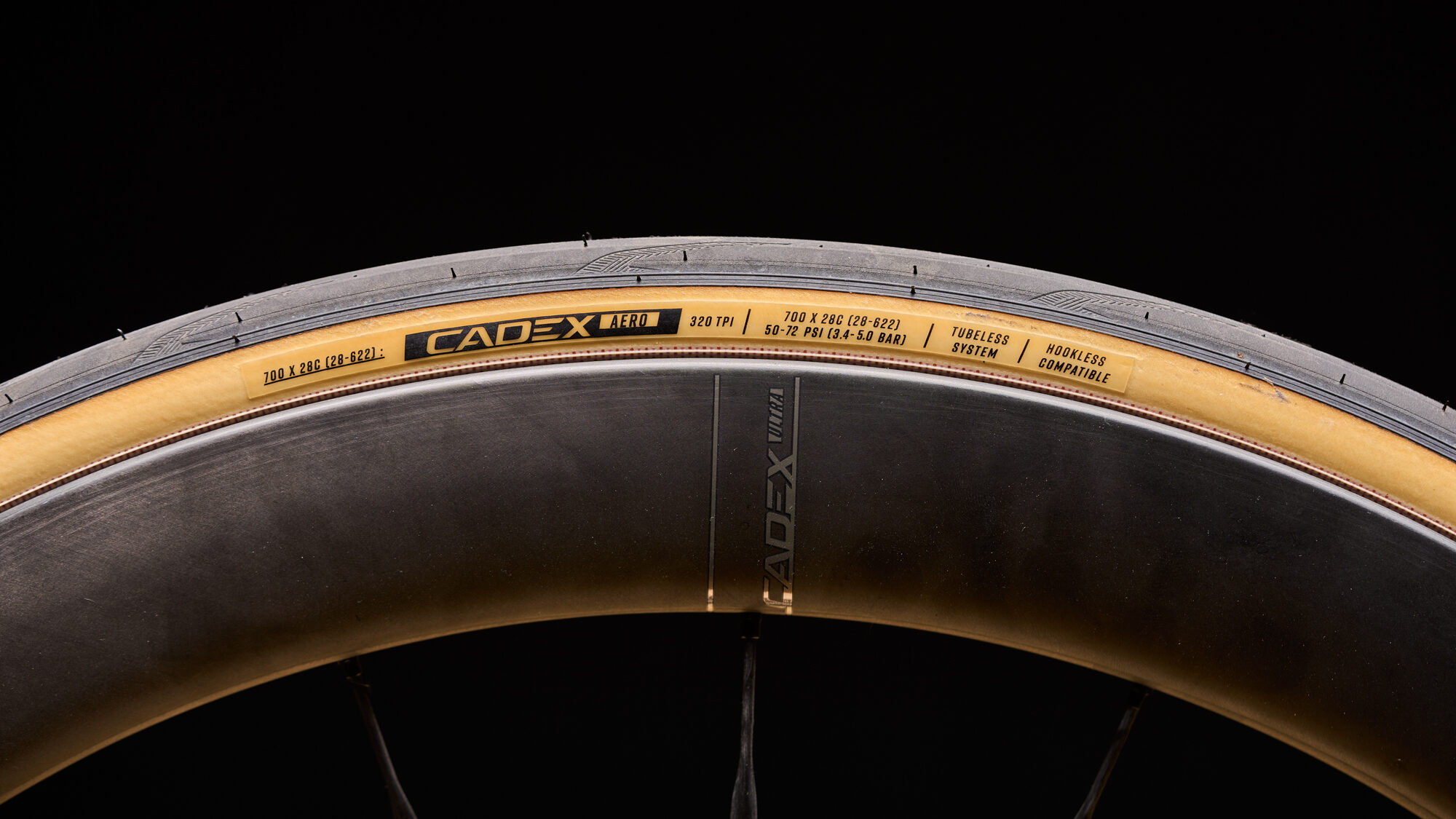
Now take the CADEX Aero Tire 28. In August, BRR issued its first-ever safety warning in 12 years of testing. The reason: a tread just 21 mm wide on a 28 mm tire, which BRR says puts you on the sidewall at modest lean angles. Its visual estimate was 3 to 4 mm of sidewall contact at a 35-degree lean, on a 19 mm rim.
That’s a gutsy call. But notice the setup. CADEX built this tire for its own 22.4 mm hookless wheels, and BRR itself says the problem gets worse on wider rims. Its headline rolling resistance number was run at 80 psi — above the roughly 73 psi hookless limit BRR cites in its own hookless test. On its intended wheel, within hookless pressure limits, this tire can’t be ridden the way it was tested.
In other words, according to BRR the narrow rim probably made the Aero Tire look safer than it is on the wheel it was designed for. So, we did what you’d expect us to do: we measured it ourselves.
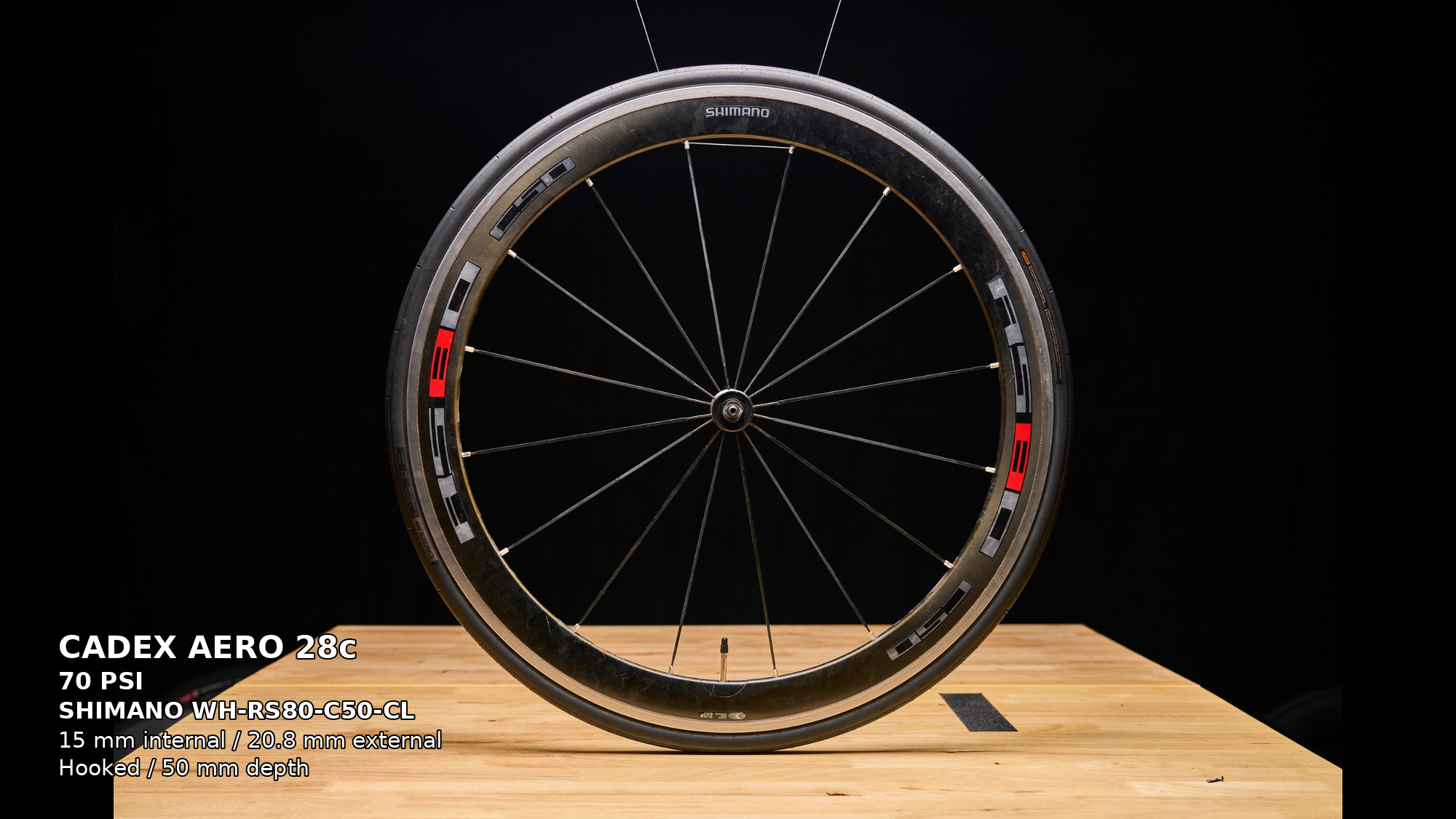
We wound up selecting two different wheelsets to do our initial tread testing. The first, an older model Shimano WH-RS80-C50. It’s even narrower than what BRR uses for their testing rim, with a 15mm internal width and a 20.8mm external width.
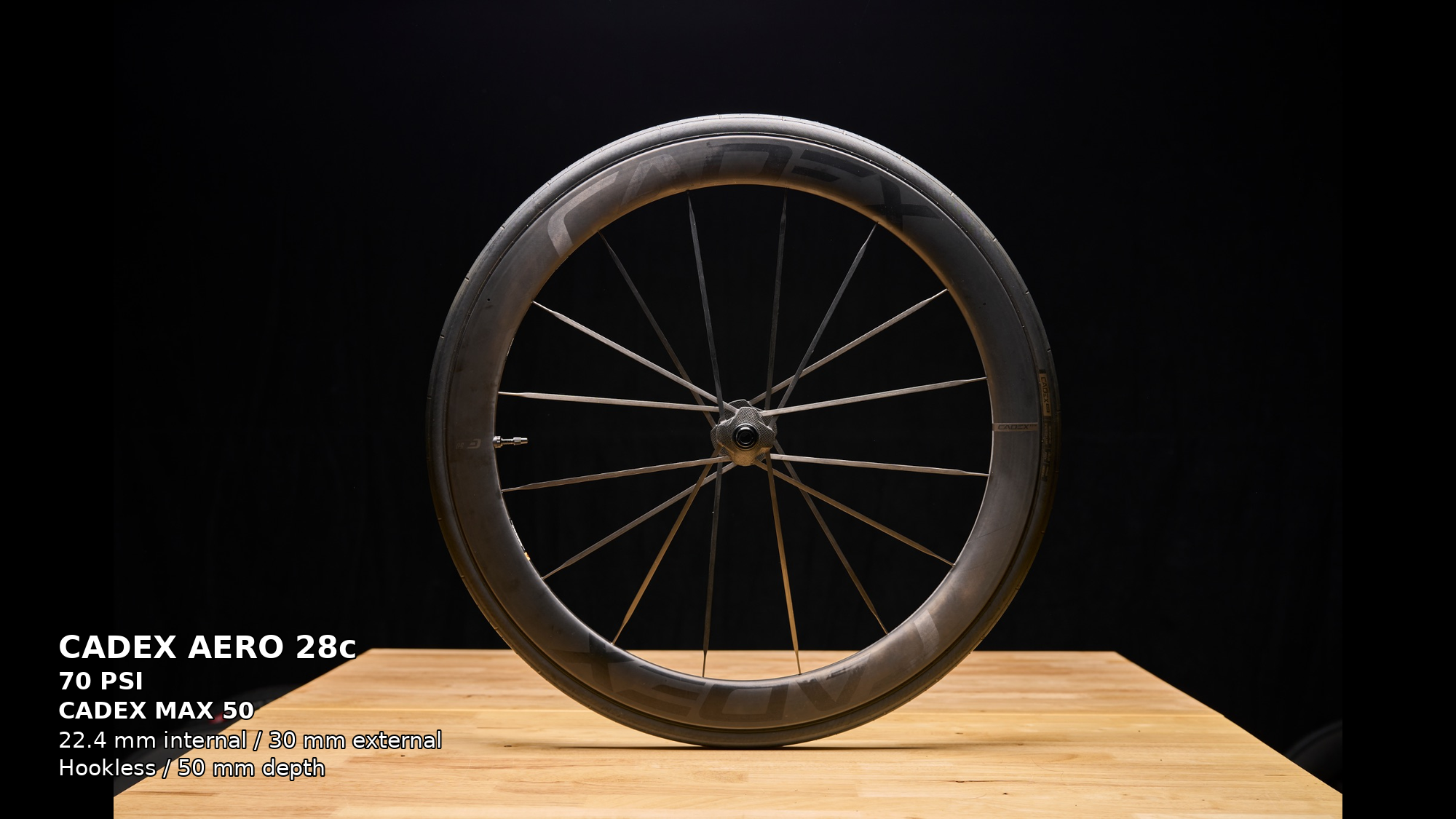
For comparison’s sake, we opted for a truly modern rim. We used CADEX’s Max 50 WheelSystem. It measure 22.4 for internal width, 30 millimeters for external. It’s also a hookless rim. To otherwise try to limit variables, we matched up rim depth at 50 millimeters.
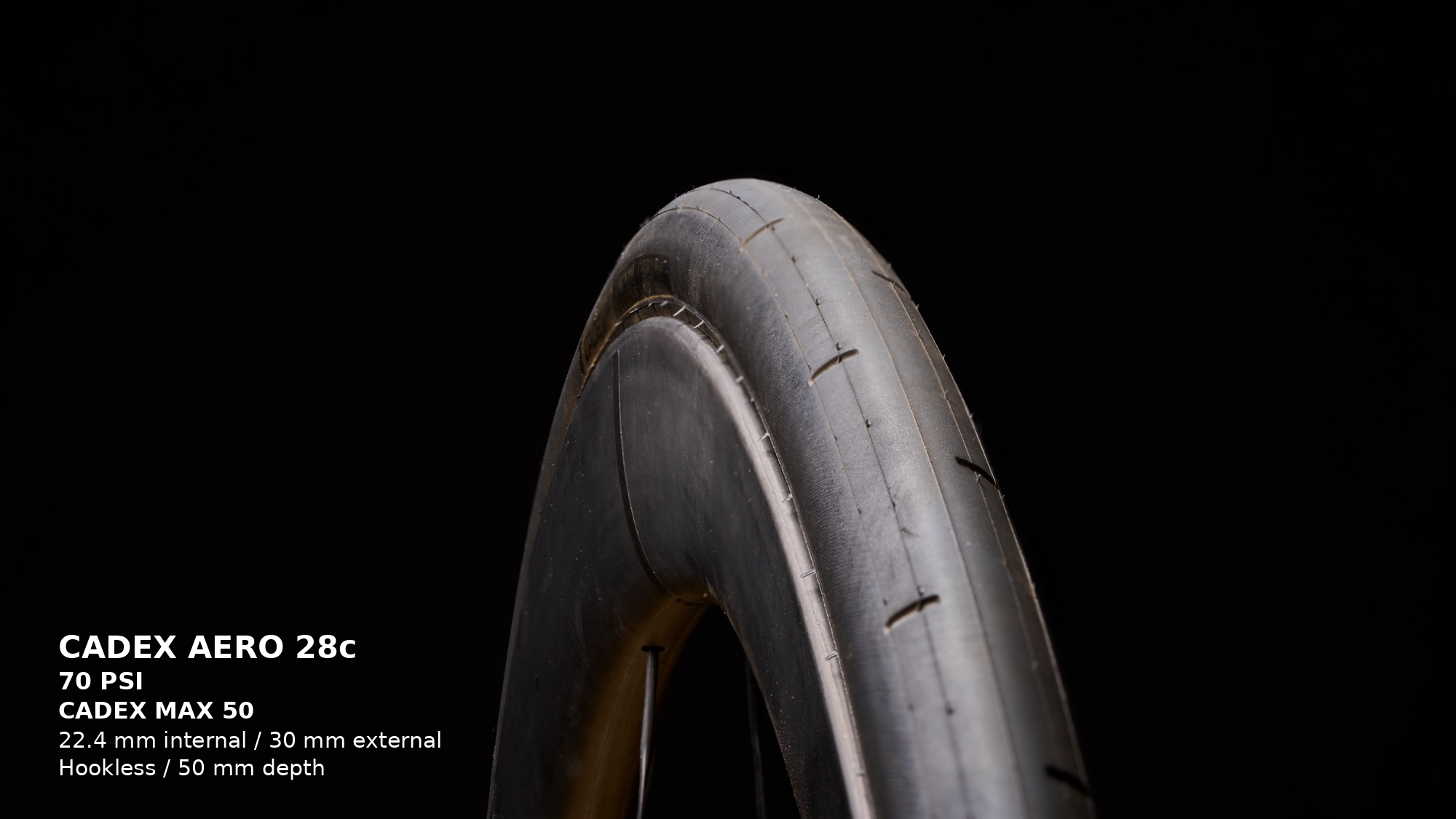
Here’s what the CADEX Aero tire looked like on from a face on perspective, which shows the tread width.
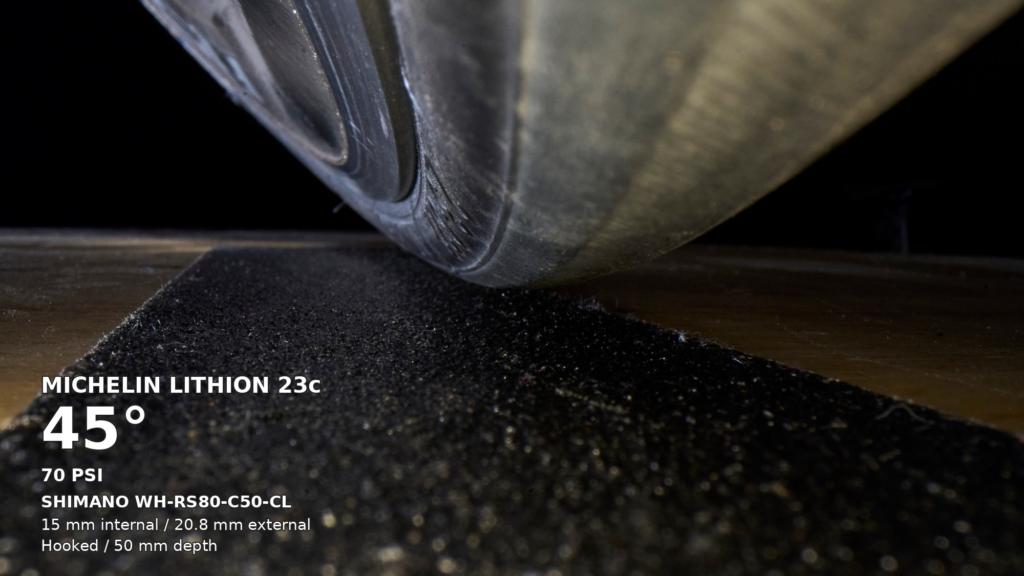
We then crafted a rig to lean the wheel over and look at tread contact on the road. We started with what GCN calculated in a 2018 video as the theoretical limit of cornering based on their speed test: 45 degrees. We also wound up testing an older tire to go along with the older rim — a Michelin Lithion 23c tire.
First, the Michelin on the Shimano wheel.
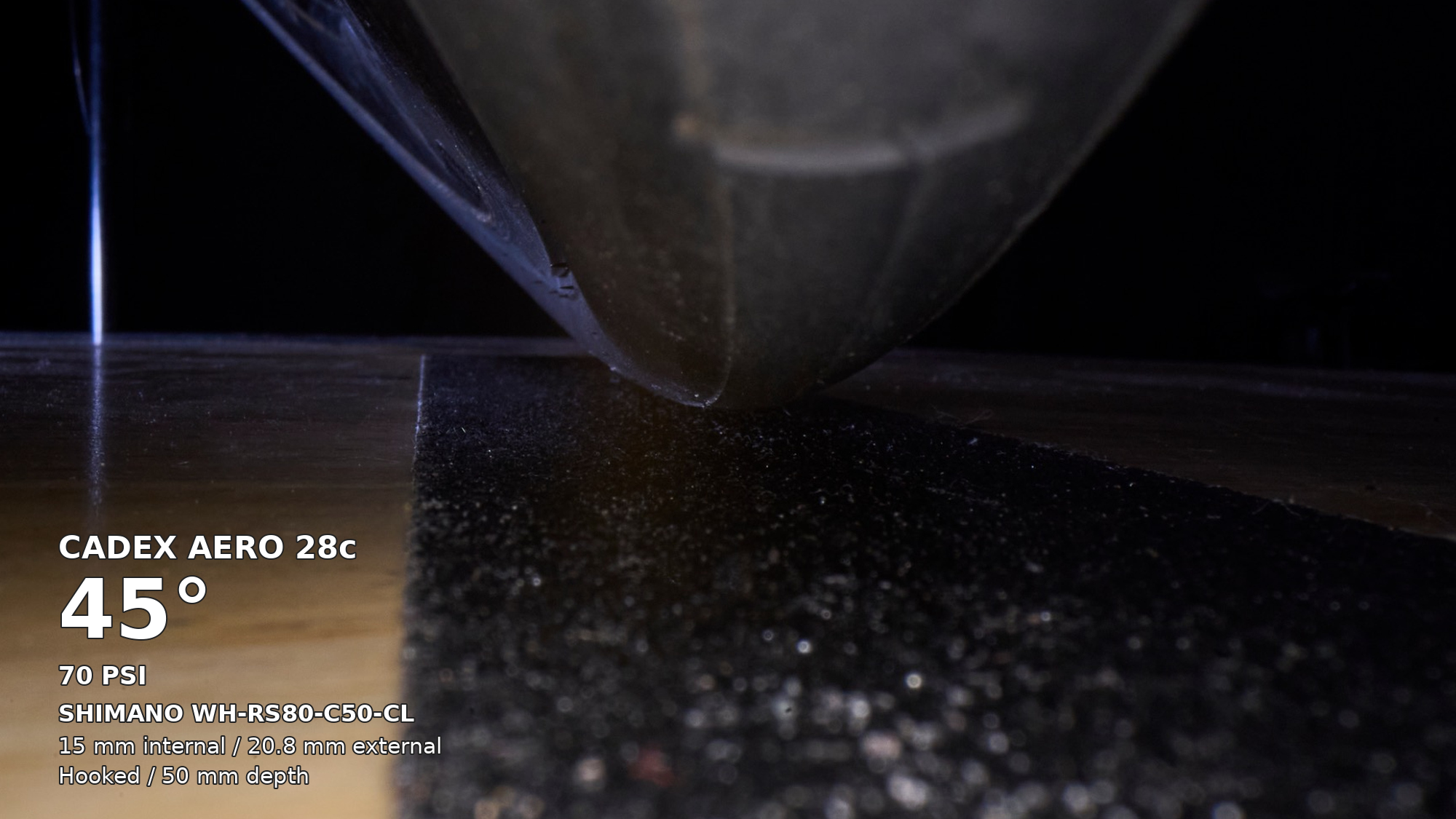
Now, the CADEX Aero tire on that older rim. Notice the deflection in the tire that keeps it on the tread here.
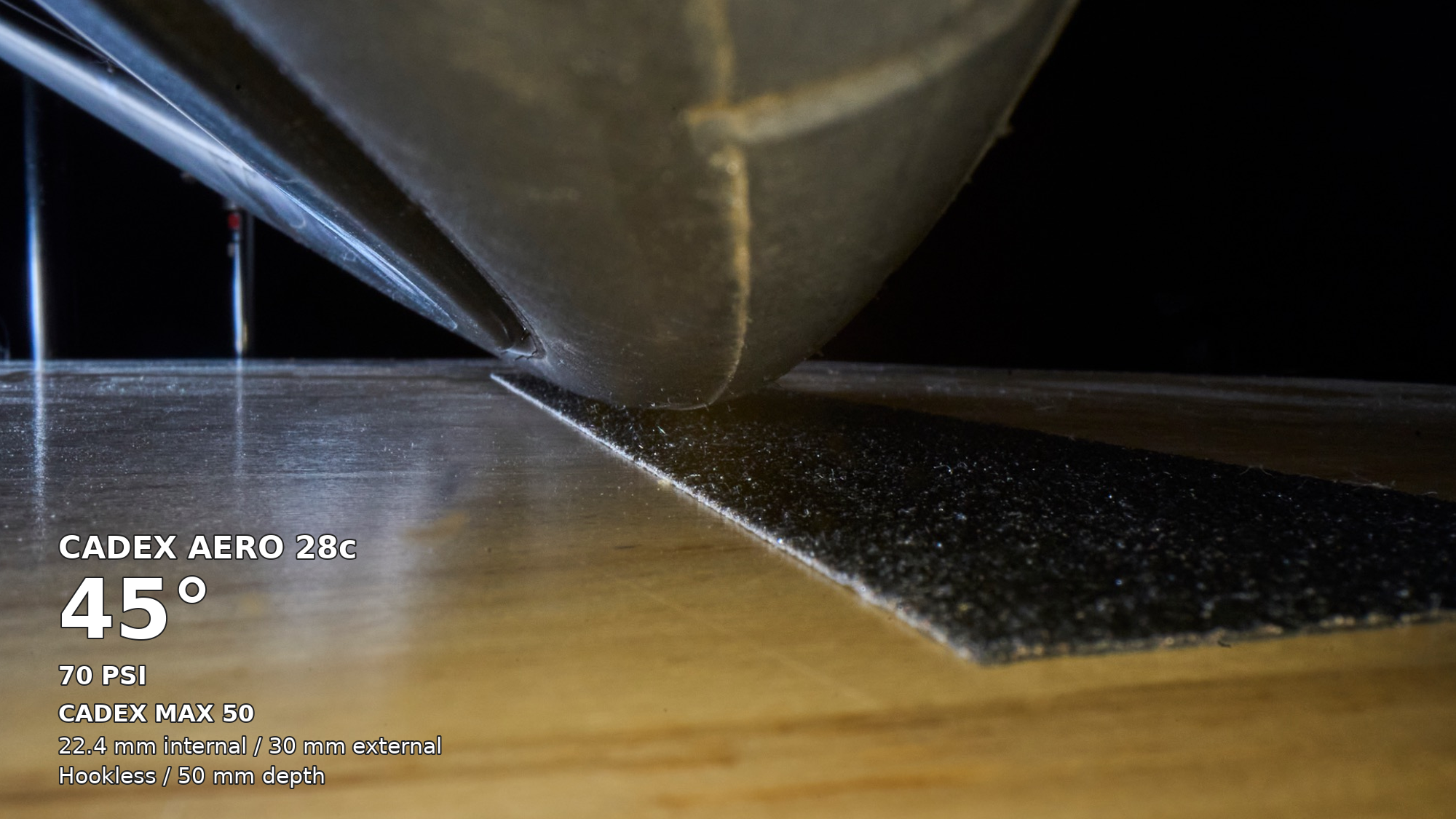
Now, let’s move that same CADEX tire to a more modern rim. Here, the sidewall does appear to contact the road, but the bulk of the cornering force would still remain on the tread itself.
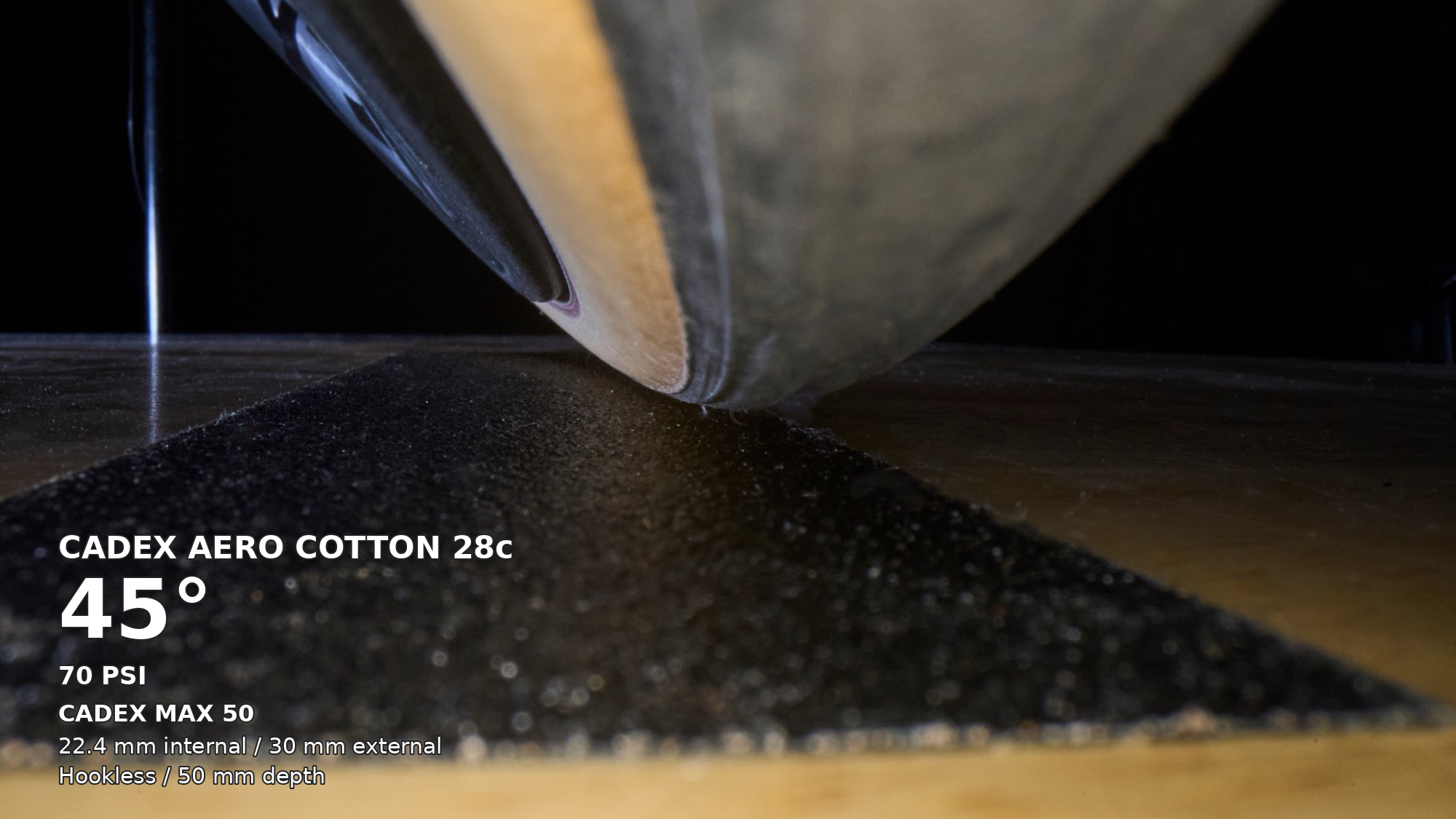
For the sake of argument, we wound up taking another CADEX tire — the Aero Cotton — and putting it through the same lean angle test.
To put the above cornering limits into perspective, here’s what 45 degree angles look like from afar.
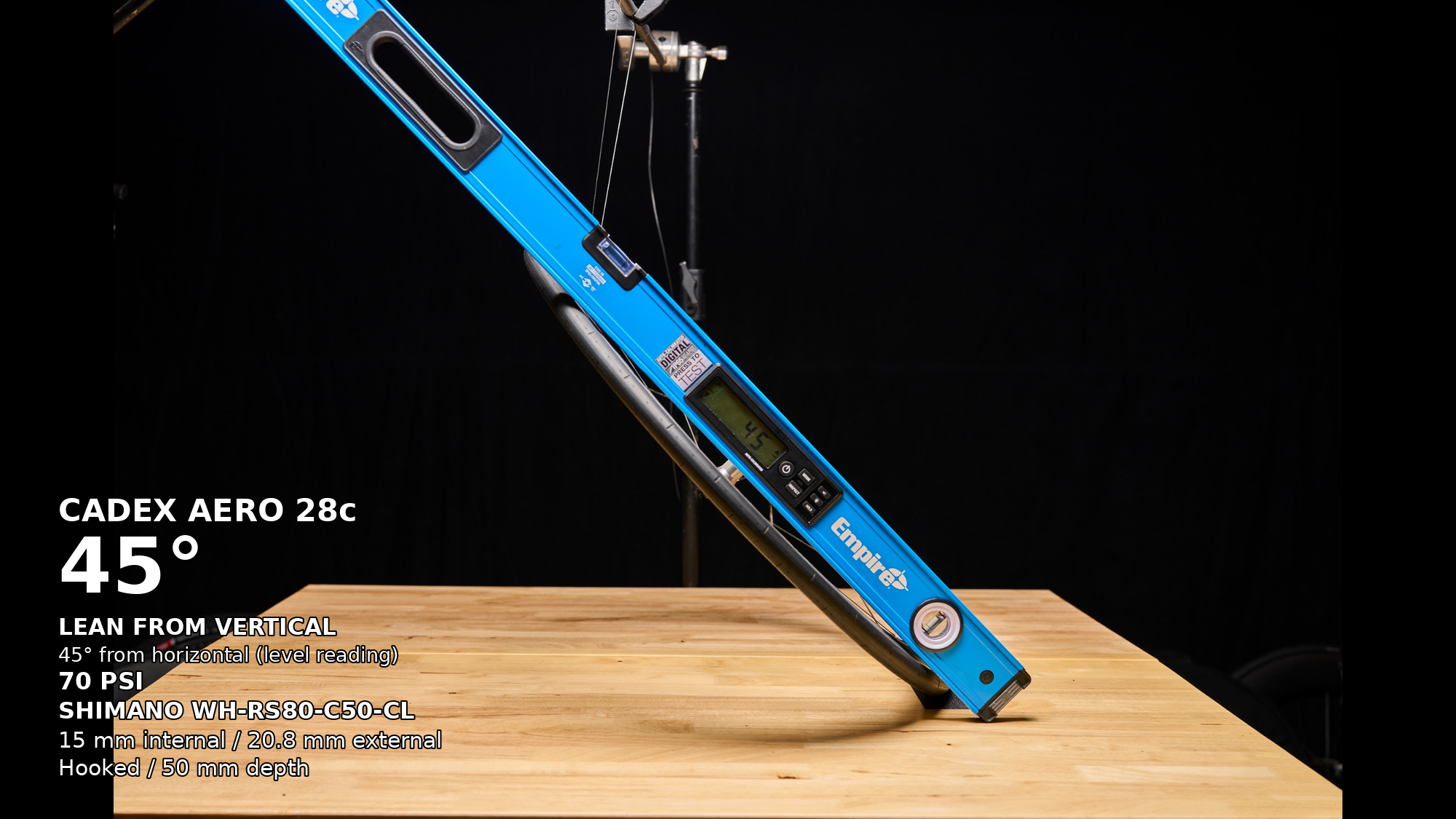
Let’s be honest — these are angles that very few of us reading these pages are likely going to see, outside of maybe the steepest of mountain descents. And even then, there are other factors that would likely prevent us from ever tilting a bike over this far; sand or debris on the road, or moisture, or painted lines would all likely have us being far more conservative on how far we’d be willing to move a bike over.
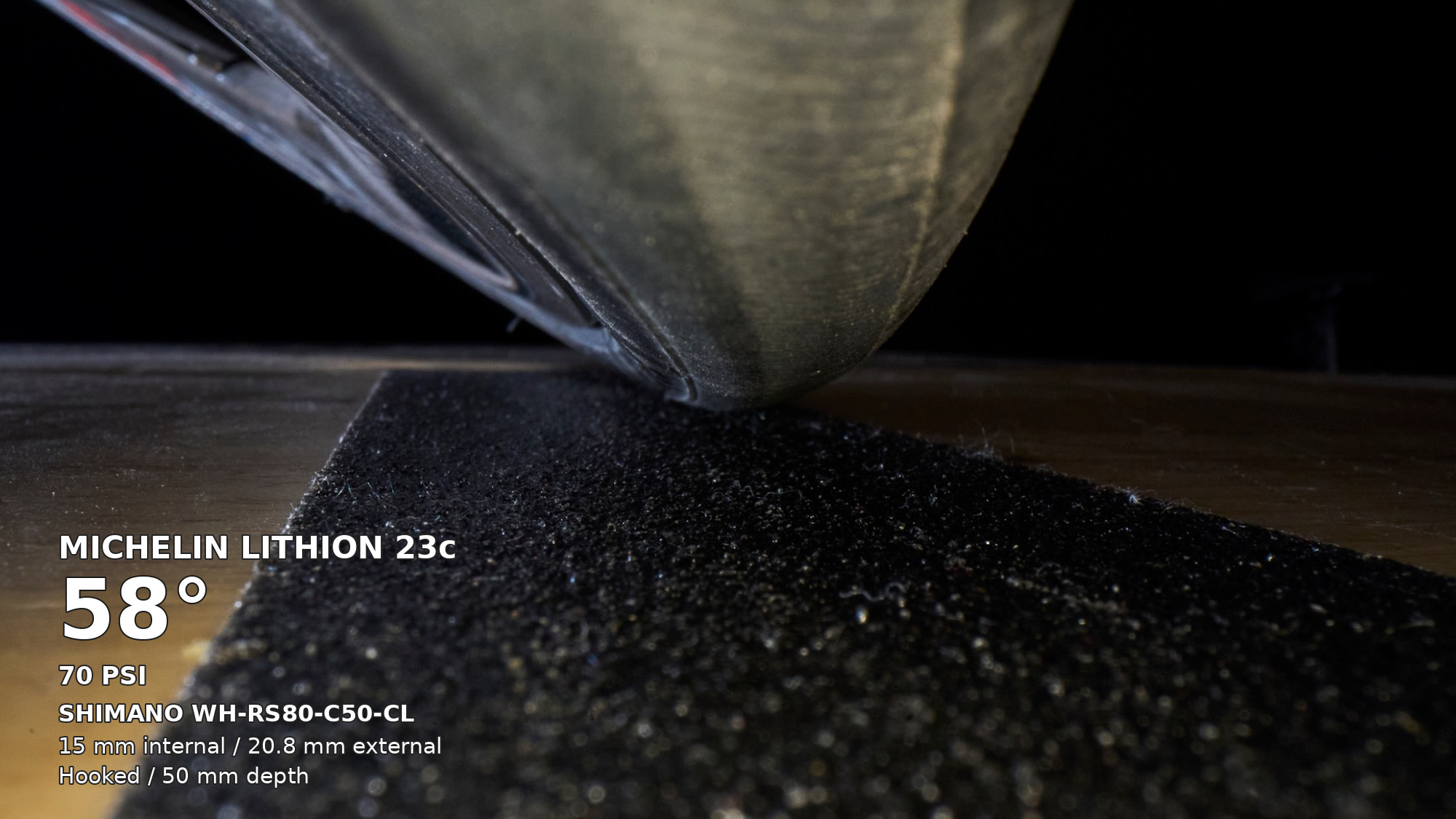
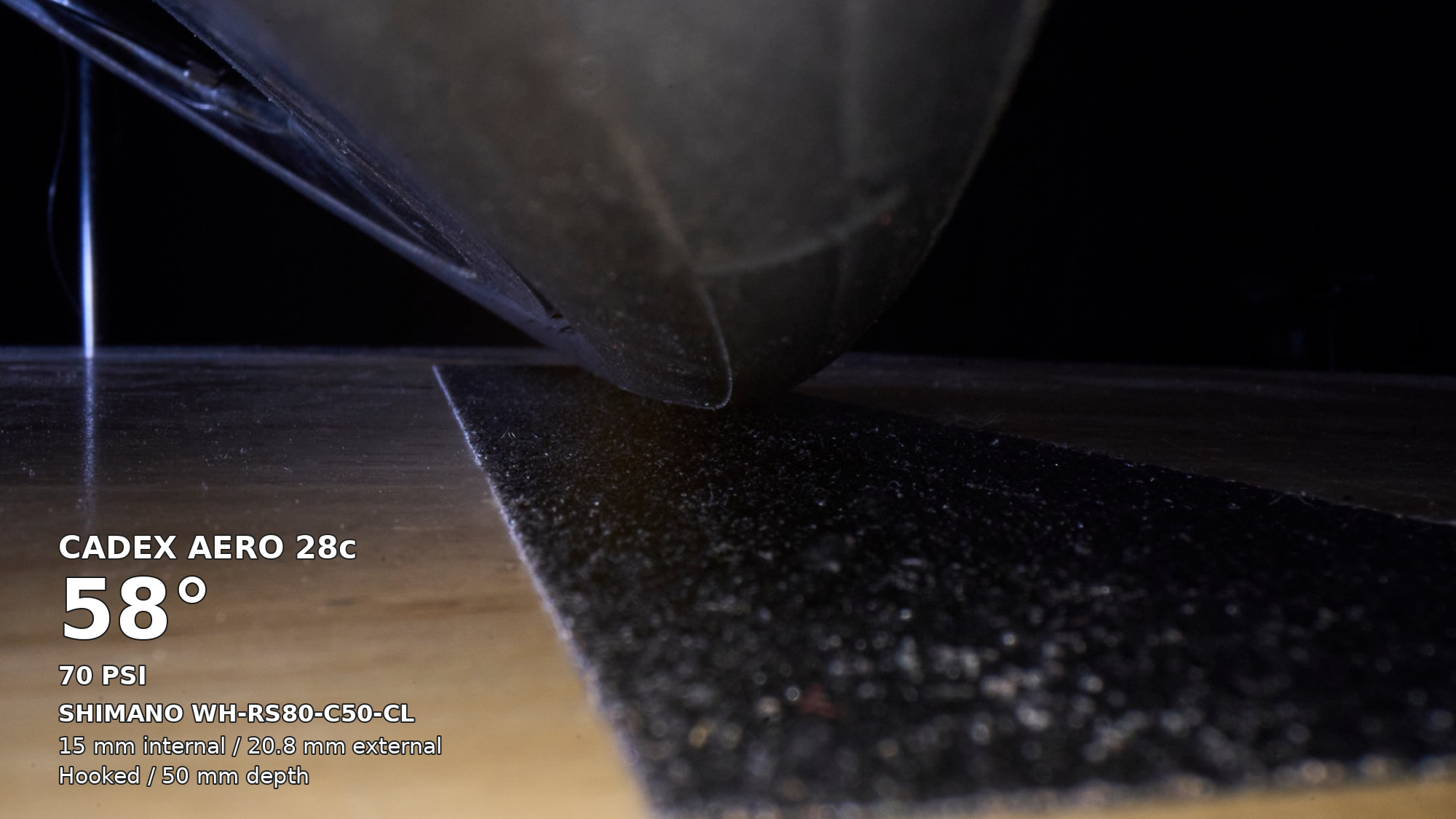
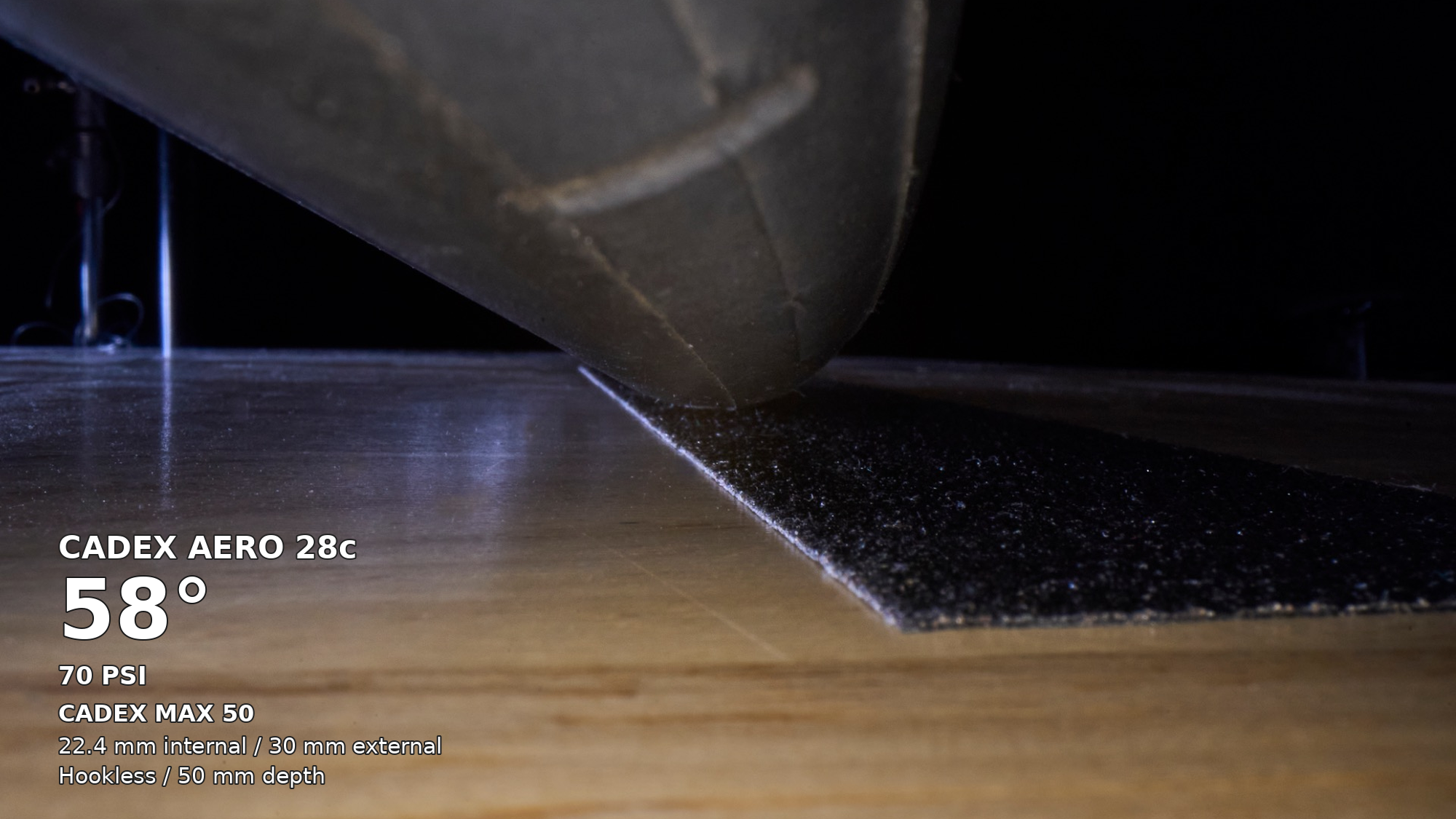
But, for a moment, let’s imagine that the road surface is perfect, and you’re doing your best Tom Pidcock impression, and you want to see exactly how close to the sun you can fly. We tested that too, putting the wheel over at a 58 degree angle.
First up, the Michelin Lithion:
Now, the CADEX Aero tire mounted on the same Shimano wheel.
Now, moving to the modern CADEX rim.
And finally, we see the CADEX Aero Cotton.
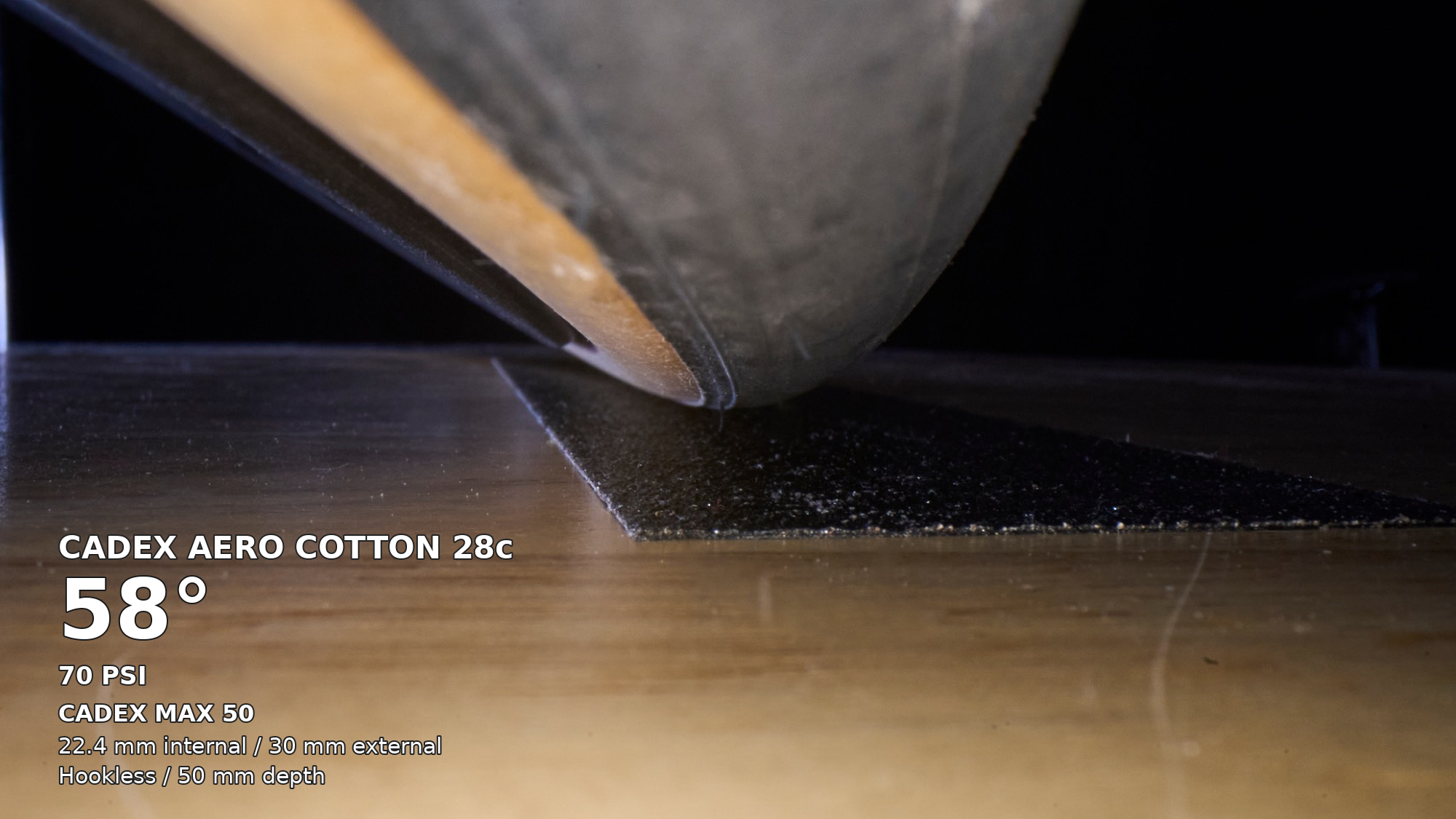
And again, here’s what that looks like when you zoom out — it’s just nearly unfathomable that you’d actually reach this angle while riding.
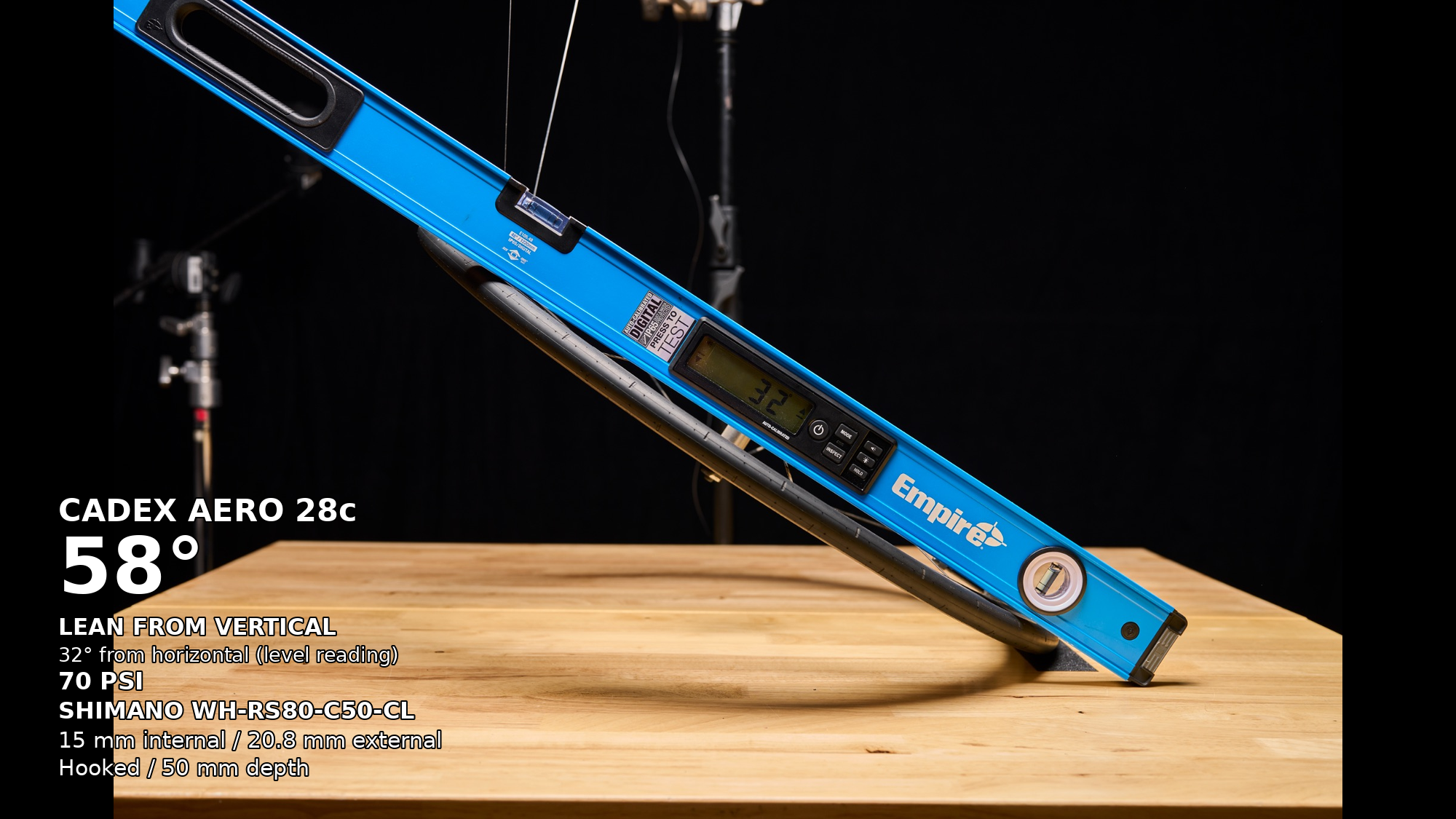
In other words, at least from our testing, we can’t replicate a result that would indicate a tire being unsafe to ride on at these pressures and on these wheels. In fairness, there is a little contact with the sidewall when leaning the bike over towards significant angles, but we do not think it likely that most riders would actually reach those angles.
A Narrow Rim Is Part of the Measurement Result
Now, let’s also give BRR’s its due when it comes to rolling resistance. In its 2021 Rim Width Test, the same tires on 18, 22, and 26 mm rims rolled almost identically once pressure was adjusted for comfort. BRR found the sweet spot at a rim width of roughly 65 to 75 percent of the tire’s rated width. If watts were the whole story, an 18 mm rim would be a defensible shortcut.
But watts aren’t the whole story. In that same test, road tires grew about 0.425 mm wider for every millimeter of rim width. That width decides the pressure bracket, the sizing you see in the review, how much of the casing the tread covers, and where the edge of the tread lands in a corner. On the WR 29, BRR measured slightly lower edge grip on the wider rim. Those are the numbers that tell you whether a tire fits your frame and holds a wet descent.
And here’s where it gets weird. In 28 mm, BRR has Continental’s GP5000 S TR at 9.7 watts and Pirelli’s P Zero Race TLR RS at 10.5 — a clear win for Conti. Step up to 30 mm and it flips: the Pirelli comes in at 9.7, the Conti at 10.0. Same lab, same 18 mm rim, same 72 psi.
Frankly, that doesn’t make much sense. Same casing, same compound, two millimeters apart — and the order reverses? It gets stranger. BRR’s own testing found that at the same pressure, bigger tires roll faster. Yet its GP5000 S TR 30 tests slower than the 28, at the identical 72 psi.
I don’t think anybody’s fudging anything. Instead I think we’re seeing the limits of the method. On BRR’s 18 mm rim, the Conti 28 measured 29 mm wide while the Pirelli 28 measured 28 — and because pressure is set in brackets, both got 72 psi, the same as a 30. A tire that runs wide on a narrow rim gets the extra volume without a pressure penalty. Add in tires tested years apart, and a few tenths of a watt can come down to which bracket a tire landed in or which sample came off the line.
That’s my whole argument in miniature. When the rim is narrower than anything most of us ride, measured width — and with it, test pressure — becomes part of the result. Put these tires on a 22 mm rim and they’d measure differently, land in different brackets, and maybe sort differently too. Maybe not. Nobody’s run that test — not BRR, and not us. Yet.
And the evidence behind the status quo is getting old. The rim width study used three 25 mm tires that have largely since been updated, all on hooked rims. BRR’s published hooked versus hookless comparison dates to 2022: one tire family, the GP5000 S TR, on one hookless wheel, a Zipp 303S. It found no meaningful difference — though the hookless rim dropped off a bit more at low pressure, and BRR noted the Zipp had little bead lock. That’s a reasonable result. It’s also four years and a whole generation of hookless-specific tires ago.
What a Modern Standard Could Look Like
To be clear, I’m not asking anyone to stop using BRR as a resource— it’s the reason I raced the Corsa Speed, and I still use it as a reference. And I know changing a long-running test is easier said than done. But here are a few ideas I think are worth considering:
- A 22 mm internal, hooked rim makes a lot of sense as a new standard. That’s the current DT Swiss ARC 1100 rim, and DT Swiss was comfortably the most common wheel brand in this year’s Kona bike count. More importantly, 22 mm bridges the gap of where most modern cycling wheels are. It’s within a millimeter or two of the 20 and 21 mm rims still on plenty of bikes from the last generation of DT Swiss and HED wheels, and within one to three millimeters of the 23 to 25 mm hookless rims from Zipp, Reserve, and ENVE. That puts it right in the middle of what the six biggest wheel brands at Kona are building today. Zipp’s 23 mm riders give up a fraction of a millimeter, well inside the rounding on BRR’s own width measurements. And a hooked rim would let BRR keep running its higher-pressure tests, too.
- The archive could be bridged rather than frozen. Retesting the most popular current tires on a new rim would show readers how the old numbers translate. Consistency matters, but only if it actually reflects what the broader cycling population is using.
- Listing the test rim on the protocol page would help. Naming the internal width, and whether it’s hooked or hookless, would save readers from digging through individual reviews.
- Hookless tires could get a hookless-legal test pressure. If a tire is sold for hookless rims, it’d be useful to see at least one result at the maximum pressure that the ETRTO states you can run on them.
- Brands could tell us what they designed for. Vittoria publishes a recommended rim width for the WR. It’d help if more tire makers did the same, along with the pressure they designed around. It’s the same thing we’ve asked from hookless rim manufacturers — what tires are compatible, at what widths, and at what pressures.
None of this is cheap, and the folks doing this testing aren’t sitting on infinite time and resources. I don’t pretend these are easy changes. But the closer the test gets to the bikes we actually ride, the more useful that list becomes.
BRR once found me 2.6 watts a tire. I want that list to be just as useful when I pick my next race tire — on the wheels I’ll actually put it on.
We’ve moved our tires onto wider rims. Here’s hoping our tire tests follow.





Is Tom A. still on this forum? He did some good Crr testing that I always followed.
E
Lurks on occasion but I can’t recall a recent post.
Would also be curious about the actual friction ratios of using a steel drum versus some other surface that might be a better analog for asphalt but that’s opening a whole other can of worms.
NO!!! NEVER CHANGE ANYTHING ALWAYS BE THE SAME!!!
There was a guy local to me in NC near Chapel Hill years and years before the BRR hit of the Victoria’s that did roller tests and concluded the same.
Do or do not. No try. BRR does. The guy near me did. Do not publish this but “do not”.
58° would require extraordinary circumstances to pull off, but people hit ~45° fairly frequently. I’ve destroyed sidewalls on Power Cups and Corsa Pros.
BRR did a rim width test and concluded “With all tires adjusted to air pressures that result in roughly the same comfort level, we see that all tires now perform nearly the same.”
Jarno doesn’t need to change anything.
Tire drop, but sidewall deflection/compression is synonymous. For this type of testing, though, they’re really more trying to normalize casing tension, which is related but not exactly the same thing.
Literally covered that in the article. And pointed out that there are some tires that show as being slower in a narrower width that are faster in a wider one, and vice versa. And it mostly boils down to how that tire happens to measure on a rim that the tire wasn’t optimized for and what pressure that eventually goes to.
In other words, not the same.