
A Beginner Triathlete’s Guide to Pool Etiquette
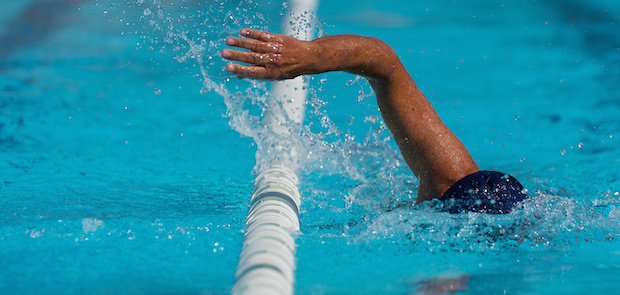
Triathlon is a very welcoming sport and community, but that doesn’t mean you can do whatever you want. Just as there are rules of the road when it comes to cycling and running, there is an etiquette that comes along with swimming — particularly when you’re in the pool. Even if you’ve been swimming for a while, it’s worth taking a peek at these unwritten rules to see if you’re being a good lane partner to everyone else whenever you jump into the water for your swim training sessions.
Pick the Right Lane
The first thing you should do when you get onto the pool deck is check the various lanes to see who is swimming where. An eye-test is a great way to gauge where you should hop in, but sometimes there won’t be enough people swimming for you to know which lanes are slowest and which are the fast ones. Most pools will have signs at the end of each lane to let you know if it’s slow, medium or fast. If there are no signs, you should check in with the lifeguard to see which lane is which.
There are a few things to think about when you’re picking your lane. Firstly, leave your ego at the door. There is no shame in swimming in the slow lane. Everyone else in the pool will appreciate you being honest with yourself and picking correctly instead of seeing you jump into the medium or fast lanes only to get in their way.
Secondly, think about your workout plan for the day. If you have a lot of shorter, fast repeats, it may make sense to go in the faster lanes. However, if you plan to do a lot of kicking or other, slower strokes like breast and back, going in the medium or slow lanes could be the move.
Thirdly, trust that aforementioned eye-test. If you’re swimming at a new pool, the lane speeds can be different from what you’re used to. The paces can even vary in the same pool from day to day, depending on who shows up. If there are other swimmers in the pool when you arrive, take a look and think about which group you’ll slot in with best.
Finally, remember that you can (and should) change lanes if you realize you picked the wrong one. If you find that you’re slowing the other swimmers down, move over to a slower lane. If you’re the one getting slowed down, move up to the next-fastest option.
Always Circle
Those signs denoting the lane speeds may also show the direction you’re supposed to swim (whether that’s up along the lane rope and then back down the middle or the other way around). Once more, if this information isn’t presented to you, check in with the lifeguard to see what they recommend.
While it is nice to not swim in a circle, it’s a good idea to do so even if you’re the only person in your lane. That way, if other people join, they won’t have to awkwardly stop your swim to let you know to start looping.
Stop in the Corner
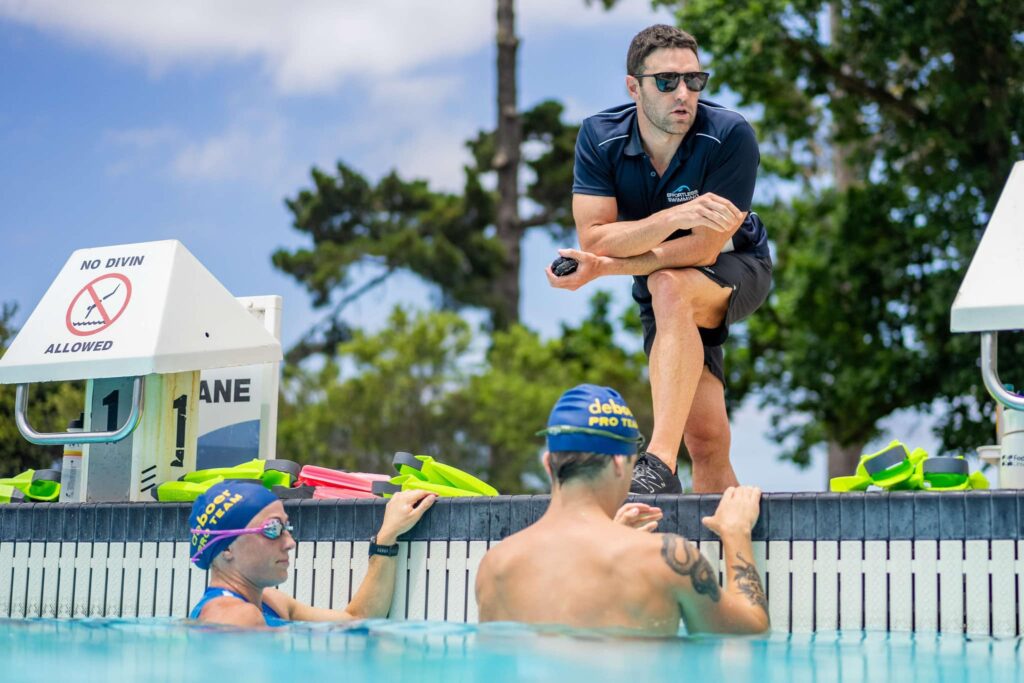
If you’re sharing a lane, make sure to always move to one of its corners whenever you stop to rest at the wall. There are few things more annoying when lane swimming than to get to the wall, look up to flip-turn and find out that there is a body standing in your way. Don’t be the person who blocks everyone else’s path to a good push-off.
Don’t Stop Mid-Pool
Even if you pick the right lane, there will come a time when you’re slower than your lane partner and they’re lapping you. For many new swimmers in this position, the impulse is to pull up and tread water — even mid-lap — when they feel the other person is trailing them nearby.
Don’t do this. You may think this is the best option and that it will make for a quicker pass, but the odds are that it will take longer and disrupt the other swimmer’s flow even more than if you simply carried forward before stopping at the wall. No one in the pool is expecting you to come to a full stop in the middle of a lap, so if you do, it will at the very least create confusion (and at worst cause a collision).
Instead, finish your length, wait at the wall (again, making sure to get over to the side), let the other swimmer pass and then continue your workout behind them. Either that or the other swimmer will take the opportunity to pass you mid-pool, in which case simply stick close to the lane rope and let them go.
Make Adjustments
If you’re fastest in the pool, congrats, but that doesn’t mean you should get special treatment. The other swimmers in your lane will hopefully follow the above tip if you’re repeatedly trying to pass them, but if they don’t, you may have to adjust your workout.
Try to leave the wall and start your reps in a calculated manner so you give yourself as much room as possible before you may catch them. For example, if you’re swimming 400-metre repeats and sharing a lane with one other person who is significantly slower than you, try to time your push-off so it’s only a few seconds before they reach the same wall. That way, you’ll have a full lap to make up before catching up to them.
If you’re in a lane with more people, this can be harder to coordinate. You can try your best to figure out the ideal time to push off, but you may have to accept that you may have to adjust your workouts on the busiest days in the pool. Sometimes even 100-metre repeats are too long and can lead to you catching up to slower lane partners. If you find that to be the case, switching to 25s or 50s can give you the space to complete a set without hindrance.
No Diving
As a triathlete, you probably don’t practice your dive too much. However, maybe you’re training for a masters swim race this winter and want to perfect your entry into the water. Well, public lane swim hours are not the time for this practice. If you have a lane to yourself, that’s fine (as long as the lifeguard is OK with it), but it’s not safe to be diving into a shared lane.
Maybe you can discuss it with your lane partner(s), but even if they say to go for it, you need to be extremely careful to be aware of your surroundings with each dive. Do not dive unless the other swimmers in the lane are past halfway to the other wall — and ideally if they’re going the same direction you’re diving.

It’s great that you want to become a more effective swimmer—and a good dive is a big part of that—but when sharing the lane, pushing off from the wall is the best and safest way to start each lap.
Thoughts on Other Strokes
If you plan on performing other strokes during your workout, there are a few things to consider. As already mentioned, keep the slower speed of breaststroke and backstroke in mind when picking your lane.
If you’re doing backstroke, be sure to stay as straight as possible. There is almost always something for you to look at on the ceiling that can work as a guide from wall to wall, whether that’s an actual line painted for that exact purpose, a pipe, tiles or anything else.
If there is nothing to follow (maybe it’s a truly bare ceiling or perhaps you’re swimming in an outdoor pool), then you’ll need to stay close to the lane rope to ensure you’re not drifting into the path of other swimmers. Give the rope a tap with each stroke so you know you haven’t moved into the centre.
When it comes to butterfly, you shouldn’t do it when sharing a lane. As with the dives, you can ask your lane partner if they’re OK with it, but it’s probably best to leave it for workouts when you’re swimming alone. Butterfly as a stroke that takes up most of the lane, and just like with backstroke, you don’t want to be moving into other people’s ways.






Just a thought on the “always” circle guide you put out there, it’s actually the opposite I have found. I have swam in many, many lap lane pools over the past 40 years, and it is almost “always” split the lane with another, up until the time a 3rd person comes to the lane. And I have had that happen exactly no times in the past 30 years. I have found that some people will actually wait on deck for a 1/2 lane to open, because they do not want to circle. The problem with circling is that the varied abilities, and the just different workouts people do. I can swim next to someone I lap every 100 easily, circling would just be a night mare, for both of us. I’m sure there are some out there that end up in crowded lap lanes, and of course circling is they only way to go, but it should not the be the go to from the first time you stroke in the lane by yourself…
I always default to circling. Yes, even with people much slower (or faster, for that matter, as sometimes the college kids will come dust my ass). One, reduces the likelihood of clapping hands, but two, ever since my big bike wreck, it limits the number of chances of a head on collision off the wall.
In general, it’s meant I’m the lane people either avoid or people flock to when it’s busy (those that hate circle swimming and those comfortable with it).