
The New Stages SB200 is a Burly, Bulletproof Beast
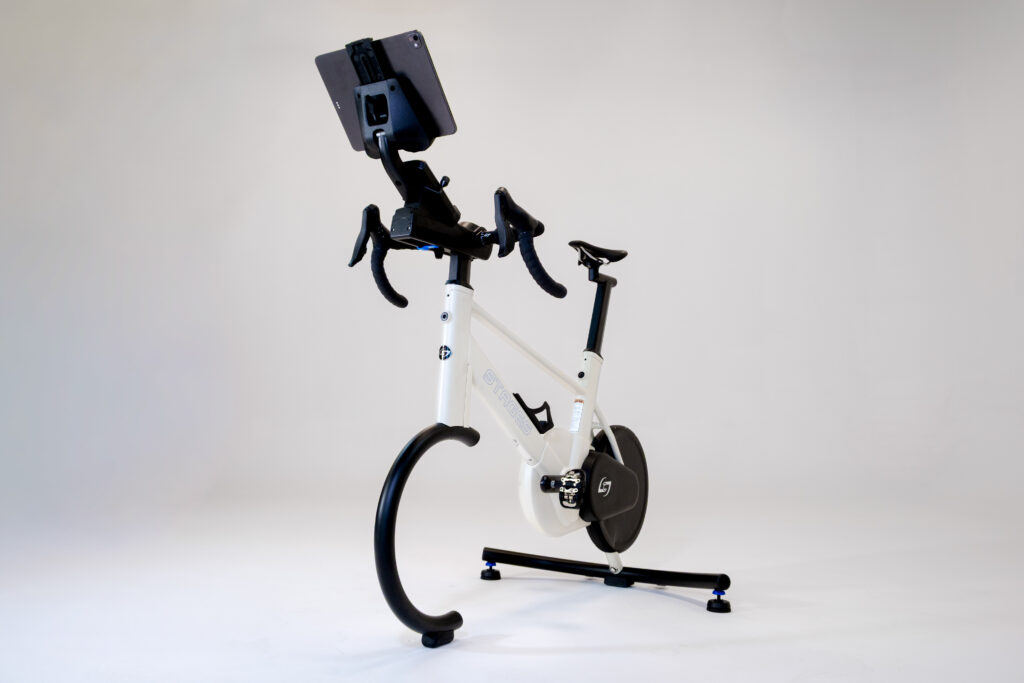
Over the past six years I’ve slowly but surely absorbed the job title of Slowtwitch’s unofficial Head of Indoor Riding, inheriting the fiefdom that the one and only Slowman built. As such, I’ve put tens of thousands of miles on a few different trainers and bikes. I’ve done three different IRONMAN builds riding indoors nearly exclusively. That also means that I’ve been very hard on those trainers and bikes over that time, too. I’ve broken one trainer, rusted through four chains, and broken two horizontal dropouts.
In other words, if an indoor cycling product is going to have a problem, I’m going to find it.
And so it’s in that context that we wound up having the latest generation of Stages indoor bike, the new SB200, arrive on my doorstep. It’s a bike that announces itself upon arrival with a thud, as we’re talking about a package that weighs in at over 100 pounds. But that’s also just about the single loudest noise that this bike will make in the course of ownership with you. As it’s an impressive piece of machinery that will make nearly no noise the rest of the time you own it.
What’s New on the SB200
Perhaps the biggest change between the SB200 and the prior SB20 is one you would not expect given the title of this article and some other references soon to come: it went on a serious diet. We’re talking north of 50 pounds lighter between versions. The new bike weighs in, according to Stages, at just over 70 pounds in total. That’s still…not light. But, if you really think about it, you’re talking about a package that is basically a bike and a pretty heavy duty training unit. In that case, it weighs probably exactly what it should.
The other big focus was on ride quality. The prior bike used a 55 pound flywheel to generate inertia. That’s effective, but it also brings mass and doesn’t necessarily do the best job of simulating riding outside — which, well, why else are we doing all this training inside?
To that end, Stages developed a new two-stage drive system, which features a first stage synchronous belt, and then a second stage Poly-V. That drive system, paired with an electromagnetic brake that provides 400 watts at 40rpm and more than 1,500 watts at 120 rpm (and a total maximum wattage of 2,500 watts), makes for what Stages is calling an ultra-realistic ride. In fact, Vice President of Product Development Pat Warner calls the SB200 “an outdoor bike simulator.” Accuracy is claimed to be within 1%. The bike also performs an auto reset to zero when coasting. Spindowns can be performed within the Stages app, but the appear to be superfluous (at least, in my experience).
All of that comes in a package at $2,399. That has it comfortably split the difference between the Wahoo KICKR Bike Shift and Pro models, and well undercuts the Tacx Neo Bike Plus.
Unboxing and Building the SB200
As mentioned at the top, this bike arrives in a package that weighs an eye-watering 102 pounds. I am very glad I intercepted my UPS driver as he was bringing this up to my door, as a.) he was struggling with it and b.) the bike belongs in our ground-floor coverage anyways.
At any rate, this is how it shows up:
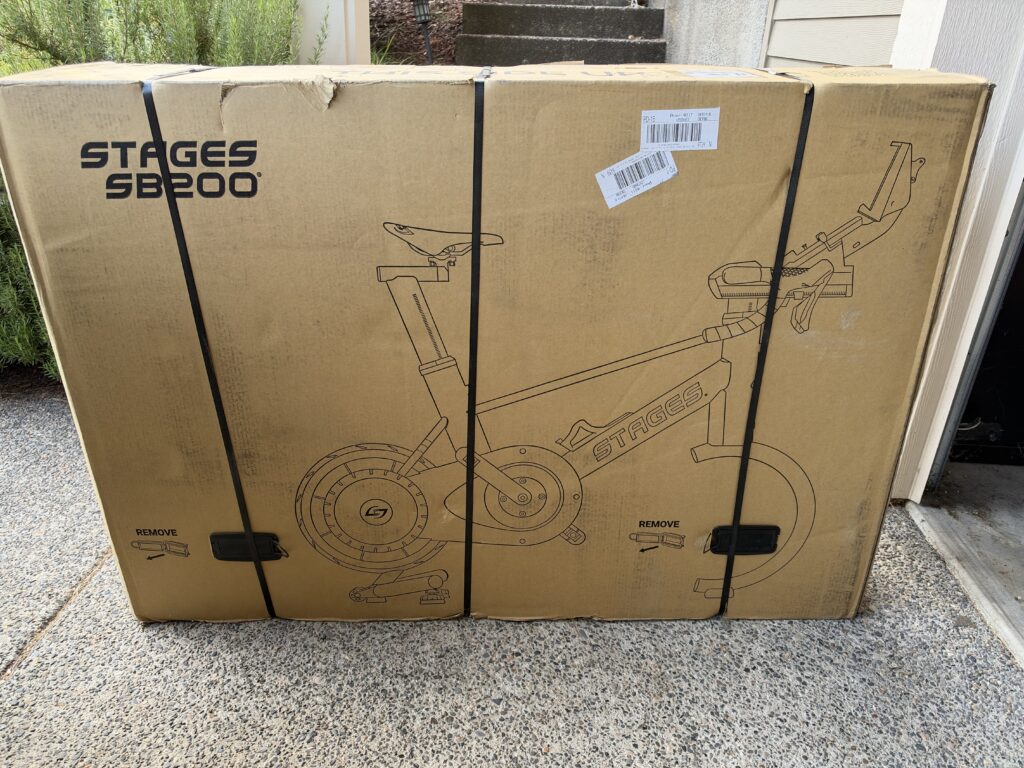
Admission time: when I went to move this into the garage, I had made the assumption that I was moving something with the approximate weight of a bike. So I had a bit of a surprise when I then tried to actually, you know, move the thing.
Anyways, once you’ve got it inside, there’s a handy QR code right on top of the box to send you to an assembly video.
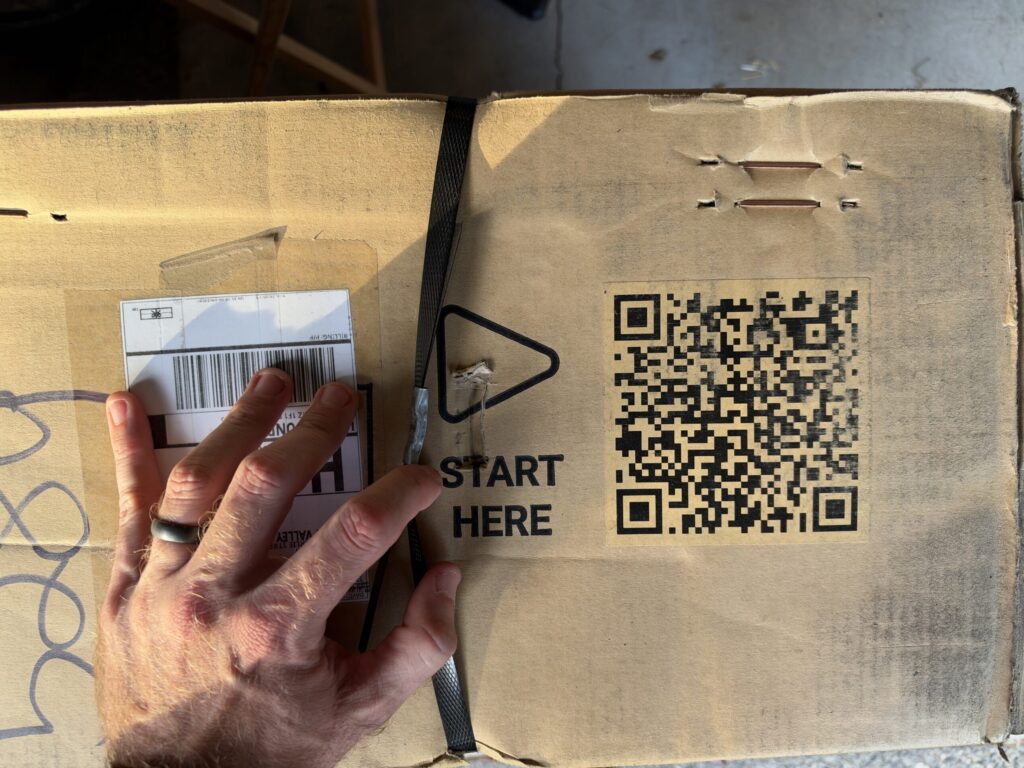
Watching the video itself is highly recommended, especially as unpacking the bike has specific instructions. Messing with the box without watching the video will make your life far more difficult.
For instance, if you follow those instructions and pop off the straps and the four plastic pieces, and then lift the top cardboard cover off, you reveal a very smartly packaged bike and all the accessories.
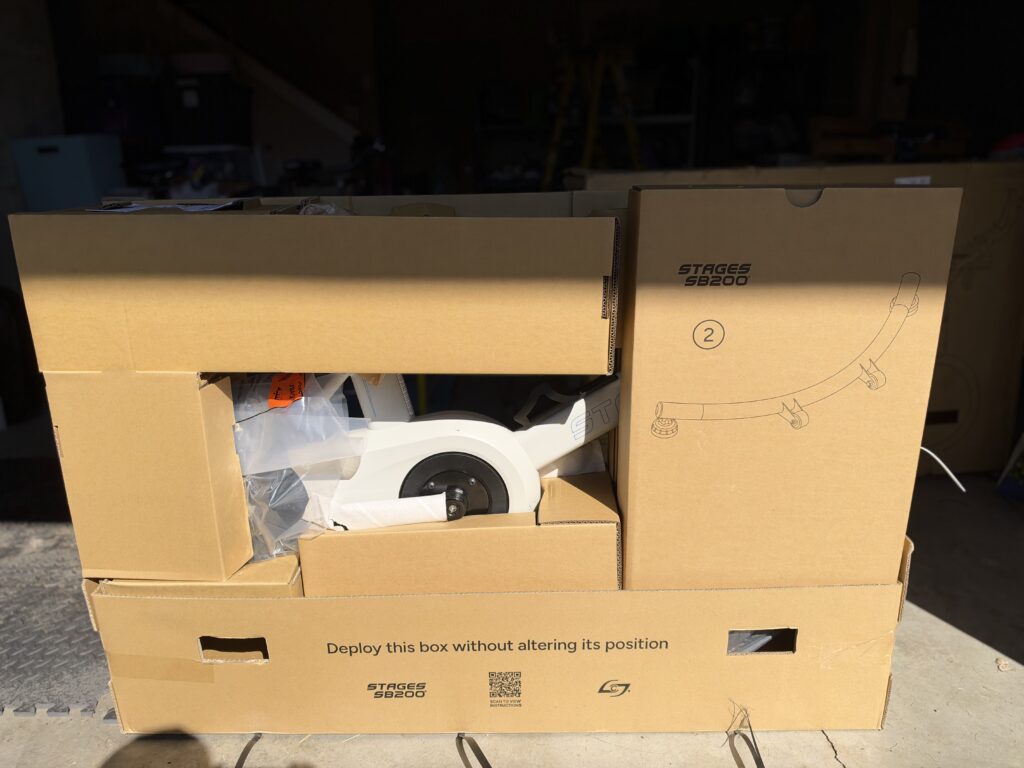
On top of that box will get you your instruction manual – as well as the key box that holds most of the assembly pieces in it.
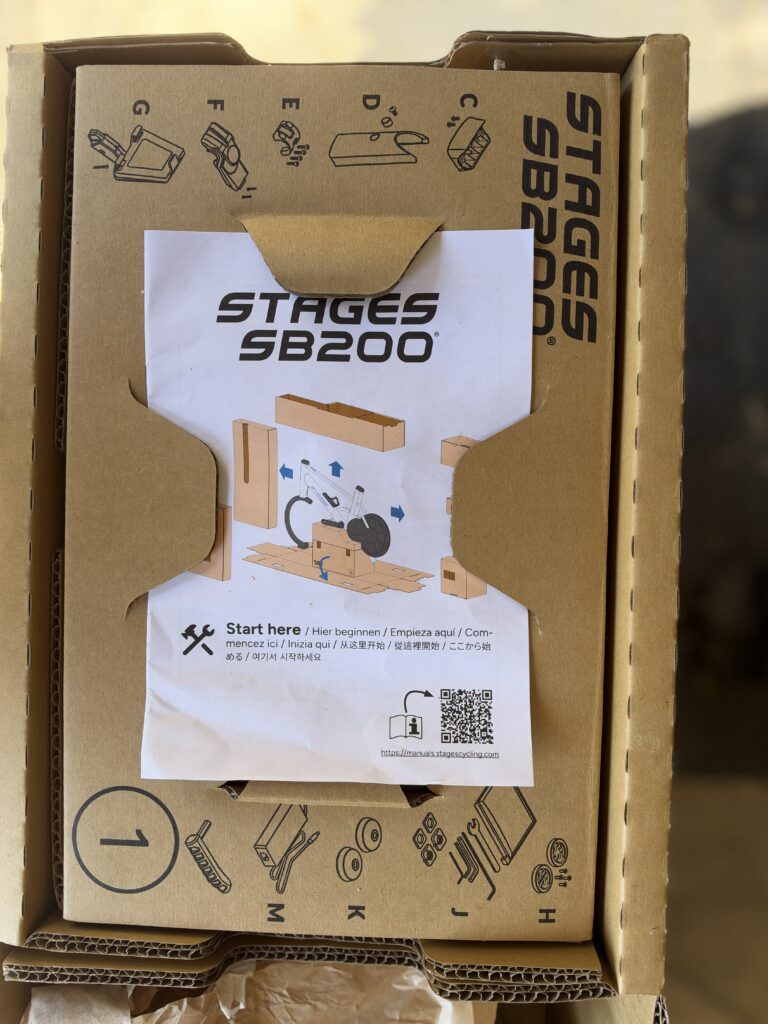
Reading through the instruction manual, and you’ll discover that the bike ships on what serves as its own assembly stand as you get the bike and the stand mated to one another. So you remove all of these assorted cardboard pieces until you’re left with this stand.
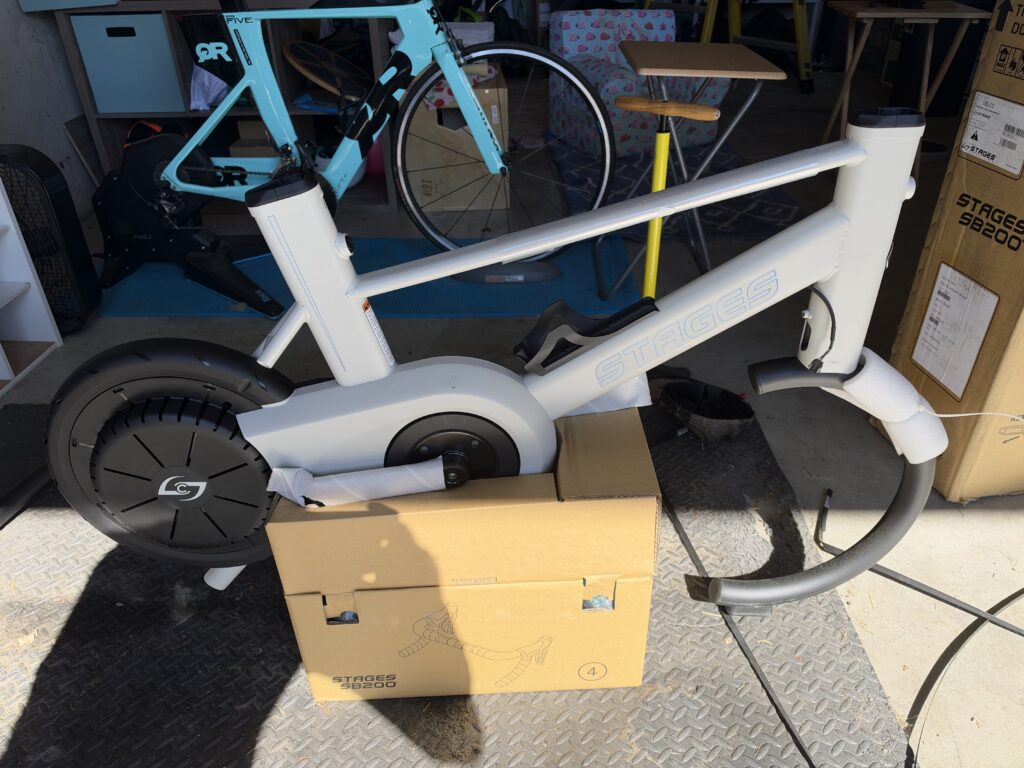
From here it’s time to unpack and build. Roughly in order:
- You attach the rear stabilizer bar and get them mated.
- You’ll get the electronics out of the head tube routed and connected, and put the cover on.
- Install the “steer” tube, which also has the mounting plate for the handlebars.
- Connect the handlebar electronics, then attach the handlebars.
- Install the seat post and get it roughly into position.
- Choose your appropriate crank length and install pedals.
- Ensure everything is tidied up and bolted down.
After those steps, you’re left with a bike that’s pretty much ready to ride.
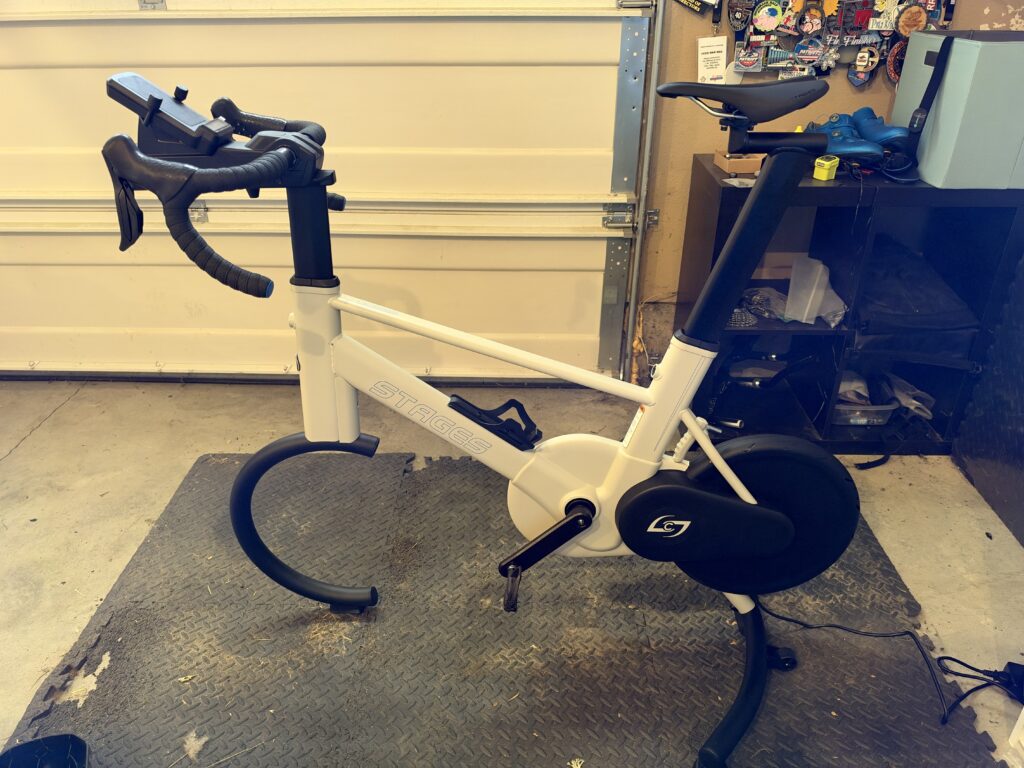
Total assembly time, including stopping to take photos, was just over an hour.
Once the bike is built, you then need to get it paired up in Stages app. The app will control most of the bike behavior. It can also serve as the entirety of your training existence, if you so choose to. It’ll allow you to have controlled workouts or otherwise capture data right there. If you’re the kind of athlete that used to love just staring at Sufferfest data or the old CompuTrainer squiggly lines, the app will be more than sufficient for you.
But, for those of us who are embedded with a virtual training platform of choice, the SB200 easily plugs into those, too. And it’s in the Stages app where you’ll dictate what gearing choices you’ll run or how aggressively the bike will respond to whatever gradient signals get sent from the training platform (note: this is different than the training platform’s own resistance settings).
You create a profile for each platform, or shifting profile, you might be after. In this case, I opted for what I deem to be “the standard:” Shimano shifting profiles, Zwift connection.
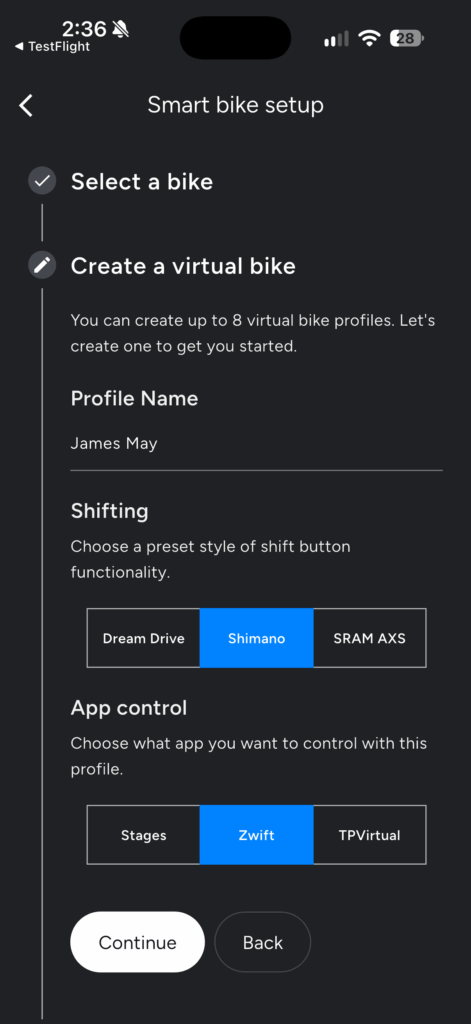
Once you’ve picked these, the next screen lets you decide what gear ratios to run, as well as whether you wish to customize the functionality of the handlebar buttons. I opted for a pretty default Shimano option offered on a fair number of bikes these days: a mid-compact 52/36 chainring paired with an 11-34 12 speed cassette.
If you choose Shimano, for instance, out of the box the shifters work exactly like that of any Di2 transmission, with their button placements in almost the exact same place. You can choose to modify that (though I don’t know why you would). But then you can choose to have the handlebar buttons do different things; e.g., move a button you would press for a power-up. For my own purposes, the only handlebar buttons I cared about were the L and R ones for steering, as the SB200 would be my first experience with a steering compatible bike.
Both the front-end and the seat tube have indicated measurements on them to make dialing in fit fast. It took me all of about two minutes to quickly get my saddle height and my stack and reach numbers squared away. It’s also nice that these adjustments are performed with the provided 8mm key that conveniently stores on the rear of the frame. That being said, there are many different bolt sizes used throughout the bike; these are provided in a small bag by Stages, but I kept my Park Tool set handy throughout assembly.
Riding the SB200: What I Love, and the One Tiny Gremlin
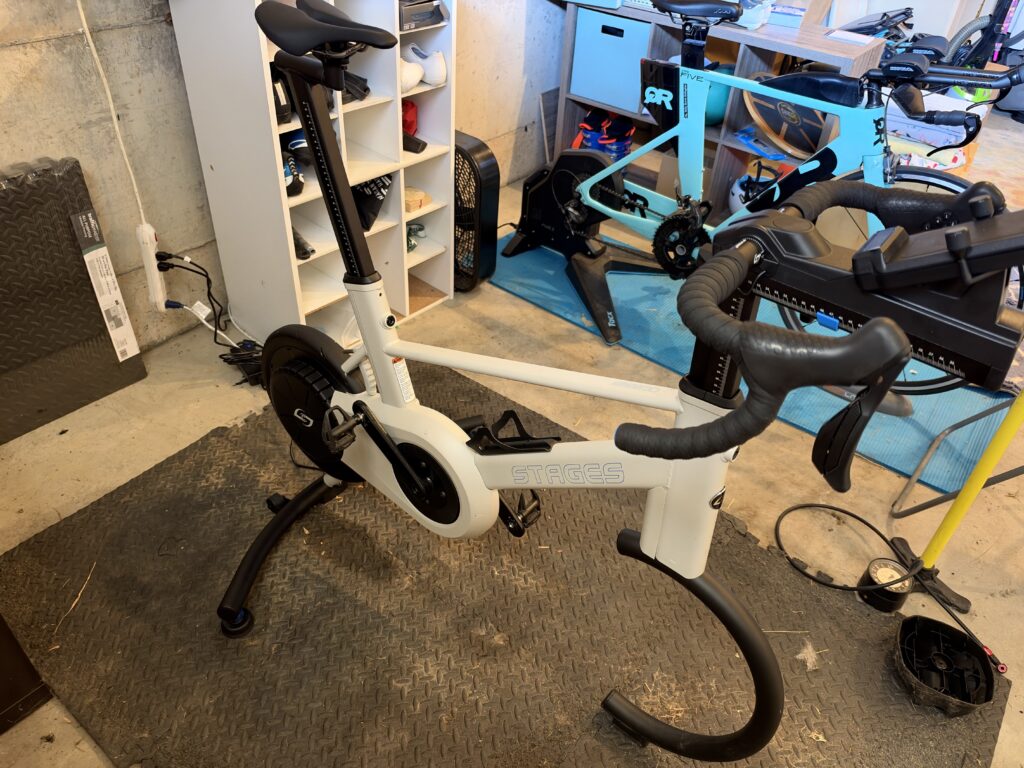
I’ve gotten on board the SB200 a few times since I got it put together. That includes quite literally putting myself up on the clock to try and get into a race that was happening roughly 90 minutes after I started assembling the bike. So I was glad that I was able to get the build done and new app all paired up well within time for me to get some Gatorade, get changed, and get back downstairs for a proper warm-up on the bike.
Pairing the bike up with either Zwift or TrainingPeaks Premium (the two platforms that I have) was as simple as turning them on and telling the apps to pair with the new bike instead of searching for my long-standing Wahoo KICKR. It worked flawlessly to connect to my aging MacBook Air and get into my events.
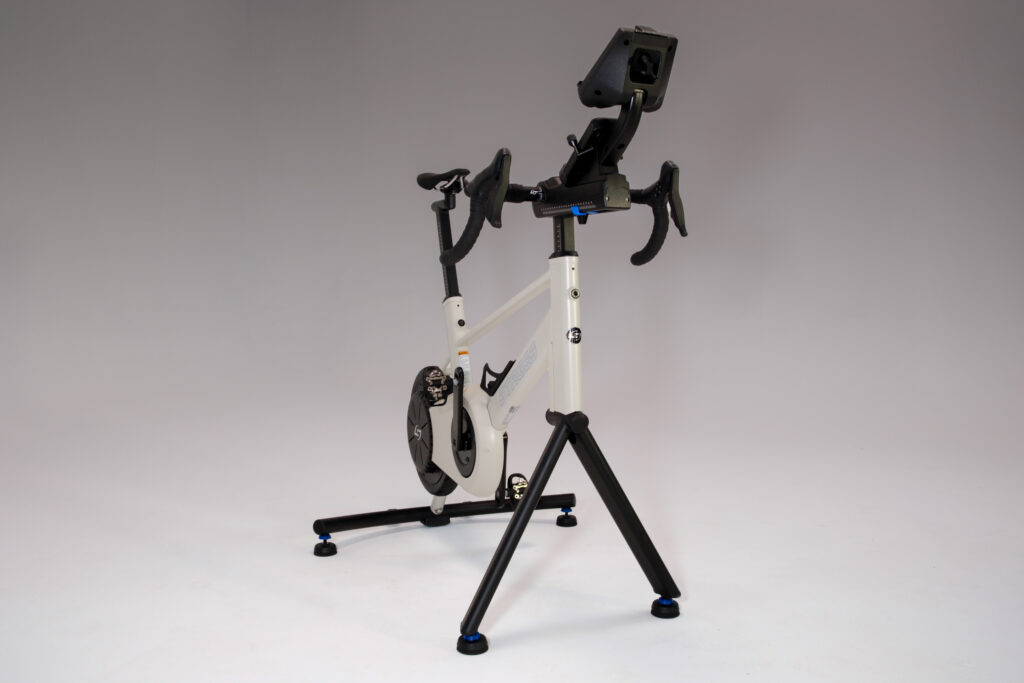
There are two things that are immediately noticeable when riding the SB200. First, it is incredibly sturdy. The wide rear stabilizer paired with the feet manage to both give you the feel of a “real” bike underneath you while feeling plenty stable enough for those end-of-race sprints that leave you in a puddle of sweat. To that end, they nailed the outdoor simulation.
From a drivetrain perspective, it is slightly more artificial. It’s almost too smooth. Because there’s no chain to drive and no real cogs to burn through, there’s the lack of tactile experience that comes with it. It’s not dissimilar from, say, driving a proper manual transmission versus a dual-clutch gearbox that you can paddle shift. They might do the same thing on paper, but there’s a connective tissue element that is missing.
There are positives to that experience, though. It is comically silent. There’s none of that typical trainer noise while you’re riding along. For people who might use Discord or similar voice apps while riding along, this is your ticket to a far quieter experience. And that two stage drive system works well. It did a much better job, in my opinion, of simulating how terrain will impact pedal feel with more immediacy when riding routes in either Zwift or TP Premium. The bike rode extremely well on a variety of terrain in the virtual platforms.
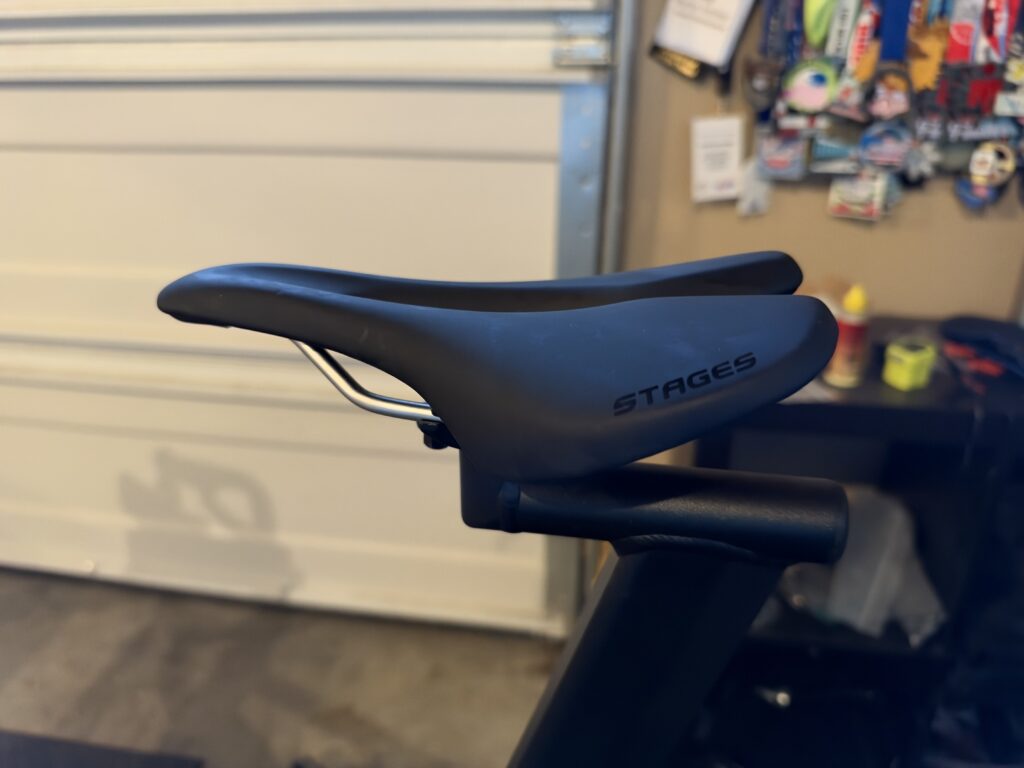
Stages also nailed the saddle that they ship with this bike. The SB200 comes with an ergonomically shaped seat that looks awfully close to some in-line Giant saddle product. But it is tremendously comfortable. This is a saddle that I might need to migrate to some other bikes of mine and boot my long-time favorite Fizik to the curb. It’s that good.
Steering works just about as well as I expected it to. It’s very much a video game in that you can button mash to make your avatar move in the direction you intend. You can also feather it to make your avatar behave more realistically. I’ll need to spend some more time on it with routes where it matters more, but in initial testing, I’d say steering is really just more a minor gamesmanship action (e.g., trying to avoid giving someone drafting) than it is adding realism to the experience.
There are a couple of things that, in an ideal world, I would change but aren’t deal breakers. First, I’d love some options in handlebar width. The bars that show up are a one size fits most 40cm wide. I’d love to have a narrower and a wider option on the table, but that’s adding a lot of complexity to a bike that has to be packaged just right to get to the customer door. The bar tape is also somewhat industrial grade and not very grippy; I am sure it is there for longevity purposes as opposed to providing the right tackiness. But, again, that’s something that I could change tomorrow.
And then there’s that little gremlin I mentioned: because of my choice of rubberized flooring, and the front “wheel” construction, there’s a squeak. I probably would never notice it if I had a different bike and trainer set-up. But because the SB200 is so damned quiet, the squeak is by far the loudest thing I hear while riding besides me praying for a swift and merciful death while blowing up. It’s like hearing a disc wheel sound echo in your aero helmet for 112 miles; at some point, it will drive you insane.
I think if I had the optional more rigid fork, this wouldn’t be an issue. And honestly, a squeak is something I can live with.
Concluding Thoughts
I, admittedly, had never ridden one of these bikes before. I really didn’t understand their purpose in the market, given how much we spend on other bikes that you can take, well, off the trainer and outdoors.
No more. I get this thing completely now.
It’s not that it is radically different than riding your normal bike indoors. It’s not. And that’s the point. You’re protecting your race bikes from the gallons of sweat and sports drink that only seem to wind up all over bikes when you ride them inside. It means not worrying about rusted out bottom brackets or snapping chains or corroded headsets. Honestly, if I were shopping for bikes these days and had a budget in mind, I’d buy one of these and then look at either a lower-spec new bike or a quality used one.
I’ll look forward to putting a lot more mileage on this over the coming weeks to see just how well it stands up.
Stages SB200 Smart Bike
$2,399 USD
Available: Now
Studio Product Images Courtesy of Stages Cycling

Start the discussion at forum.slowtwitch.com