
Retail Pricing Practices in U.S. Might be Forced to Change Due to California Lawsuits

We, as athletes, all love a good deal. A coupon code here, a team membership there. Something, anything, that might help make our sport slightly more accessible. Who doesn’t like saving a little bit of cash now and then?
There’s arguably no greater tool in a retailer’s toolbox than a sale. Anytime that four letter word pops up, you usually will see a spike in web or foot traffic. The question, of course, is where to draw the line on prices with those sales. Too low, and you are practically giving product away for what you might have paid for it. Not enough of a discount and you don’t generate the sales activity you were looking for. And it’s even tougher when you’re talking e-commerce.
And now, you can add an extra element on top of that decision-making: the potential for lawsuits resulting from sales.
Retail pricing practices are undergoing new scrutiny following the filing of two lawsuits last month that allege deceptive pricing practices by two big brand names — Nike and Lululemon. The suits allege that these brands are using what California law deems to be artificially inflated original pricing to show on their respective online discounted items. The logic, then, is that these prices are deceiving consumers into thinking they are getting a deal.
The Filings in Question
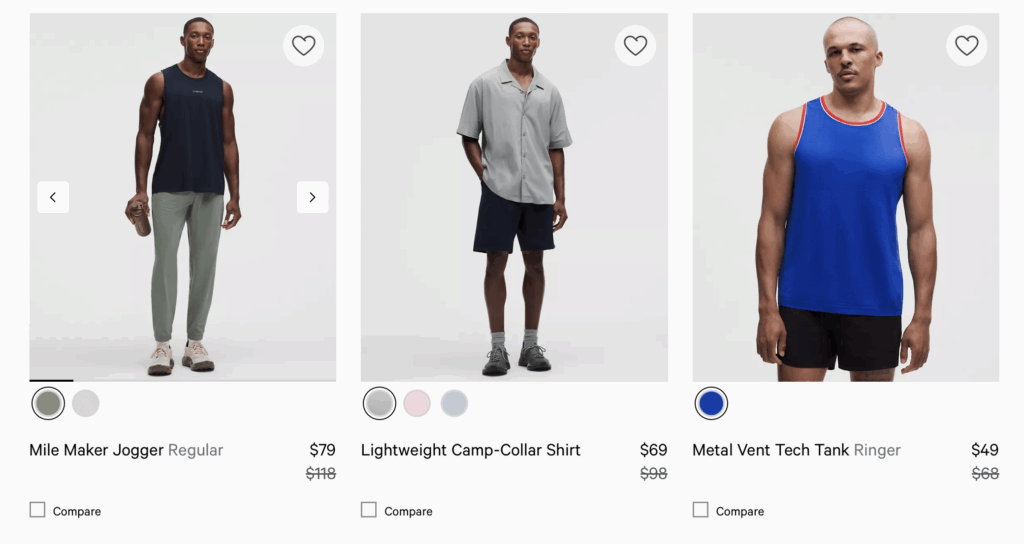
California resident Annette Cody filed suit against Lululemon on July 20th, alleging that the company used “fictitious regular prices” with “corresponding phantom discounts” to deceive consumers.
Cody’s suit states that she purchased a pair of Lululemon’s Wunder Train high-rise tights in April 2026 for $59, listed as being on sale from $98. Her claim was that Lululemon had not sold the Wunder Train tight for $98 since October 2025.
According to Cody’s filings, “These pricing and advertising practices reflecting high-pressure fake sales are patently deceptive. They are intended to mislead customers into believing they are getting a bargain by buying products from defendant on sale and at a substantial and deep discount.”
Similarly, fellow California resident Corinne Pearson filed suit against Nike in Los Angeles federal court on July 21st. In her suit, Pearson accused Nike of using “phantom” discounts on its website and mobile app. The suit claims Nike uses these inflated reference prices alongside the “sale” price, tricking consumers into believing they are saving money when, in fact, they are paying the everyday, regular price.
Pearson’s suit claims that she purchased a pair of retro Nike Air Max 2017 with a published original price of $190. She bought the shoes at what she believed, based on Nike’s website listing, to be a 39% discount on the original price. After she made the purchase, the suit alleges, Pearson noticed that the shoe was continuously marked down for a period of six months, from early September 2025 to the middle of March.
That, according to the suits, is a violation of California’s so-called “False Advertising Law,” which the suits allege requires retailers to use the “true market price” of an item in the last 90 days as the “before” price in a sale.
In an interesting wrinkle, both plaintiffs are represented by the same firm: Pacific Trial Attorneys. This is not uncommon with certain types of claims, where a firm makes multiple similar filings against companies. For example, Pacific Trial Attorneys has done this with certain ADA claims against websites in the past. It’s also not dissimilar from the recent filings against Puma by some of their former elite runners who are alleging their injuries were caused by Puma’s shoes; they are represented by the same counsel.
What Does the Actually Law Say?
The “False Advertising Law” is really just shorthand for the lengthy name under California’s Business and Professions Code, Division 7, Part 3, Chapter 1 that handles how businesses may advertise to consumers.
The specific language that is in question here can be found in § 17501, which reads as follows (emphasis added):
For the purpose of this article the worth or value of any thing advertised is the prevailing market price, wholesale if the offer is at wholesale, retail if the offer is at retail, at the time of publication of such advertisement in the locality wherein the advertisement is published.
No price shall be advertised as a former price of any advertised thing, unless the alleged former price was the prevailing market price as above defined within three months next immediately preceding the publication of the advertisement or unless the date when the alleged former price did prevail is clearly, exactly and conspicuously stated in the advertisement.
In other words — in order to use a “before” price in an advertisement, California law requires retailers to use a price that was actually charged for the item in the last 90 days, or to clearly state the last time they charged full price for that particular item.
The suits allege that neither retailer performed this action, instead showing the original (or manufacturer’s suggested retail price / MSRP) of the item, despite the fact that their products had not sold for that MSRP over the previous three months.
Is There Actual Harm Here?
Under the California Code, there are three types of actions that can take place. Severe violations of the Chapter may result in misdemeanor charges. California may also fine companies who are in violation at a rate of $2,500 per instance. And then, of course, there’s the civil causes of action in play here.
Both suits seek financial restitution, monetary damages, and the respective courts to “halt the use of misleading, inflated reference prices.”
All things considered, though, it is difficult to see the actual harm that either consumer suffered here. Cody’s Lululemon purchase was effectively 40% off MSRP. That specific tight remains on the Lululemon website, with prices ranging from $49 – $79 based on color and size, and is listed as Final Sale (as colors are phased out seasonally). The Air Max 2017 in question from Pearson’s suit can’t be found, but there are plenty of Nike shoes on sale, with prices clearly discounted from the original listed price of the item.
There’s plenty of room for interpretation statutorily, too: for instance, the “prevailing market price” is not just the one that the individual retailer used in their listing; it’s what it actually sold for in the market. So if all other retailers, for example, were still listing a shoe at $100 but I sold it for $75 for the last four months, that prevailing market price (and therefore, the legal strike-through pricing) is $100.
It is hard to fathom an actual harm to the consumer here, given that the consumer is making a purchase near to what wholesale pricing for those respective items would be.
What Might Change If These Suits Are Successful
Though both filings are the kinds of suits that are quietly settled, they may also draw the attention of California lawmakers. Remember, there are three causes of action that can be brought under the California Code here, and two of them involve the state itself getting involved.
Assuming that the suits themselves are successful in some manner (including, for instance, a settlement agreement), it could eventual compel online retailers doing business in California to do one of three things.
The first, in my opinion, would actually be the most harmful to consumers. Retailers could simply end sales on items for a day to reset the clock on promotions, and then re-list those as newly reduced prices. I would argue that’s far more deceptive towards consumers than the existing behavior, but it satisfies the letter of the law versus the intent of it.
The second course of action again satisfies the letter of the law, but it instead would be punitive towards both consumers and retailers. In this scenario, retailers would be forced to use that actual average price listed for the item over the last 90 days to satisfy the “prevailing market price” provision. That raises a whole series of other red flags — like minimum advertised pricing provisions between retailers and manufacturers, or actually trying to keep track of these average price provisions.
The third and most simple solution is certainly not the most elegant, but it’d be the lever I would pull if I had to. On products that are on sale, I’d add a couple of product variables to show the date and price that the item was originally listed, and the date that a sale price on that item was first created. It wouldn’t be pretty, and I’d argue that there’s a chance that’s even more confusing for consumers than the present state. But it might be the path forward.








Both of those people should go to a hard labor fire camp for their misuse of our legal system.
They should be sent to work in a Goodwill or a Thrift Store
“Those shoes you paid $100 for are $15 here; a little worn, but not enough to notice”
Honestly, if I like the Evo SL, a pair I got on sale. Ross has been getting a ton of them. And you can get them brand new for like $35. They also have track spikes. Alphafly 3s. Unfortunately haven’t found anything in my size 8 yet. It’s almost like bourbon hunting.
I usually get my shoes at the asics store at the nearby outlet mall. They might be last year’s model (or older), or discontinued (so you can’t find part for them LOL), or some weird colorway, but that doesn’t bother me at all
Speaking of colorways, I once found & bought a pair of women’s size 10, for $30 or something (down from $120); so what if they were purple uppers with neon green highlights
I hope in terms of race pricing, it means the price you see up front is the price you pay… No active fees, no USAT membership addon, etc. after filling out registration. If you have USAT membership, then you can use the member ID as discount code or something. I have seen some race websites adjust to this.
The California law seems a bit complicated to implement. For a few years now the EU has been requiring that a retailer advertising a sale display the lowest price asked over the previous 30 days as an additional reference. It’s enough and it enforces transparency. and yes, you do see products on sale at €70 off €100 where the lowest 30-day price is €70.
It’s actually the law firms that are behind this kind of stuff. Everything is much more expensive to account for it, home owners insurance, medical insurance, product liability insurance, rent, etc. etc.
The US tort and litigations system is over $500 billion a year. Just so we’re on the same page that’s $1.3 billion spent every SINGLE DAY, EVERY SINGLE YEAR, --FOREVER-- at an annually increasing amount.
The California law pretty clearly wasn’t designed to handle the Internet, AKA the land of constant sales.
Like, for instance, Xterra wetsuits. They are never at full retail price (edit – they now say that their comparison price is to “represent the price at which the same or similar merchandise has been offered for sale by other retailers, including triathlon shops, specialty stores and online stores selling other triathlon wetsuits from other brands.”) But most of us know that – we just see what is perceived to be a “good enough” deal.