
A Peptide Debate is Rocking Ultra-Running. Is Triathlon Next?
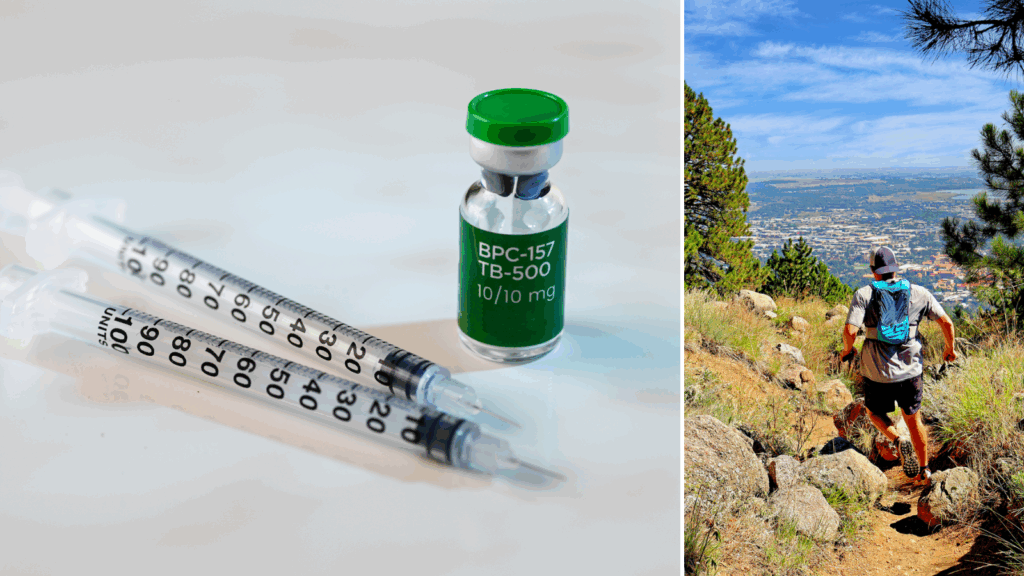
Last week, the ultra-running world found itself at the center of the anti-doping universe with the revelation that a record-breaking runner admitted to the use of a banned substance while on a podcast. It has ignited a fierce debate online as to what substances should actually appear on the WADA Prohibited List as well as who that list should actually apply to. Naturally, there’s also plenty of overlap with triathlon and other endurance sports.
Peptide BPC-157 and the WADA Prohibited List
At the center of the ultra-running controversy is a peptide known as BPC-157. BPC-157 is a synthetic pentadecapeptide originally isolated from gastric juice — as in, the stuff from inside your stomach lining. And that’s the most concrete thing we know with certainty about BPC-157; there is extremely little known about the peptide, its benefits, and side effects. As in, as of a 2025 systemic review of the compound had identified that there has been precisely one human study, consisting of all of 12 people, on it. The 35 other studies that had been performed on BPC-157 had all been performed on animals.
The extremely limited information that can be gleaned from those studies is that BPC-157 results in “improved outcomes in muscle, tendon, ligament, and bone injury models in animals.” According to Dr. Christopher Raffo of Maryland Orthopedic Specialists, it appears that there are multiple pathways in which BPC-157 works in these situations:
- Promoting new blood vessel growth;
- Boosting collagen production;
- Reducing inflammation; and
- Supporting muscle and nerve function.
Raffo writes that, “These combined effects are particularly intriguing for orthopedics because many musculoskeletal injuries (Achilles tendon ruptures, rotator cuff tears, chronic tendinopathies) occur in precisely those areas where blood flow is limited and healing is frustratingly slow.”
However, to be clear, BPC-157 is not FDA approved. It can be bought online “for research purposes only” (and no, I am not giving you a link to it). That puts it squarely in a regulatory gray area whereby it can be procured legally, but there is no standardization, potential for contamination, and unknown long-term effects.
As such, the WADA Code prohibits BPC-157 as a non-approved substance under class S-0. That means that its usage is prohibited at all times. The Prohibited List states:
“Any pharmacological substance which is not addressed by any of the subsequent sections of the List and with no current approval by any governmental regulatory health authority for human therapeutic use (e.g. drugs under pre-clinical or clinical development or discontinued, designer drugs, substances approved only for veterinary use) is prohibited at all times.”
So, to summarize: BPC-157 may be beneficial in healing orthopedic injuries, but it is not approved for FDA usage and therefore banned under the WADA Code.
The Ultra-Runners at the Center of the Debate
BPC-157 usage in ultra-running stormed into the spotlight last week with the public revelation by Mike McKnight on Cam Hanes podcast that he had used the peptide to avoid back surgery over the winter. McKnight recently set a new course record at the Arizona Monster 300 this spring, and finished 13th at Cocodona 250 in May. He’d previously won and finished second at Cocodona 250 in 2022 and 2023. His most successful season of racing was back in 2019, where he won 3 of 4 ultras he entered into.
McKnight said in a post on Instagram that he had suffered a herniated disc in his back while slipping on laundry detergent just after Cocodona 250 last year. He had scheduled surgery on the disc when, he says, friends recommended the peptide to him. McKnight says, “A nurse came to my house, taught me about the benefits of it, and recommended how much to take each day. I followed her advice, and saw major improvements by the end of the first week. By the time my surgery date had arrived, I felt almost 100% better. I called the surgeon and canceled my surgery.”
McKnight said in the same post that he was unaware that BPC-157 was prohibited by the WADA Code. However, he also said that “I’m also not going to sit here and say I regret my decision. This decision kept me from having to have back surgery. This decision made it so I could walk and start doing something that has been a part of my life for almost 15 years. If being honest about this decision brings me hate, I’ll move on with my life. If this makes it so I’m banned from every race under the sun, I’ll wake up tomorrow and every day after that and go for a fun run.”
Hanes, for his part, had previously publicly admitted to his usage of the peptide after Cocodona 250. He said that he was taking BPC-157 in an attempt to avoid surgery on a broken foot — the type of injury that Dr. Raffo described as the peptide potentially providing benefit for. Unlike McKnight, Hanes is not a contender for overall victory at races. The 58-year old ran a 13 minute personal best at the Eugene Marathon in April, running 2:39:11 and finishing in 70th place. He did, however, win his age group.
The ultra-running world seemed to split itself into three separate camps. The first, which includes Sage Canaday, was to hold strict scrutiny to the WADA Code; they took the substance, admitted to it, and therefore should be banned. Canaday also took issue with athletes not having knowledge of the Code, posting a video to Instagram on how to find out anti-doping rules.
The second camp centered on the benefits of the peptide, and that both McKnight and Hanes had used BPC-157 in a medical manner as opposed to one for performance enhancement. And then the third camp differentiated on the athletic status of McKnight and Hanes; McKnight, as a professional racer and coach, should be held to a different status than Hanes, who is “just” an age-grouper (one with 1.8 million Instagram followers, but an age-group athlete nonetheless). That was, in part, the take of Kilian Korth.
Further complicating matters is that anti-doping efforts in ultra-running are a patchwork of efforts. Since 2023 USADA has performed a total of 175 tests to Mountain, Ultra and Trail athletes. Triathlon has had five times the number of tests performed by USADA alone during the same time period. To describe it as messy is doing a disservice to the word.
Triathlon, the WADA Code, and Applicability
The debate in ultra-running has raised a critical point: where should we draw the line on who falls under the full WADA Code?
To be unequivocally clear, today, everyone who participates in a sanctioned event falls under the WADA Code, just like how everyone falls under the drafting rules, or the prohibition on earbuds, or the limits on wetsuits. By that extent, both McKnight and Hanes should earn bans for their behavior, health outcomes be damned.
Outside of the walls of Slowtwitch, though, and you will find shock and awe from triathletes everywhere that there are any medical treatments, including standard over-the-counter medications, banned in sport. You don’t have to go far to find people who are amazed that hormone replacement therapy is regulated because, “I get it from my doctor.” There was, for instance, Andrew Starykowicz’s ban for medication received during the course of an infection in 2020.
It would not be surprising, then, to find age group triathletes today who are using BPC-157. It would, however, be extremely surprising to find a professional in that same bucket, just given the number of organizations now testing athletes.
In my opinion, there are three distinct buckets of athletes who participate in endurance sports. You have your professional / elite license holders. These are folks who absolutely, positively should be held to the absolute strictest sense of the WADA Code. It’s the exact kind of athlete for whom the Code, and by extension, all of the anti-doping organizations were created for, coming out of the Festina Affair at the 1998 Tour de France. WADA was born directly from that case — to snuff out doping at the highest levels of sport.
Then there are your competitive age-group athletes. These are people who might be winning their local road races, or earning IRONMAN World Championship slots. They, too, are competing on an international or national level. Some may be on the pathway to professional or elite status. This is where we have argued in the past that more efforts need to be spent by race organizers on anti-doping. We’ve been pining for the return of having to opt-in to World Championship qualification pre-race, a function that was turned off in the registration process at least 15 years ago. And by checking that box, you’re agreeing to be held to the full WADA Code and more stringent enforcement across the entirety of the rulebook.
And then we have your participatory athletes — your 13 or 14 hour plus IRONMAN finishers in the deepest age groups. These are athletes who, frankly, fund a lot of our sport’s existence. And given their finishing position in races, they are also the ones most likely to take a similarly unapologetic position to that of McKnight — it helped heal me, it was medical treatment, sport consequences be damned. And there’s a real question as to whether there’s value in holding these people to the same strict standards that we do in the first two buckets.
I am somewhat sympathetic to that viewpoint. As I’ve written on these pages for the last seven years, I think we can probably recognize the difference of an athlete who is trying to compete for a Kona slot and one who is simply trying to check off their bucket list, and the level of enforcement of rules for each party; for example, I think rules on running with your family, or on drafting, can be loosened for your purely recreational athlete without ruining the integrity of the sport. But I also think that there are places, such as with experimental treatments like with BPC-157, we probably need to press pause on — at least until there’s some actual human trials that trend towards FDA approval — and keep things where they are today.
Ultimately, in this case, I err on the side of some type of ban for both athletes. McKnight, as a professional, can’t hide behind not knowing better. He has to know that he is subject to the WADA Code, and that’s the extent of it For Hanes, it’s slightly more complicated, in my opinion; he’s a bit of a victim of having such a good run in Eugene. That puts him more in that second bucket of “elite” amateur, and probably needs to be held to a higher standard.
But, in my opinion, our rulebooks need to better reflect the realities of medical care and athletic status. Professionals and elite amateurs should be held to the highest standards and restrictions on what treatments they seek out. I just don’t think that’s the right course of action for your recreational athlete. Where that line ultimately gets drawn is yet to be determined — but unapproved treatments should remain banned.
Tags:
Anti-DopingUltra RunningRelated Articles:

Continue the discussion at forum.slowtwitch.com
134 more replies



Funny timing!
Here in the Ironman tradeshow in Ottawa, there was no joke a popup tent advertising infusions for TRT and BP157, among other things. You’d have to think that this must be a violation of something Ironman is signatory to?!
As I briefly walked by I told them that stuff was banned, and they replied, “no it’s not illegal anymore” – thinking I was speaking of legal ramifications. But I simply replied that is banned for competition here and I can’t imagine any athletes talking to them as it would look very suspicious and continued on my way.
I do have a (non triathlete) friend and his wife who have sworn to me how bp157 was a miracle. Incidentally he goes to Mexico for a week every month…He was turned onto bp157 by one of his mexican friends who had a persistent knee injury that was better not very long after taking bp157. He didn’t believe it, but when he got a foot injury, something like plantar fasciitis that wouldn’t go away he bought some injections and said it was a miracle for him. So when his wife had some hip injury from lifting weights, she took it too had a similar experience. I have no idea what protocol or what they did, but I know it involved regular injections.
The crazy thing to me is, if this stuff really is a wonder drug that heals those run injuries which are so common, at some point it almost seems unethical to ban it*. It’s also interesting to see the way “innovation” is happening in places where regulations aren’t so strong.
But I confess I don’t understand peptides that much, other than the collagen peptides from costco you add to smoothies. And I do think that stuff seems to have a positive effect.
That’s the kind of stuff that seriously plagues a lot of people, including endurance athletes. Sounds too good to be true, but damn the performance benefit is irrelevant if it helps repair tissue and not only doesn’t damage the heart, but repairs it!
You can find any number of hocus pocus remedies out there that people swear worked, without proven studies it’s all snake oil. Remember how many professional sports people swore that the hologram wrist bands improved their performance…
I read that this was temporarily specified by WADA in 2022 and then deemed covered by S-0.
So, envisioning a way ahead, to summarize: BPC-157 may be beneficial in healing orthopaedic injuries and once it is approved for human therapeutic use by any governmental regulatory health authority (FDA is just one of many) it would not be a non-approved substance under class S-0 of the WADA Code, and therefore not be banned.
In what way might this substance be performance enhancing (PE), beyond healing of muscle, tendon, ligament and bone? Can it have a PE effect beyond healing if used?
Be clear: I am not advocating its use and since it is not approved for human use - it’s WADA banned - just exploring the philosophy of what should be banned. We don’t know if its use has adverse side effects: research not done.
With the correct research and regulatory approval though, isn’t this a class of drug which may offer “patients suffering from injuries another avenue that aids in joint preservation, tissue regeneration, and improved pain relief” with no performance enhancing effects?
This is not news: Sage Canaday has been going on about Cam’s usage for months now, and Hanes pretty much said “yeah, so?”
Oddly enough, one of Canaday’s more vocal supporters is Camille Herron, the world-renowned Wikipedia editor
It was McKnight’s appearance on Cam’s podcast about 10 days ago that kicked the hornet’s nest.
It’s been talked about a lot too with most of the Iowas cross country team being kicked off after allegedly using it.
One of them dropped down to D3, cleaned up the championship and the podium protested:
This is a bit over the top to compare it to a hocus pocus remedy. I get your point that I should have the same skepticism about this that I do with my daughter’s XC coach about crystal therapy…
But this compound isn’t snake oil…
It’s peptides - it’s what plants crave….waitâ
Anyone can take what they want - just don’t compete (and I include participate) in any sanctioned event. Go for a run, bike, lift at the gym - just not a competition.
As an aside; I have had 6 surgeries and have used a slow, patient recovery process to get back to competing. It took 10 months of walking, then walk/jogging, before I could continuously jog after my back surgery. No banned substances.
Zero tolerance!
If doctors discover that certain peptides improve results post surgery or accident or injury with no significant side effects, it would be unethical to ban this particular one. Again, it’s interesting to see how the wise and very useful regulations are potentially holding back progress. If latin America, Africa and Asia become the new frontier of bio-improvement innovation while the US and Europe refuse to even countenance such development we are simply holding back progress.
Of course, I’m not arguing for doping. And I realize a huge component of the drugs that pros, and increasingly amateurs use is specifically to aid recovery so they can train more and train harder, etc. There’s a slippery slope here for sure.
If age group athletes want to be short sighted and use unregulated peptides for a plastic trophy , they can go right ahead. I’ll be doping with my wife’s meal prep and sugary coffee drinks.

On the implied idea that top age groupers are less likely to use peptides than pro license holders. “AG elite” is the perfect place to stay to satisfy the ego and evade policing of PEDs and drafting. Especially with the latest AG crop coming straight from the hybrid athlete looksmaxxing scene.
How do you know it’s not? There has been next to no trials performed on human. “Only three very small human pilot studies or case series have been performed for BPC-157: an intravenous safety trial, a knee pain injection evaluation, and an interstitial cystitis bladder treatment”
Total amount of people involved in trials is only about 16! That’s nothing. I bet more people have been involved in trials for crystals!
People are willing to inject themselves with shit based on hopes and dreams, I get it. But I also get this stuff is extremely cheap to manufacture and has huge margins when sold to the end customer. So there is a huge incentive to sell the dream….
and zero idea if it’s actually effective and or going to cause cancer down the road.
Discussed this exact topic with another coach just few days ago. Is triathlon next?….. I’d suggest peptide use and even micro dosing “anti-aging” meds is here aplenty already the half live’s of these things is so short as Joel Filliol once put it “Long Distance anti-doping is an IQ test”.
Now this isn’t casting aspersions at anyone in particular but in a chat with David Howman some years ago (WADA head at the time) he said “If we look at even simple examples of cheating in society e.g. in high pressure high reward environment such as Ivy League schools and plagiarism. Studies have shown 1 in 10 exert some element of cheating. Why would sport be any different?”
IMHO if anti-doping measures can’t get a handle on microdosing or peptides in the near term I can envisage we could easily see a given individuals capacity to recover from extreme exertion and extreme training loads getting better and better.
Again not casting aspersions just looking at it from a societal and scientific basis.
Is triathlon next?