
Antonio Arimany Isn’t Wasting Any Time Changing Things Up at World Triathlon
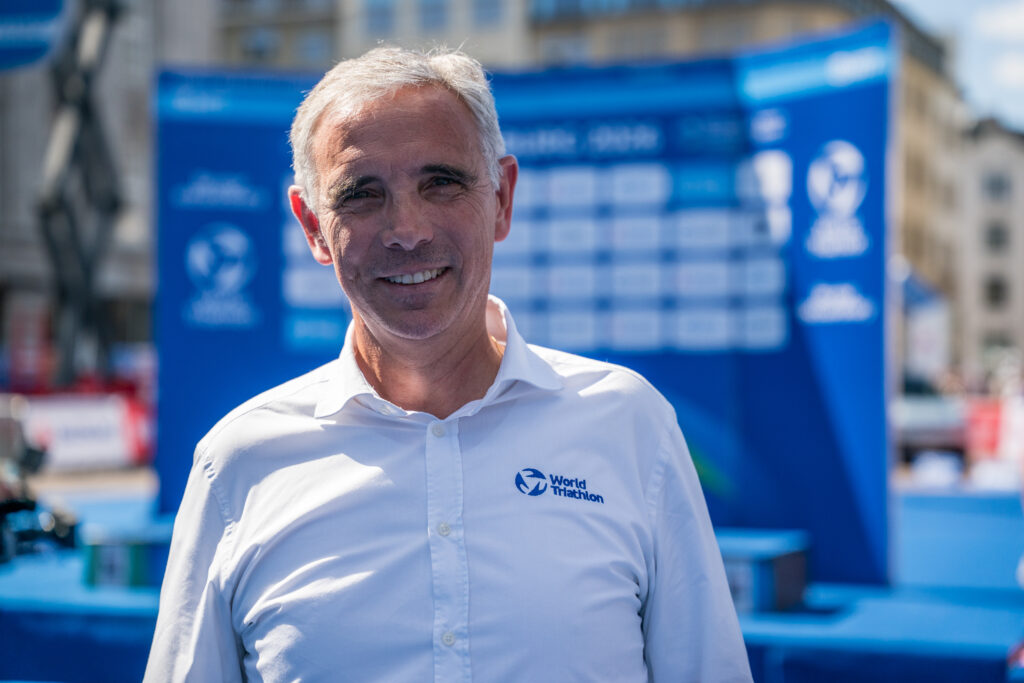
Antonio Fernández Arimany became president of World Triathlon in October 2024, taking the reins after Marisol Casado’s 16-year tenure and becoming only the third president the governing body has had. (Casado took over from founder Les McDonald.) A lawyer by background, Arimany spent eight years as the federation’s Secretary General and brings decades of Olympic administration experience, including senior roles on Madrid’s bids for the 2012 and 2016 Games.
We caught up with Arimany in Hamburg ahead of the World Triathlon Championship Series race there.
Slowtwitch.com: You’ve had a crazy week — Roth, then Chile, now Hamburg. What took you to Chile?
Antonio Arimany: We had the Pan-American Championship, which is the continental championship for this year, and it’s an important event. I wanted to be there with our friends from America.
What did you think of Challenge Roth?
That event is amazing. It was my first time there, and the atmosphere is something unique. I was very surprised by the size of the event — not the number of participants, but the size of the expo area, the setup of the place, and the finish line structure that remains there permanently. It’s a location in Germany that everyone knows because of the triathlon. I’m very grateful, and I have to congratulate them on the work they’ve done for so many years to build this into a reference event for the sport.
There’s a big announcement this year about World Triathlon and the PTO working together on long-distance racing. Is that the right way to look at it?
No — our agreement with the PTO isn’t about long distance. It’s about creating the Triathlon World Tour, which will include what is today the T100 events and the T50, our World Triathlon Championship Series. The agreement is about partnering to consolidate both into a World Championship structure that’s more attractive for TV broadcasters and sponsors, so we can grow the sport beyond its current size. Today we’re attractive to triathlon fans, but we want to be attractive to sport fans generally — people who’d watch even if they’re not triathletes. That’s the goal: to become like tennis or golf, where far more people watch the sport than compete in it. There’s a lot to do in the coming years to get there.
World Triathlon already does a fantastic job with coverage and world-class events. What does the PTO bring to the table that you weren’t already doing?
Two things. First, we have a maximum of 10 events in our series, and they have a maximum of 10 in theirs. You can’t really promote or commercialize a sport with only 10 events a year — you can’t grow. Now we’ll commercialize 20 events at the highest level, roughly 20 or 21 weekends since they split men’s and women’s races. That doubles our media presence throughout the year, all under the same branding, sponsors, and commercial expertise.
Second, we have to admit we’re not specialized in commercializing the sport. We’re good at organizing events, officiating, and controlling quality — but not at sponsorship or selling the sport to the commercial world and to TV. That’s what the PTO brings. They’ll handle the commercial and sponsorship side; we’ll handle the sport side — officiating and maintaining the quality of events.
Was this relationship already in the works, or did the Deloitte report push you toward it?
We already knew the challenges we faced finding sponsors and selling TV broadcasting rights. The Deloitte report put that reality on paper and confirmed what we were experiencing. That was a wake-up call — we needed to find a way to commercialize and grow the sport.
Around that time I also met with private equity and corporate funds to see if triathlon could be an attractive investment asset. They all said yes, but the problem was they didn’t know where to invest — you have Ironman, World Triathlon, the PTO, Super League, Challenge, and so on. Their conclusion was that they wouldn’t invest in any single one of us until the sport had a more consolidated product. That’s when we started working toward commercial consolidation, which led to creating the Triathlon World Tour with the PTO.
This isn’t a closed partnership — the goal is to build the biggest triathlon tour in the world, and other organizers are welcome to join. If we grow, we all grow, and ultimately that benefits the athletes, which is what matters most.
The more the sport grows, the better it is for everyone.
Exactly. We have to be generous and open-minded enough to see that we can grow more together than by competing with each other. We want to keep developing the sport and doing more. We’ll stay open to other distances too — shorter or longer — but that’s a conversation for the future. Right now we’re focused on integrating the T100 and T50, which is a lot of work, and we’re in the final phases of finalizing that agreement.
When I spoke with Sam Renouf a few months ago, the PTO was hiring 14 people that day. Sounds like a lot of work ahead.
Correct — and part of what we’re asking of them is to make the product grow: commercially, on sponsors, in media presence. We want our athletes to be better known, to earn higher prize money, and to attract more sponsors — not just event sponsors. If the sport becomes more popular, athletes benefit immediately from that new status.
How does World Triathlon stay separate from the PTO and the commercialization side? I spent years as an athlete rep hearing complaints about Ironman owning a world championship — is there some juggling involved here?
I don’t want to compete with anyone — there’s room for everyone. Ironman did a great job promoting this sport worldwide. My view is we all have to grow together. For us, the Olympic Games are the pinnacle of the sport, and then there’s our World Championship. But now, with different distances, there will naturally be different world championships. Ours will be in the T50 format. There’s already a T100 World Championship that we recognize, and there’s a long-distance world championship — today part of our multisport festival — while Ironman organizes the Ironman World Championship. Everyone recognizes Ironman and Kona as the World Championship of long distance. That’s the reality, and we can’t close our eyes to it.
What we want is more clarity for the athletes, ideally one world championship per distance, similar to athletics having a world champion for the 100 meters and another for the marathon. Since we’re in the Olympic Games, the T50 distance is the sport’s main distance today, and that gives it the highest recognition. But we’ll see how things grow, and we have to work long-term to avoid unnecessary fights and disputes.
For the T50, how is the investment split between the PTO and World Triathlon?
It’s not really about how much each side is putting in financially — it’s about contributing our respective expertise. We bring our events and officiating expertise; they bring their commercial capacity. Through the partnership we’ll generate more revenue, which gets distributed between both parties according to effort and financial risk taken. This isn’t a case of handing something off and relaxing — we’ll keep working together as partners to make the World Triathlon Tour succeed and keep growing the sport.
How do you feel the sport is doing right now?
We’ve recuperated to pre-pandemic numbers, and the sport is doing pretty well this year. The situation in the Middle East and the war there has affected us, of course, but worldwide participation across events is growing. I’d say the sport is in a healthy state and becoming more popular.
Spain and France seem to produce a lot of top T50 athletes, partly because of strong club systems. How do we get that everywhere?
Germany and the UK are doing a fantastic job too, as are Australia and Canada. It comes down to draft-legal racing and the number of events — France has the French Grand Prix, Germany has the Bundesliga, Spain has an internal club league that runs every year. Triathlon is a sport built on events: the more you organize, the more chances your athletes have to develop. Strong athletes tend to come from countries that organize more national-level events, because those athletes get more experience and there’s a bigger pool for talent detection.
Does not having to worry as much about commercialization free up World Triathlon to focus more on officiating and development programs like coaching?
We’re already doing that, and we’ll need to keep doing it as the sport grows — providing more officials, more opportunities for coach education. That’s our responsibility and will remain so. Thanks to the sport’s growth, we’ll be able to do more of it, and not just in terms of raw numbers, but also more countries organizing events and bringing athletes to international competition.
How has this new position been for you, politically?
It’s been an interesting year and a half since the elections, but I’m glad that’s largely over now and things have calmed down. That didn’t stop me from introducing the changes and processes I had planned, and fortunately it didn’t block the organization from moving forward. Actually, the scale of change we’re implementing is the biggest the federation has seen in about 20 years — since we entered the Olympic Games. It wasn’t easy personally, dealing with articles and having to explain what really happened, but in the end things turned out as expected, and we’ve managed to keep implementing my program.
The sport world is changing — private organizers and private money are coming into all sports, not just triathlon. We needed a system to benefit from that investment, which is why we’re partnering and creating this new way of working. If triathlon is attracting private investors, it’s because triathlon is not only a great sport but a good business — and a good business should benefit the sport.
Was there ever a concern it was too soon to make these changes?
I think the moment you’re elected president is the moment to introduce changes — you can’t wait four years. I had a clear vision, we had the Deloitte report, so why wait? Every year you wait is an opportunity lost. That’s why we moved immediately to address the new reality of private organizers in our sport. Rather than compete with them — which we probably wouldn’t have had the financial capacity to do — we partnered with them so everyone benefits. That strategy was clear to me from the beginning.
Was there resistance?
Every change in a traditional federation generates concern — will this work, will it not. Whenever you introduce change you take on risk, but if you don’t take risks you can’t improve. It’s not 100% guaranteed to succeed, but if you don’t try, you definitely won’t succeed. That’s my philosophy: try new things, with proper due diligence and risk analysis, to improve. I’m pretty confident this is the right move.
What would success look like for you?
Success would be seeing the sport’s audience multiplied by ten. We have to be ambitious — we want triathlon and its athletes to become genuinely popular worldwide, the way they are in other major sports.
LA 2028 seems like a huge opportunity for World Triathlon to break into North America. Do you see it that way?
LA 28 is an opportunity in many ways. We’ll be the first medal event, and we’ll help show LA to the world from Venice Beach — I don’t think any sport will have a better venue at those Games. We’re already working to use the attention from the Olympics to build American public interest in Olympic-distance racing. I’m confident that after LA we’ll have a permanent venue in the U.S. for the Triathlon World Tour — it’s a great opportunity to make the Olympic format popular in the U.S., where long-distance and non-drafting events are already popular. It’ll help Canada too, through that regional influence. Triathlon was born partly in California, in addition to Europe, so this is a chance to use that heritage to promote the Olympic format.
What would success specifically coming out of LA look like?
Having a legacy event — a permanent Triathlon World Tour venue in the United States — and using that to grow awareness of the Olympic-distance sport there. That’s the opportunity in front of us, and we have to use it.
What makes triathlon special to you, given your experience across many sports?
Triathlon has real global presence — all continents, with big names from South Africa, North Africa, Australia, New Zealand, Japan, China, Europe, and the Americas. That worldwide base gives us the grounds to grow significantly in a way many other sports can’t. It’s also one of the healthiest sports in the world, and mass-participation events create a great feeling — cross the finish line and you immediately want to do another one, and get better. You can keep practicing this sport until the end of your days; there’s no real age limit, unlike sports where injuries force people to stop. Because you’re not focused on just one discipline, you avoid the specific injuries that come from doing only one thing.
Equality and accessibility, especially in long-distance racing, have always seemed like a challenge — expensive bikes and gear. Does that hold the sport back?
Technology keeps advancing and making the sport more open for everyone. Yes, there are expensive bikes, but that doesn’t stop you from practicing the sport — it just means you practice it differently. What we have to guarantee is equal conditions for top athletes to compete regardless of where they’re from. Fortunately, thanks to the community, promising athletes are able to find sponsors for equipment, so that’s less of a concern at the elite level. And for everyone else, you can have fun with an MTB and low-level equipment — because in triathlon you’re competing against yourself as much as anyone else.
There have only been three presidents of ITU/World Triathlon. What does it mean to be one of three?
It’s a big responsibility to follow Les [McDonald] and Marisol. Becoming president wasn’t in my plans — it wasn’t on my agenda even a year before. I was asked to run by many federations, and eventually they convinced me. I took the role because I believed I could contribute something to the sport, and these changes I’m implementing are what I think I can contribute. I’m enjoying the position despite the challenges, and every day I look forward to doing more.
You’ve clearly got a strong team at World Triathlon.
Absolutely — I couldn’t do any of this without my team. I’m very proud of their expertise and the hours they put in. It would have been impossible to introduce anything new without them. It hasn’t been easy for them either, through a year and a half of political situations, and I appreciate that they kept working through it. I’ve told them: that’s not your issue, keep doing the fantastic work you’re doing, and know you’re part of this growth and success. The team is always the key thing for me.
It sounds like things only get busier from here.
Unfortunately I’m putting them under more and more pressure, but it’s what we have to do — and I appreciate that they take it with a smile. If we grow, we’ll be able to grow the team and give them the support they deserve.
Hopefully the next few months involve a little less travel — though I doubt it.
When you’re in this position you have to understand you’ll travel constantly, and I’m happy to. I get to see the different cultures and understand how differently things are done across continents — that’s one of the great things about this world. We’re different, but we’re able to work together, and it’s amazing to meet all these people, even when it’s tiring.




As of right now are the T50s going to be on triathlonlive.tv and the T100s on YT?
I don’t have the same viewpoint. USAT is bleeding money and has lost their ass on every wtcs venue they’ve hosted, even during the “prime” of triathlon in the US (in the 201x’s).
Obviously the president of WT basically has to say the things he said for sports to take advantage of the olympic buzz from hosting. So fair play on having a nice sound bite about it.