
It’s Here: Meet the All New Canyon Speedmax
Before we get into the details of the new bike, I want to touch on the launch of this latest generation of Speedmax. This bike wasn’t supposed to be leaked at all. Canyon had originally set an embargo date for July 2nd to coincide with Roth. Well, like with all things manufacturing these days, timing is super hard to get right and so Canyon needed to push. So while we in the media have had our hands tied behind our backs, the show at Roth had to proceed as planned. And, well, we all know what happened then. Everyone that didn’t need to respect the embargo was spilling all the details they could on this bike. And while you can tell a lot by photos and pro athletes talking about their special builds, there’s still a lot of information left to unpack.
I first saw this bike at the Canyon USA HQ the day before Oceanside.

We sat in a conference room with the head of the Speedmax project for about four hours and looked at all the specs, and a bike that, while it couldn’t be ridden, was the final version of the bike we see today.
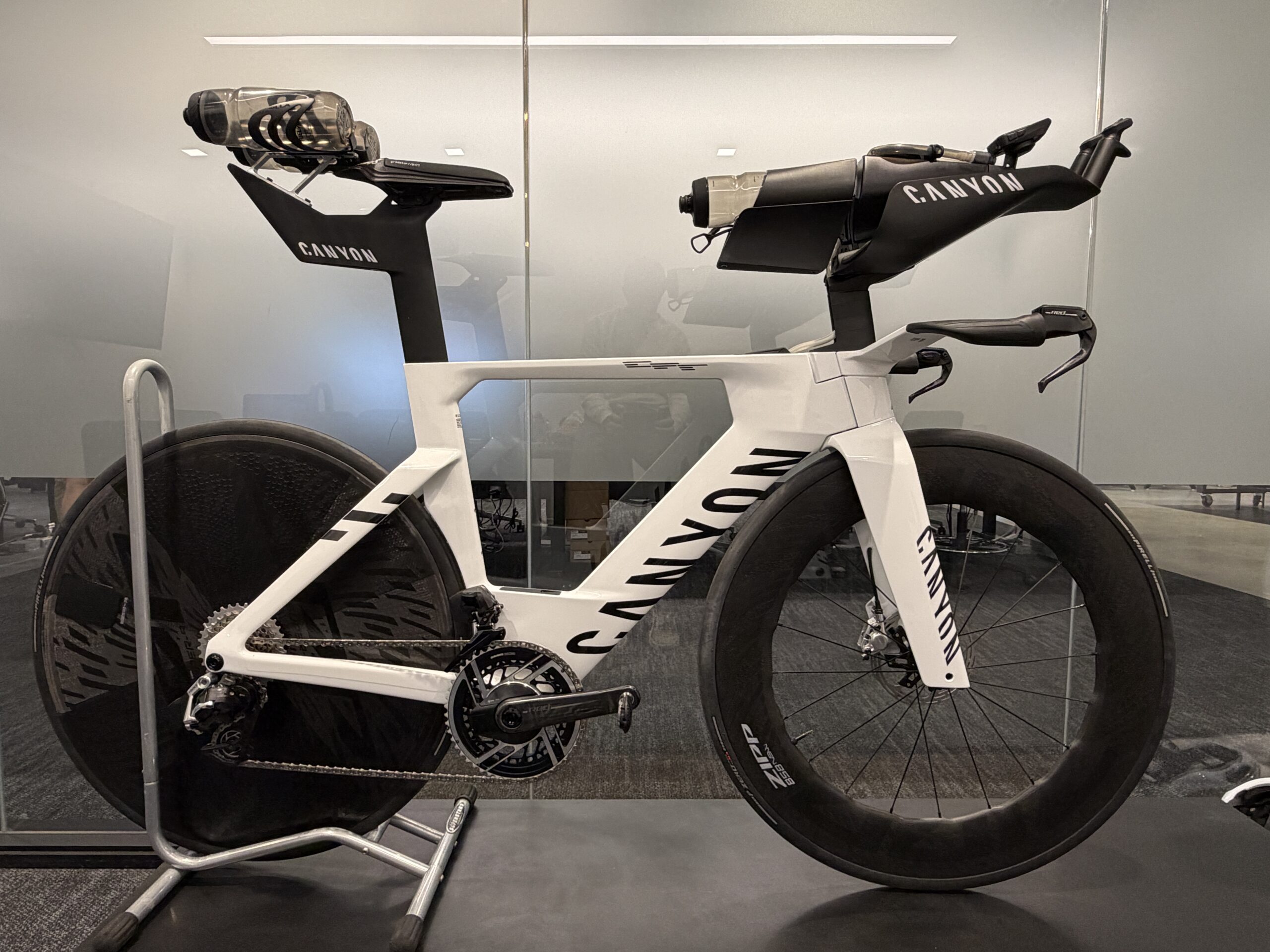
I left that meeting thinking to myself, “Wow, they did a nice job on that bike.”
One of the repeated things I saw on the forum over the last couple of days is how not much has changed with the frame. And while there is some truth to that, I’m also not sure that much really needed to be changed. Canyon’s starting claim for the new Speedmax is that the prior generation version-5 frame was already the fastest tri bike in the world, and they don’t claim the version-6 frame beats it on drag.
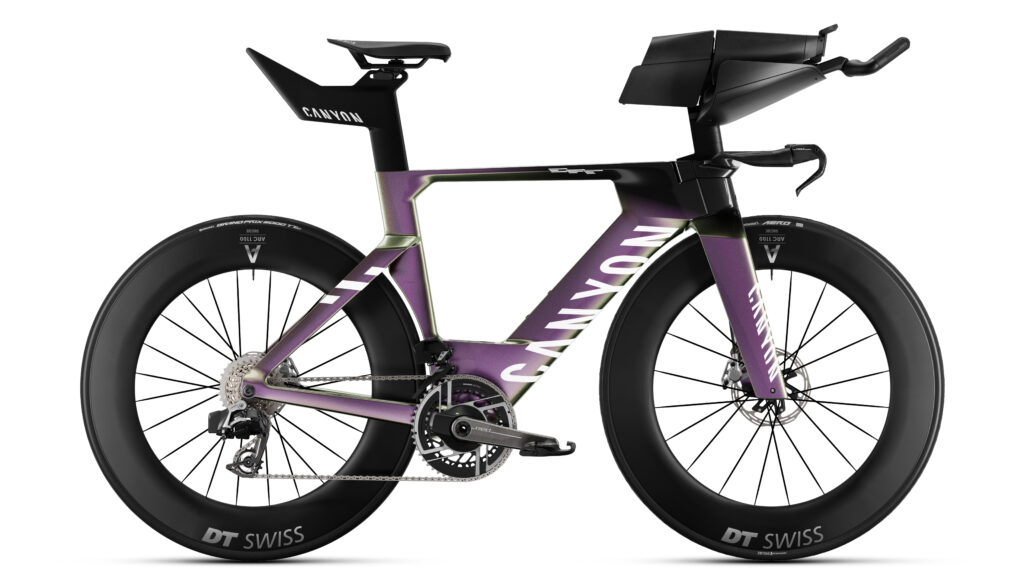
So if the frame didn’t really need work, what did? According to Canyon, this is a lot about the fit of everything on the bike around you. Canyon calls this its AeroID and it consists of the four pillars upon which this frame is built around.
- AeroFuel
- AeroFit
- AeroShield
- AeroBase
AeroFuel — The Modern Way of Carrying Race Nutrition
Modern race fueling has climbed to 90–120g of carbs an hour (if not more), and IRONMAN still has a hard time finding fueling partners to help people achieve that. It means you have to carry a lot more liquid and gel than we sometimes would like (although it is possible to carry it all). Version 5 carried a roughly 750ml bladder in the down tube and a tool box at the bottom bracket. Version 6 claims over 3,500ml of total nutrition/water capacity.
The part that confuses people: that 3,500ml is not one giant tank. It’s the whole system added up — the reservoir between your arms, the bladder inside the frame, and one or two bottles behind the saddle. They have done a good job making it all reachable without sitting up out of your aero position. But it’s something that the customer needs to sort of “buy into” with all the 3rd party options these days. Does the Canyon customer get what they need directly from Canyon or will they seek add-ons from elsewhere?
One structural change ties into the frame: the old top-tube storage compartment is gone. And that storage moved into the AeroModule between the arms.
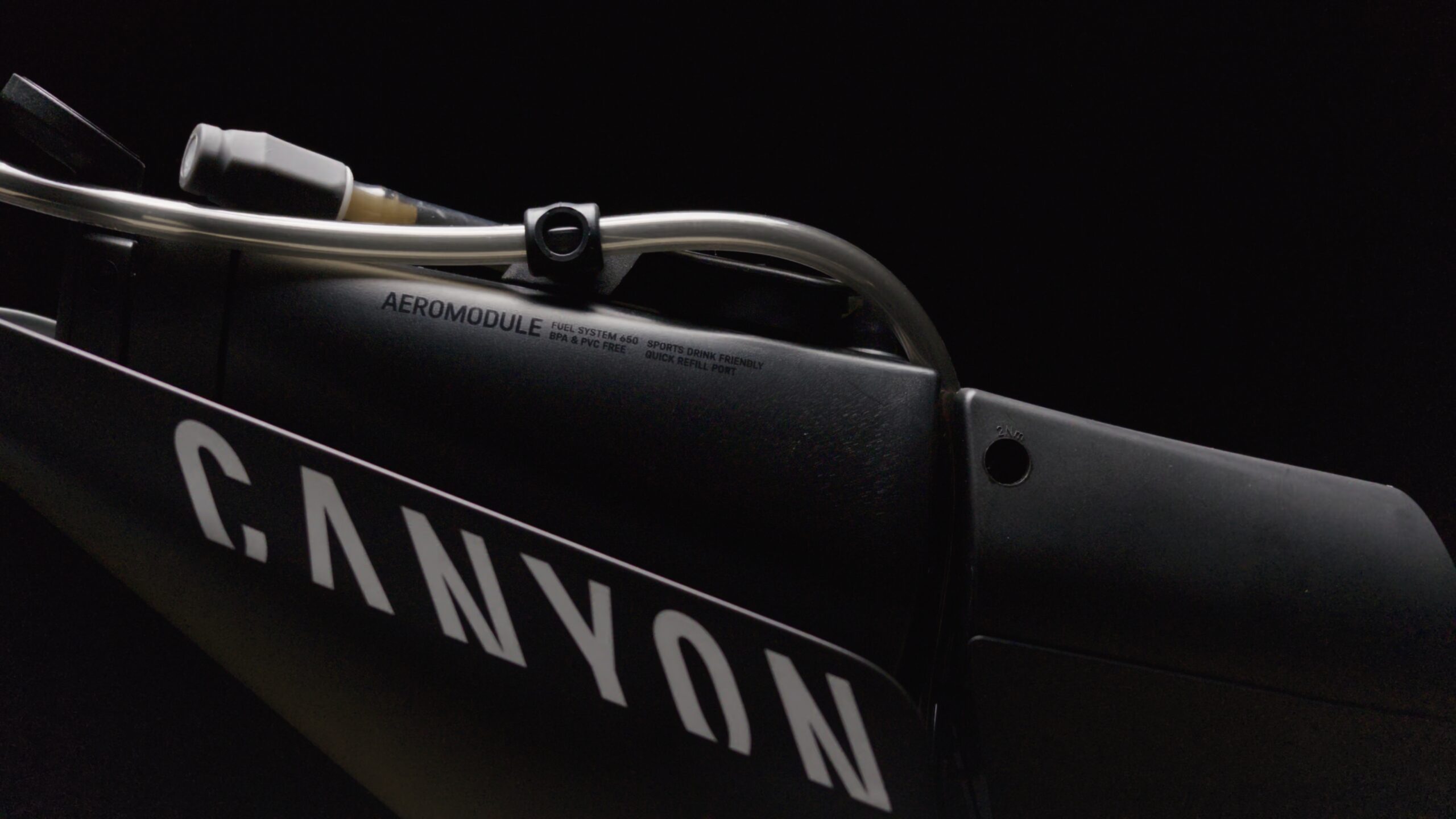
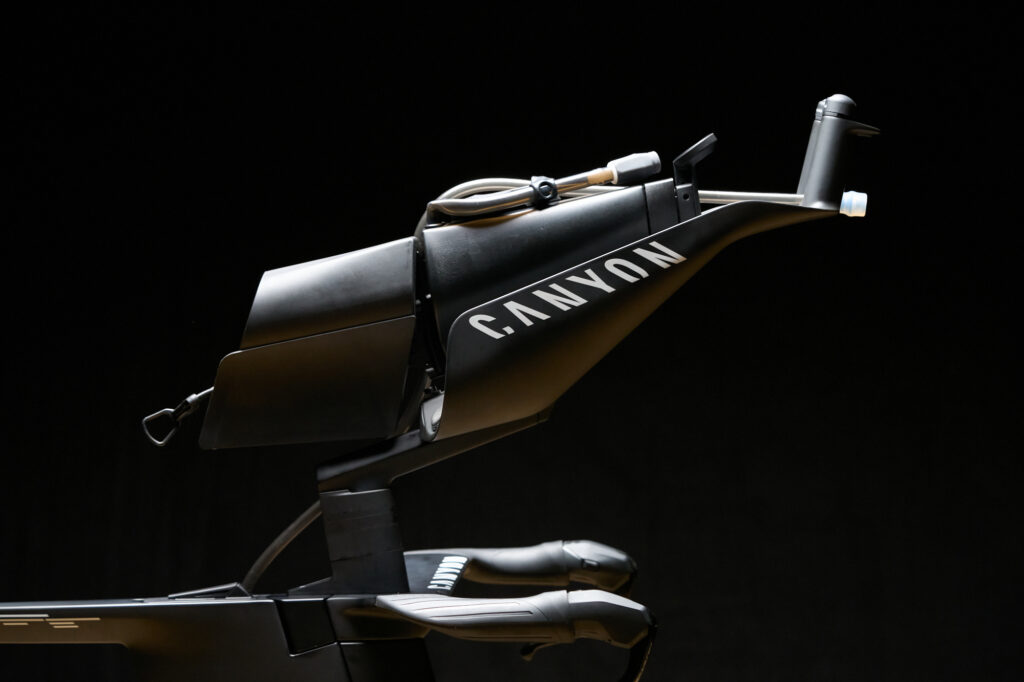
AeroModule — This pod sits between your forearms. It clicks on and off without tools, and these module pieces come in 3 sizes. The numbers (300, 650) refer to size, and what they are calling the BTC Beam.
- Load 300 — the baseline storage box. Smallest and lowest-profile. Comes on every Speedmax, CFR and SLX.
- Load 650 — the same box, taller, holding more.
- Fuel 650 — a liquid or gel reservoir with a drink hose, shaped to sit against your forearms. Standard on the CFR.
- BTC Beam — the rear piece. A replacment to the the standard bottle-cage mount with an elastic strap (which I will say looks lot like the WOVE one). But regardless this is so the bottle can’t eject over bumps, plus a tapered slot under the cage for two or three gels. This comes standard on the CFR.
Why the module helps aerodynamically: Simply, it fills the empty gap between your forearms. And it looks a lot better then a plastic container from the container store that pro’s where putting down their kits before the rule committee stopped that in the name of common sense. So the air that would otherwise tumble through that hole gets a smooth surface to follow instead, which is where Canyon’s up-to-7-watt claim comes from. So the thing that carries your fuel is also, supposedly, making you faster rather than slower.
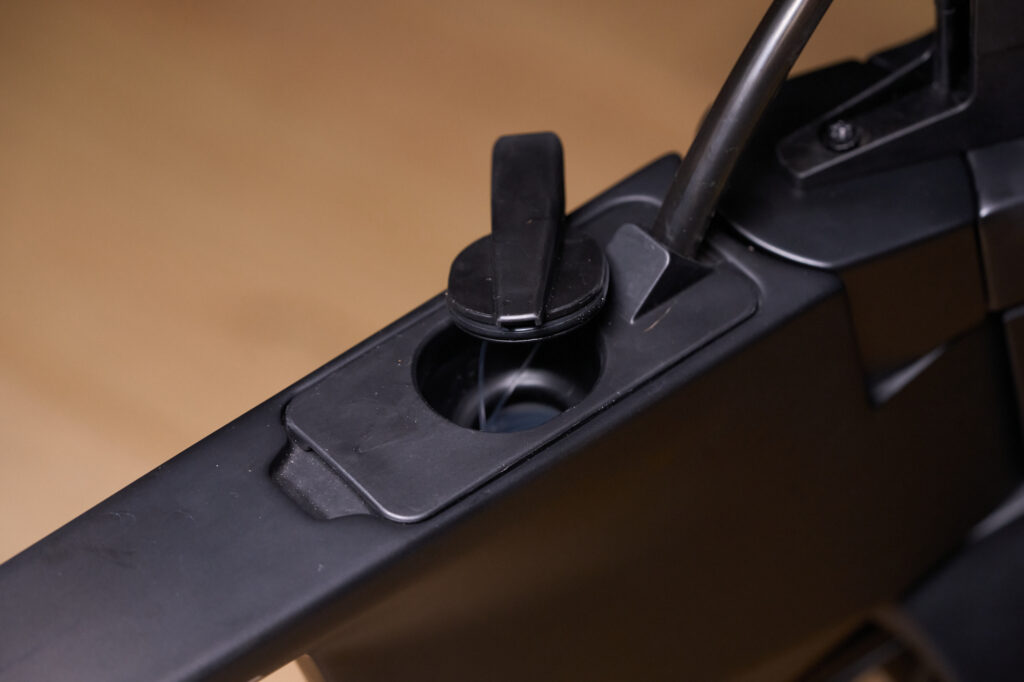
Frame bladder — This is an improved internal reservoir, 650–850ml depending on frame size, top-fill and tool-free as covered above.
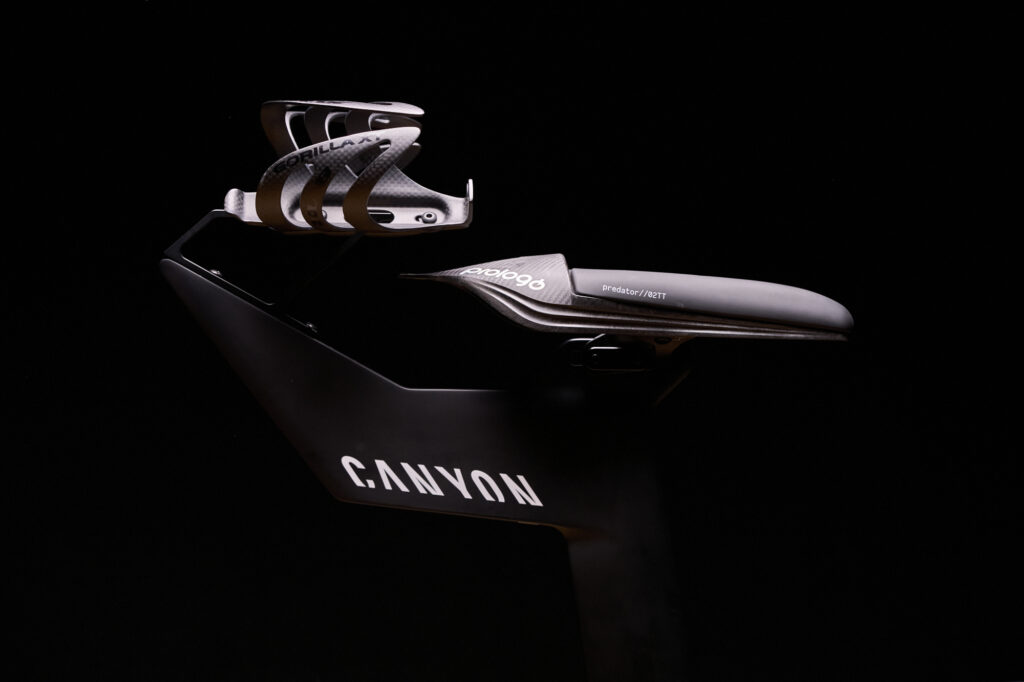
Splitter Plate Pro — this is the seatpost, and it does two jobs. It’s a fin (or fairing, depending on who you ar ) and it’s designed to channel that air between your legs, and it also lets you mount one or two bottles tucked in tight behind your backside. The carbon post adds 76g over the standard one. But it’s extremely stiff and allows for a very easy bottle mount, though racking your bike from the rear becomes a challenge. A new horizontal bottle adapter lets you slide those bottles forward, back, up and down to get them tight against you regardless of your saddle.
AeroFit Bike Geo — Killing the XS and 650b’s
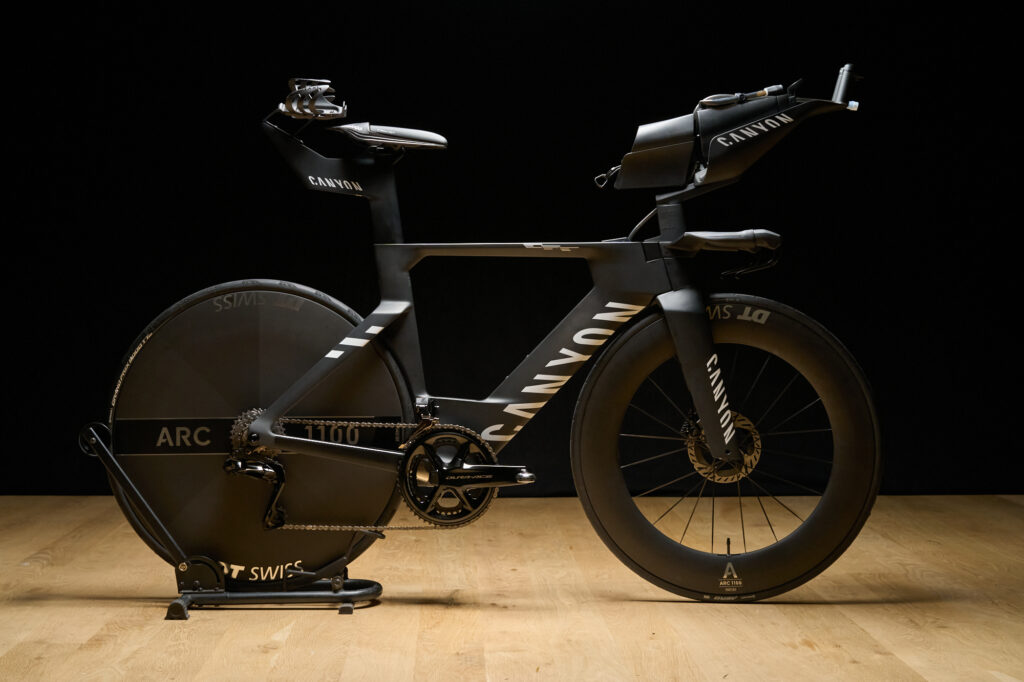
Canyon streamlined their frame sizes at launch, going with four “t-shirt” sizes.
| Frame Size | S | M | L | XL |
|---|---|---|---|---|
| Body height (cm) | <178 | 168–186 | 180–196 | >189 |
| Seat height (mm) | 660–740 | 708–838 | 745–875 | 780–910 |
| Seat tube (mm) | 480 | 513 | 550 | 585 |
| Top tube (mm) | 516 | 537 | 565 | 593 |
| Head tube (mm) | 62 | 73 | 105 | 137 |
| Head angle | 73° | 73° | 73° | 73° |
| Seat angle | 80.5° | 80.5° | 80.5° | 80.5° |
| Chainstay (mm) | 420 | 420 | 420 | 420 |
| Wheelbase (mm) | 989 | 1013 | 1046 | 1078 |
| Stack (mm) | 470 | 481 | 511 | 542 |
| Reach (mm) | 419 | 440 | 463 | 486 |
| BB offset (mm) | 75 | 75 | 75 | 75 |
For the four sizes that share a name across generations, the geometry theme change is consistent:
| S | M | L | XL | |
|---|---|---|---|---|
| Stack | +1mm | −8mm | −16mm | −11mm |
| Reach | +4mm | +2mm | +4mm | +3mm |
| Head tube | 0 | −10mm | −18mm | −13mm |
What actually changed: front ends got lower through shorter head tubes, frames got shorter in the seat tube, and the saddle-height ranges for M through XL dropped roughly 20–30mm to line up with Canyon’s road bikes. The stated reason is to let smaller riders size onto bigger frames and pick up reach, which is why the height bands now overlap — a new M covers 168–186cm, a new L covers 180–196cm. This is also something that will help brand loyalty customers as they step up bikes.
Assuming someone comes up from lets say an Aeroad sizing becomes very easy to choose.
What didn’t change: Seat tube angle stays 80.5°, head tube angle 73°, chainstays remain at 420mm, and wheelbase moves a millimeter at most. So the steep, over-the-bottom-bracket tri position and the way the bike steers carry straight over. This should keep handling mostly the same. Anything that Canyon claims as more stable is probably based on all of the new add ons not really the frame per say.
AeroShield
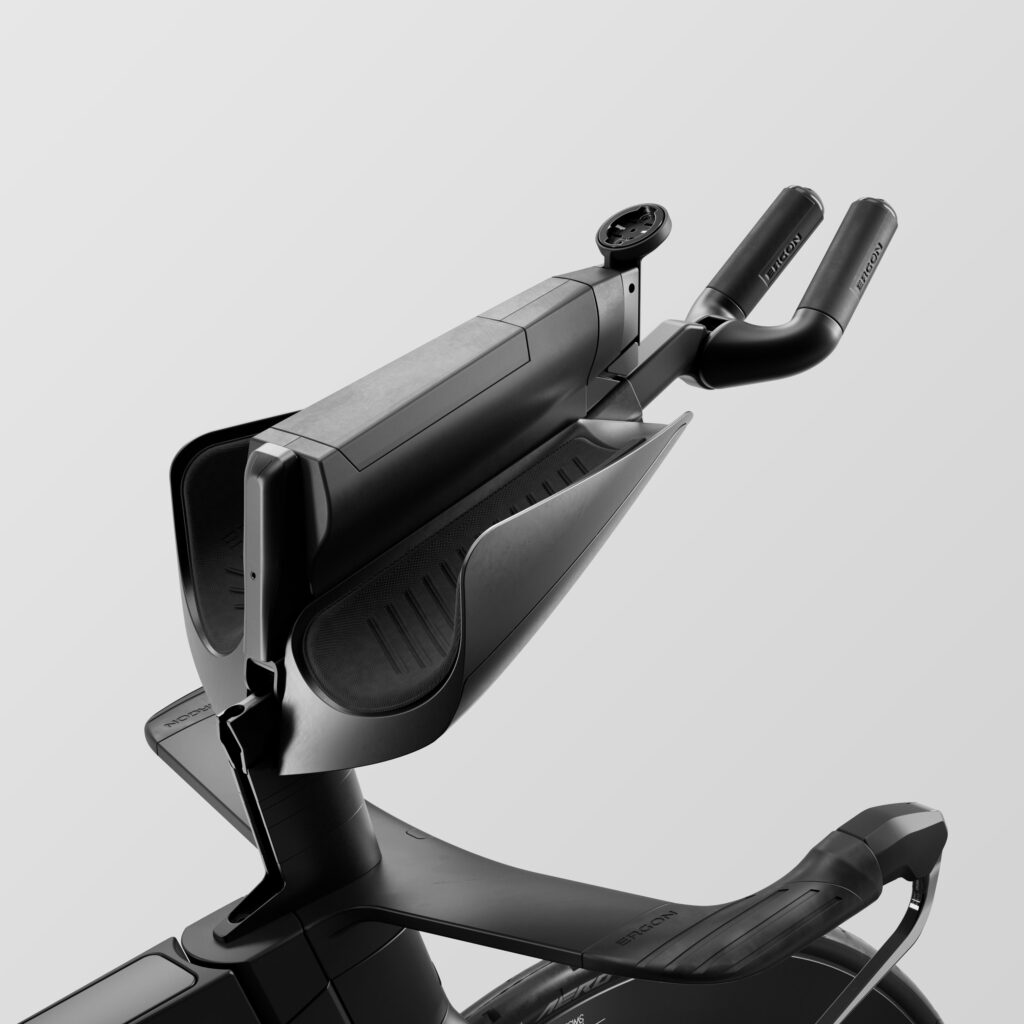
Version 5’s front end was a normal tri setup: a base bar with a bolt-on aerobar, pads and extensions you could move, an angle kit if you wanted more. Version 6 replaces all of that with AeroShield, a single closed and faired cockpit.
“Closed” is the key word. The shell is faired to guide air around your arms, with raised sidewalls that support you in narrow positions and, Canyon says, help steering control. The padding is medical-grade foam with a textured surface. The tradeoff of a closed, integrated cockpit is the same one every faired front end carries: it’s more to pack in a bike case and more to service than a simple bolt-on bar.
The stepless adjustments on the standard AeroShield are grip angle, grip spacing (Ergon grips), and 70mm of extension length. Pad width is stepless too, within two shells tied to frame size: 200–275mm on the S/M, 225–300mm on the L/XL.
The Cockpit Post — read this part slowly, because the naming trips everyone up. The real fit range doesn’t come from the cockpit itself; it comes from the post it sits on, which slides into the head tube and clamps like a seatpost. There are three separate axes, and each uses different words:
Stack (height) — three settings, Low / Mid / High, 105mm total, stepless within each band:
| Stack setting | S | M | L | XL |
|---|---|---|---|---|
| Low | 0–35mm | 0–35mm | 0–35mm | 0–35mm |
| Mid | 35–70mm | 30–70mm | 25–70mm | 20–70mm |
| High | 70–105mm | 65–105mm | 60–105mm | 55–105mm |
Reach (length) — set by which of three posts you buy: Short, Long, or X-Long. Each gives 50mm of stepless fore-aft, so all three together cover 150mm.
Tilt (pad angle) — 0–20° stepless on every post, sitting on top of a base angle. There are two bases, Standard (10°) and Pro (20°), and they’re not offered on every post:
| Post | Base tilt available | Effective pad tilt |
|---|---|---|
| Short | Standard only | 10–30° |
| Long | Standard or Pro | 10–40° |
| X-Long | Pro only | 20–40° |
The thing to understand about that 150mm: within any single post you only get 50mm of stepless reach, which is actually a hair less than the old frame gave you. The full 150mm only exists if you own and swap between all three posts. So the fit magic isn’t one clever post, it’s the ladder of three — and that ladder is what lets one frame cover the riders that used to need two (more on that under Bike Geo).
One naming warning: stack uses Low/Mid/High and reach uses Short/Long/X-Long. Don’t mix them up — a “Short post” is a reach choice, not a low stack. Canyon’s own kit muddles this once, labeling the stack settings “Short/Mid/High” on one page, so expect some confusion in the wild.
Canyon pre-sets all of this per order through its PPS 2.0 fit tool: feed it your current fit or your body data plus how aggressive you want to be, and the bike ships already in the right window with a torque wrench and TX25 hardware in the box.
AeroShield Pro
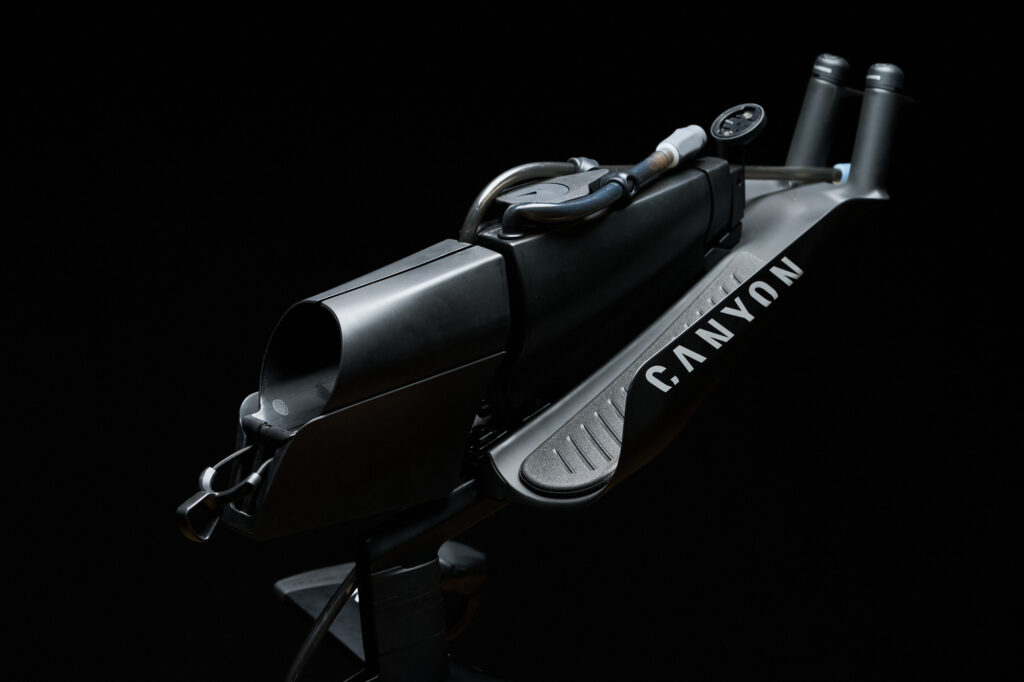
AeroShield Pro is the upgrade, and it’s built the opposite way you’d expect. Instead of adjustable width, it comes in seven fixed-width shells.
Why fixed is the “Pro” version: an adjustable cockpit needs clamps and hardware to move the pads, and that adds width and bulk out front. A fixed shell can hug your exact forearm shape and keep frontal area to a minimum. So the Pro trades away adjustability for a tighter, faster fit — that’s the whole point. It’s a monocoque (one molded piece), which makes it 300g lighter than the standard AeroShield and worth another 3 watts at 45 km/h. It’s the same cockpit that won the last two Kona titles in prototype form, and for $500 more it’s all yours
To get to the magic 7, Canyon scanned 183 forearms and focusing on two things: forearm circumference (width) and forearm length. They came up with the following
| Width | Short | Medium | Long |
|---|---|---|---|
| Narrow — 215mm | ✓ | ✓ | ✓ |
| Medium — 230mm | ✓ | ✓ | — |
| Wide — 230mm | — | ✓ | ✓ |
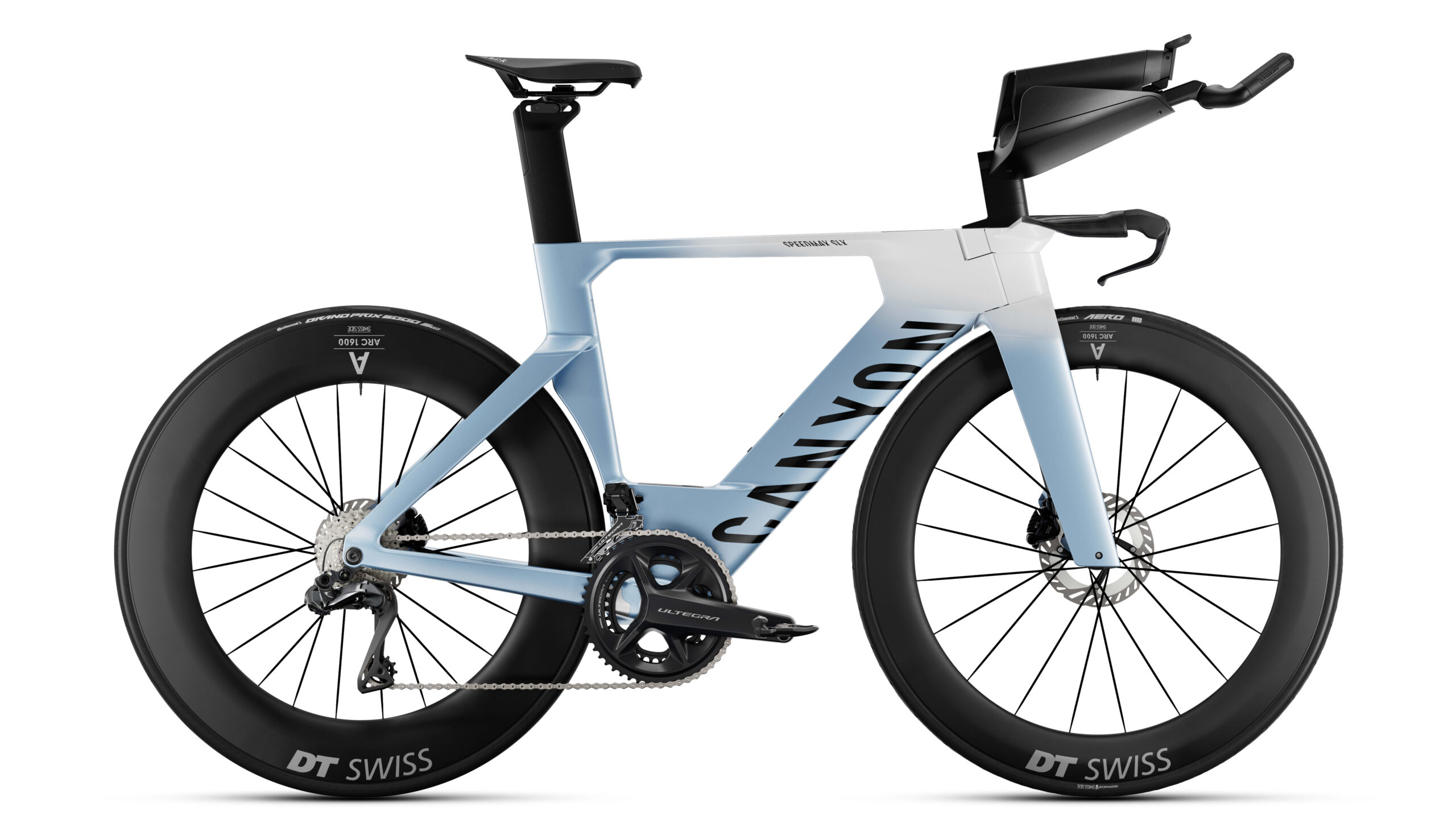
What if you don’t want the halo bike? Then buy the SLX, and don’t feel like you settled. Canyon spent this whole launch arguing that the rider is where the time is, and everything they built to serve that argument is already on the SLX. Same geometry. Same AeroShield cockpit. Same AeroFuel system. That means the fit and the fueling this bike is supposedly about cost 7,999 € instead of 11,000 €.
What you give up going down a tier: the lighter CFR frame layup, a single-sided power meter in place of the dual-sided, DT Swiss ARC 1600 wheels instead of the deeper 1100s with no Zipp or disc upgrade path, a Fizik R5 saddle instead of the R1, and the exclusive paint. None of that is nothing. But a CF SLX 8 Di2 at 9.02 kg gives up 370 grams to the CFR Di2, and if you put a chunk of the 3,000 € you just saved into the AeroShield Pro cockpit (+500 €) and the Splitter Plate Pro seatpost (+250 €), you land around 8,750 € running the identical front end, the identical fuel setup, and the identical position as the bike that costs three grand more. You’ll still be on a heavier frame and shallower rims, but race wheels will close that gap a lot faster than a frame layup will.
One warning if you’re shopping the bottom of the line. The CF SLX 7 is the only bike in the range that can’t take the AeroShield Pro. If that cockpit is in your future start at the SLX 8.
There’s a real tension buried in Canyon’s own pitch. The argument that justifies spending CFR money on a front end is the same argument that makes the CFR itself hard to justify, because the front end isn’t CFR-exclusive. That said some of you just like that SEXY AF bike and I personally cant blame you.
Canyon Speedmax 2026 — Pricing
| Model | Drivetrain | EUR | USD | AUD | Weight (from) |
|---|---|---|---|---|---|
| CF 7 Di2 (carryover) | Shimano Di2 | 4,999 € | — | — | — |
| CF SLX 7 | Shimano 105 Di2 | 6,499 € | $6,999 | 10,499 AUD | 9.55 kg |
| CF SLX 8 Di2 | Shimano Ultegra Di2 | 7,999 € | $8,499 | 12,499 AUD | 9.02 kg |
| CF SLX 8 AXS | SRAM Force E1 AXS | 7,999 € | — | — | 8.88 kg |
| CFR AXS (stock) | SRAM Red E1 AXS | 11,000 € | $11,999 | 17,500 AUD | 9.23 kg (US stock) |
| CFR Di2 (custom) | Shimano Dura-Ace Di2 | 11,000 € | $12,499 | 17,500 AUD | 8.65 kg |
| CFR AXS (custom) | SRAM Red E1 AXS | 11,000 € | $12,499 | 17,500 AUD | 8.48 kg |
Upgrade pricing (EUR / USD / AUD):
| Option | EUR | USD | AUD |
|---|---|---|---|
| AeroShield Pro cockpit | +500 € | +$500 | +800 AUD |
| Splitter Plate Pro seatpost (SLX 8 only; std. on CFR) | +250 € | — | — |
| MyCanyon artwork (CFR only) | +500 € | +$500 | +800 AUD |
| Fuel 650 AeroModule | +100 € | +$100 | +160 AUD |
| Load 650 AeroModule | +70 € | +$70 | +110 AUD |
| Fuel 650 + BTC Beam | +200 € | +$200 | +320 AUD |
| Load 650 + BTC Beam | +170 € | +$170 | +270 AUD |
| DT Swiss ARC 1100 85/Disc (CFR) | +1,000 € | +$1,200 | +1,700 AUD |
| Zipp 858/858 NSW (CFR) | +1,000 € | +$1,200 | +1,700 AUD |
| Zipp 454/858 NSW (CFR) | +900 € | +$1,100 | +1,500 AUD |
| Zipp 858 NSW / Super 9 disc (CFR) | +1,500 € | +$1,700 | +2,500 AUD |
| Crank length, saddle swaps | +0 € | +0 | +0 |
Conclusion
Back to Canyon’s starting claim to us — that the version-5 frame was already and is already the fastest tri bike in the world, and they don’t claim the version-6 frame beats it on drag. So if the frame is a solved problem, the time left on the table is in the rider — or the position you can hold and the fuel you can carry without leaving it. So the photos and forum are correct in the idea that not a lot of change when it comes to the frame.
AeroFuel lets you carry a full race’s worth of nutrition without sitting up. AeroShield and AeroShield Pro get you into a lower, tighter position and hold you there, tuned to your body rather than a generic bar. The Cockpit Post lets you set that position steplessly, the way you’d set saddle height. And the geometry is a range rebuilt so more riders land in a better position on fewer frames. The five-to-four size cut isn’t cost-saving dressed up as innovation — it’s the direct result of moving the fit range off the frame and onto the cockpit. Once the cockpit can cover 150mm of reach, you simply don’t need as many frames.
That’s the bet, and it’s a real one. Canyon is wagering that a stepless cockpit plus a fit algorithm can do the job a dedicated frame size used to do, and that the extra hassle of a closed, integrated front end is worth the watts and the fit. If PPS 2.0 puts riders where it promises, this is the smartest fit story in triathlon and the size reduction will look obvious in hindsight. If it doesn’t, it’s a lot of new complexity sitting between a rider and their position.
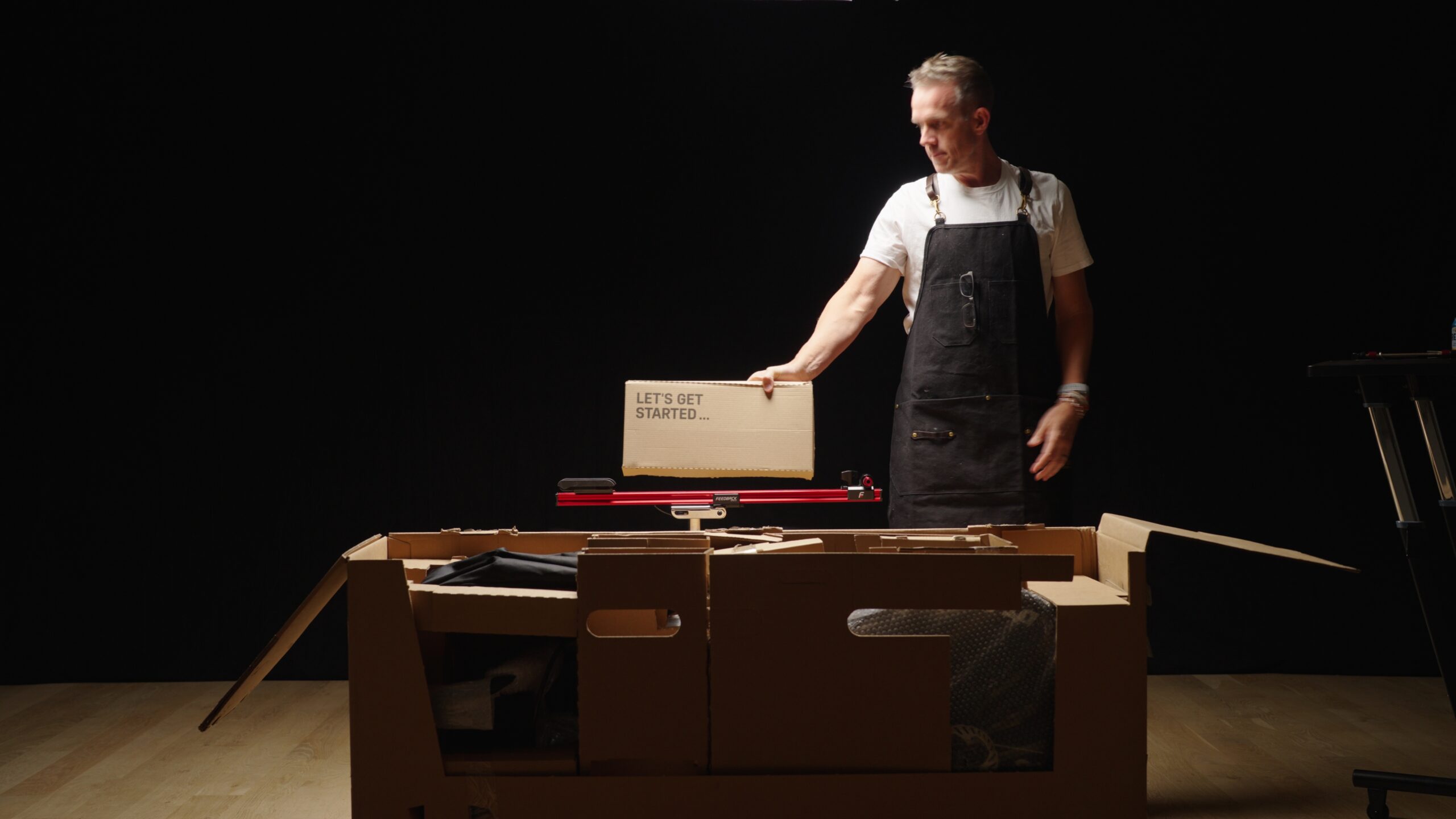
As for the customer experience receiving your bike: Canyon’s direct-to-consumer shipping and arriving is about as easy as it gets. I honestly didn’t even know what Canyon was sending me when I got it. In fact, it wasn’t until after it was all put together that I noticed it was the wrong size. But with that said, it took me 28 minutes to get it all put together and that included me finding some tools I needed to finish the job.
The only thing missing from the build kit was the Shimano DI2 tool for the cables and I needed to swap out the adapter on my Feedback stand. But those aren’t Canyon’s fault. I do have the right size coming and I’m looking forward to putting that one together and riding it for the next follow up review.
Tags:
BikesCanyonTri BikeRelated Articles:

Continue the discussion at forum.slowtwitch.com
132 more replies



Really wish we got the 105 Di2 bike here in the states. Or Rival AXS which would be even better.
If they could sell this new adjustable SLX for like $6500 that would sell like hot cakes. I’d buy one next year.
Also Laidlow, allegedly saved 15 watts (!) at 50 kph over his 2024 Kona bike per the GTN video. I assume that’s mostly position + cockpit, but that’s a huge improvement over an already incredible dialed setup.
Packability with that cockpit? Tough to recommend if that cockpit is a bear to remove for packing.
The cockpit is a piece of cake to remove. Two screws and disconnect DI2 in the worst case. Think of it as a seat post removal
That’s huge - they should include pictures of that removal in the main article, as that’s the single biggest stumbling block for most people considering buying an integrated cockpit bike.
Several of my friends have postponed buying a new TT bike in fear that they can’t easily pack the bike, compared to ‘normal’ aerobars on which you can loosen a few bolts, and either tilt them down or slide them back to fit the case. (My TT aerobars can be slid backwards thankfully to fit in my case!)
They did a lot of things right. We will hear about those. Not sure when we will hear about the cons and some nuance to marketing claims.
I have a YouTube video that Im finishing up on some of them. It’s easier to example some of them visually I think.
They didnt really “Claim anything” that are really questionable things in my opinion.. They just sort of down sized the size options and added a lot of module pieces to the offering.
I will say it’s one of the coolest features.. It’s a little tight with SHIMANO and I had to go find a couple of smaller tools that they didnt include to make it work but the thing I plan on during it packing the bike up in a case.
This is another small step on the road to fully faired bikes. That front end is absurd. I can’t see how the governing bodies allow this kind of stuff.
What looked the most interesting to me is the really low standover height on all the models… before I could only fit the medium-sized Speedmax because of the much taller standover height of the large-sized model… now the large frame size seems to have plenty of standover height, but with the added benefit of a longer wheelbase (1047mm) and fairly long trail (66mm). Would that make the new Speedmax one of the most “stable” triathlon bikes on the market for a given person? Or do dimensions like front-center (and it’s associated effect on center-of-mass distribution) and desired reach matter more for bike stability than wheelbase and trail for aero-position riding?
i like that you mentioned that because i was looking at the standover height too and noticed i can straddle both a small and medium frame!
What is a “fully faired” bike?
He’s alluding to streamliners. That’s a strawman argument. It will never reach that point in triathlon. In a parallel world where regulations ceased to exist, it would be a physical debility, even with a partially faired bike, that would quickly outweigh any aerodynamic advantage in a triathlon, unless the bike leg was short. Monobars are not far from the maximum aerodynamic optimization one could implement before encountering an insurmountable wall, which one person in another thread realized to his credit: HEAT
Ask me how I know…
Speedmax ‘history’ from Laura Philipp
laura_philipp_tri
"Two years ago [2024 summer] I got to test the first version of the new Canyon Speedmax, the Frankensteinbike. We tested different setups and Canyon collected valuable feedback from pro athletes to really match our needs.
 "
"
"It feels very special to see the final product come to live and testing it in the windtunnel . . a few weeks ago, I can confirm it is very faaast too.
"I guess [Sam and Rico] proved that on the weekend as well
I wonder whether Derron and Simmonds also rode the new bike to their #1 #2 (and KQ) in Ironman Switzerland the same day?
Simmonds did, Derron not.