
A Beginner’s Guide to Track Running
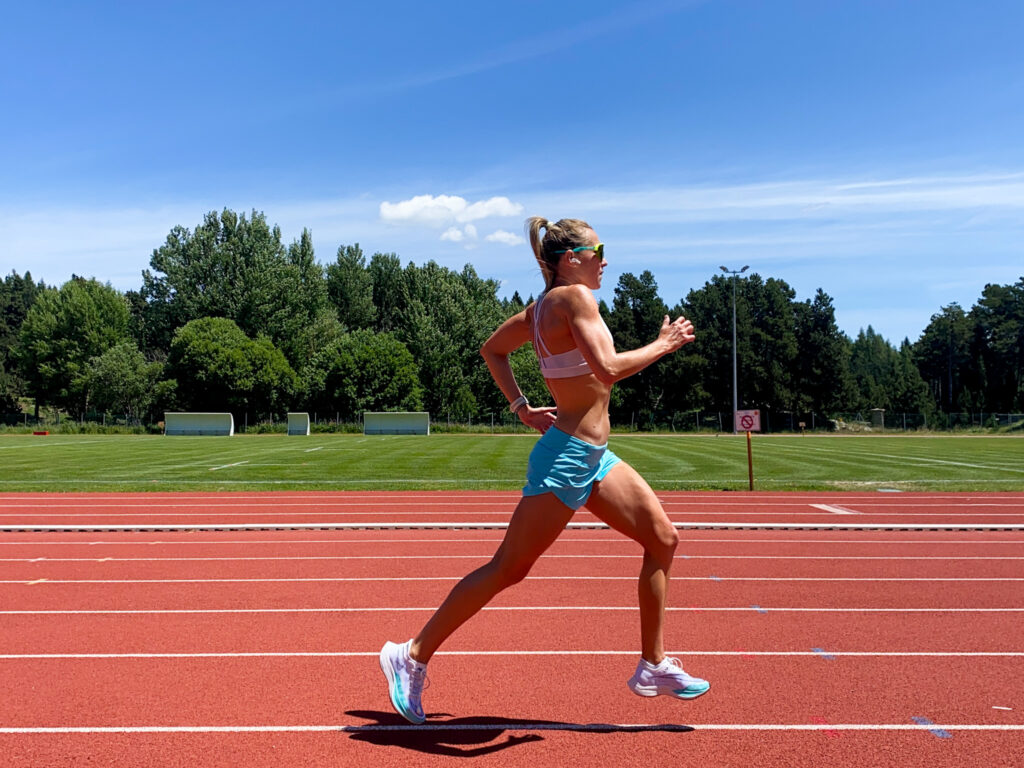
The first time I built up the courage to go to a running track, I jogged into an open stadium and came face-to-face with a wall of abs. It was just before the Olympics, and Team Great Britain was at the facility for a training camp. The athlete I almost ran into was the most ripped woman I had ever seen, and I felt two-feet tall, gazing up at her impressive washboard stomach and super-pro-looking national team kit. In the background, other Olympic hopefuls were flying over hurdles in an astounding feat of strength, speed and magic. I did a hot turn and got out of there.
Running on the track can be intimidating, especially for beginners. But, like most things, it’s the unknown that makes them seem intimidating. Once you know the rules and what to expect, you’ll be track-ready and eager to get started.
Who Can Use a Running Track?
First and most importantly, anyone can use a running track. Any runner, regardless of ability, can use a track. Some are public and some are private facilities, so you’ll need to look into opening times and access rules, but it’s not a question of ability. Think of it like a swimming pool—just because you aren’t Michael Phelps doesn’t mean you can’t use the pool.
A lot of running clubs have group track sessions, and they’re a great way to experience the track for the first time. There will be a structured workout and friends who will push you and keep you focused. That said, don’t be afraid to go run alone. You don’t need a coach on a bike to pace you or a training group to get the advantages of the track.
Why Use a Running Track?
The appeal of a track is about more than feeling like an Olympian.
Tracks have a special rubberized surface, sometimes called “tartan.” It’s firm underfoot, but provides more energy return than pavement, so you can run faster while putting a little less stress on your legs. Not all tracks have this surface, however. Smaller local tracks may be concrete, grass, dirt or even fine gravel.
All tracks offer a safe, uniform and distraction-free running experience. Regardless of the surface, there are no cars, tricky terrain to navigate, or pace-disrupting hills, so you can train with complete focus in a controlled environment.
Meters, Miles, and Math
Part of that control comes from the perfectly flat surface and precise distances.
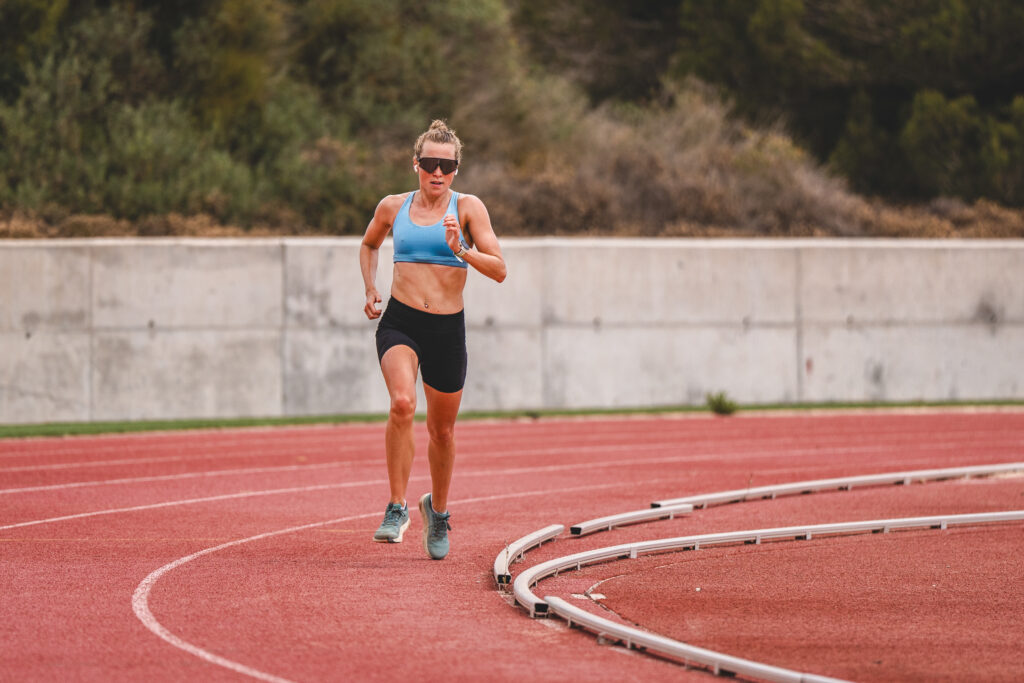
When my coach gave me my first track workout, I asked him how I was supposed to know if I’d run 400 meters—my “fancy” running watch only displayed time and heart rate. He informed me that standard tracks are 400 meters around in lane one (the smallest, inside lane). The outside lanes are slightly longer, which is why many track races have staggered starts.
The straightaway is 100 meters, and four laps is roughly one mile. Five laps is two kilometers.
A specific track workout will likely reference these distances, whether it’s 200-meter repeats, or one-mile efforts. Instead of staring at your watch to measure distance or relying on GPS, you can use the laps and marked lines on the track to do it for you with complete accuracy.
The precise distances can also help with pacing, especially over longer intervals. With clear and consistent markers, it’s easier to hit specific splits and find the rhythm of a particular pace.
Do You Need Special Shoes?
No, you don’t need special shoes. You might see people wearing track spikes, but even pro runners don’t use their spikes every time they are on the track. Just use your normal running shoes, maybe your racing shoes if you want to do some speed work. Or, like many people do, bring both and change during the session.
Etiquette
Just like the swimming pool, there is specific etiquette on a running track.
Rule number one: unless otherwise stated, run counterclockwise.
Some tracks have designated days where everyone runs the opposite direction, and you might also see people warming up clockwise in the outside lanes when the track isn’t busy, but counterclockwise is the default.
Lane one, the inside lane, is for fast running. The outside lanes are for slower running and warming up. Yield to faster runners, but if you need to pass, treat it like driving a car: check that it’s clear before you overtake, then move back into your lane once you have enough space.
If the track is busy and lane one is full of fast runners, go ahead and use the middle or outer lanes.
If you’re using lane one for a hard interval or effort, move into an outer lane once you’re done and jog your recovery there.
Headphones generally aren’t advised. That said, since I train alone and typically run when the track is quiet, I’ve always used my headphones. Follow the facility rules and use common sense.
Tips
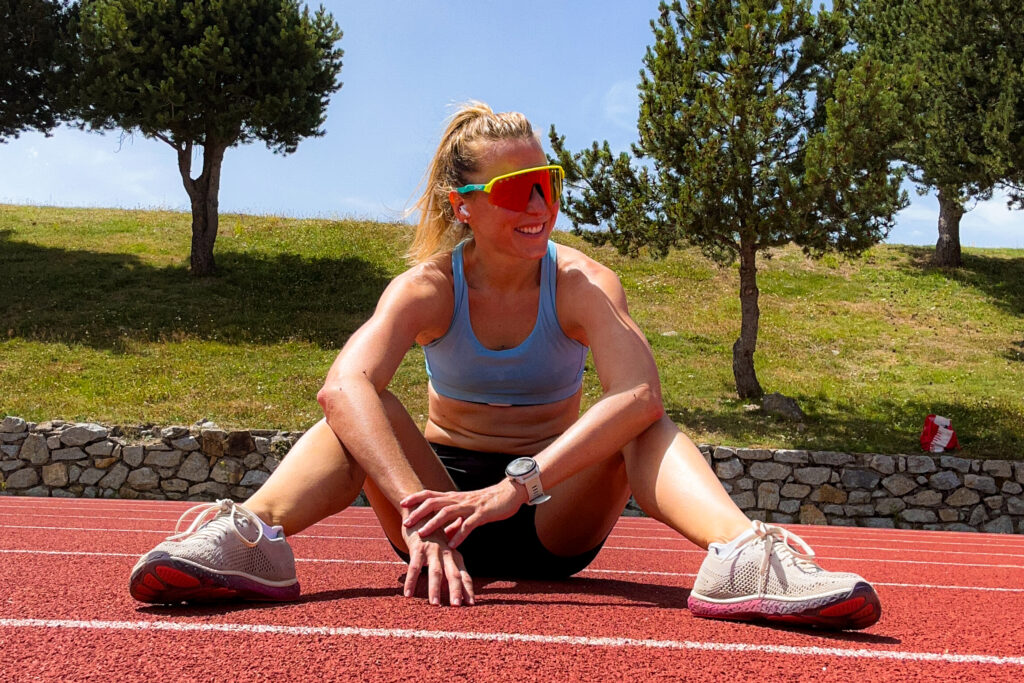
Everyone is there to run, and nobody is looking at you. I used to be nervous and think I wasn’t good enough or fast enough to run on a track, let alone in lane one (and I still feel like that sometimes). But everyone is focused on their own workout, and as long as you’re respectful and follow the basic etiquette, nobody is going to bother you.
Use the track for specific sessions. It’s a tool like any other training aid, so using it thoughtfully can be a great performance boost. Most triathletes use the track for speed work or tempo sessions, and that’s a great place to start.
Take advantage of being in one spot. Since you’ll be running in circles, you can warm up in your normal shoes (you don’t need special shoes for the track) and then do your speed work in your racing shoes—or even test different pairs.
You can also warm up in extra clothing and leave your nutrition, phone, or whatever else you usually carry on the side instead of on your person. Just keep your bags and other gear off the track and out of everyone’s way.
You don’t have to do your whole session on the track. If the track is surrounded by nature, I personally like to drop off my bag (if it’s safe to leave unattended) and do my warm-up on trails or nearby grass fields. Other times, I’ll run to the track with a small backpack containing my racing shoes, nutrition and phone, using that as my warm-up. Of course, you can use the outer lanes for your warm-up, including any skips or strides.
Start slower than you think. The excitement of the track has a tendency to make people (mmm, almost everyone) come out of the gate too hot. Track sessions are usually on the harder side anyway, so stick to your paces and don’t get swept up in the perfectly flat, springy surface and the excitement of stadium track day. (Okay, maybe a little bit—but save it for the final rep!)






A brief note about “environment”
There is no shade to be found at a track, so it’s gonna be hot in the summer. If it’s built around a football field (as most are), that’s gonna bring more heat & humidity into the mix. If they’ve recently cut the grass, be wary of your allergies, if applicable
And it goes without saying, being in a large open space, don’t use the track if a thunderstorm is nearby (lightning, y’know, and those goalposts)
love the smell of fresh cut grass! but so true - the extra ‘humidity’ makes it feel like running in dense soup.
all good points. Sharing the track (and infield) is super critical. I used to run workouts when the footballers were practicing, so it was a track workout and a test of peripheral vision.
Reminds me of the old Lee Trevino quote about being on a golf course in a thunderstorm:
If it starts thundering, hold up a 1 iron. Even God can’t hit a 1 iron.
My running buddy has a good quote “Trust the track”
GPS watches will look like you are going fast. I think that is because they are rounding up every lap. 400m is 0.2486 mile, so gps probably will round up to .25. You will notice it rings early before each time you reach the line. So GPS for ego… hit the “lap” button for accuracy
Also, the straight is 85 m, the curve 115m. The only time the track is accurately even is if you are doing 200m or more.
Our HS is very good in track, so our track is fairly well detailed; it has every kind of marking on it that you can imagine
The curvy start line where the Milers line up
The staggers across the lanes for the Sprinters’ starting blocks
The triangles which tell the Hurdlers where their hurdles will be
And so on
A bit of an unknown feature to many is that Garmin’s (and I think others) have ‘Track’ mode in addition to ‘Running’. Just a different activity. But the clever bit is that they have a database of nearly all the tracks worldwide and so you just let it know which lane you are in and it correctly handles the correct distance. So if you get there and are doing your laps in lane 3 to keep 1 and 2 free for sprinters, etc, then it will use the right c410m distance. And if you say leave your office, jog 10mins to the track, etc, then don’t worry, it’ll work fine for the warmup then ‘snap’ once you are there.
And if you want your best time, run the inside of lane 1 as close as you can to that line. It can be a difference of 3-5 meters per lap depending on where you are in that lane! That’s up to 20m in four laps.
What surprised me when I first started using a track is the massive difference in distance for one lap between lane 1 and then 2, 3, 4, etc. Around seven metres longer per lane.
The inside lane of a track wears many times faster than any other lane. For sustainability, unless I was racing, I never ran in Lane 1. I guess this was more important before the introduction of ‘tartan’ - for me, an ash surface, but i maintained that behaviour. What does it matter if ‘the time’ is two seconds longer?
On the maths; lanes are 1.22m (4ft) wide; running in Lane 2 is 2πi(D-d) which is 7.7m longer per lap.
But most athletes will run about a foot from the kerb so running in Lane 2 is in practice only 5.7m longer.
Let’s not bring Math into it, especially for beginners
Pick a lane, run around, repeat as necessary, have fun with it
. . . heat, humidity, hay fever, thunder, lightning