
Four Overlooked Features of Carbon Shoes That Can Make or Break Your Experience
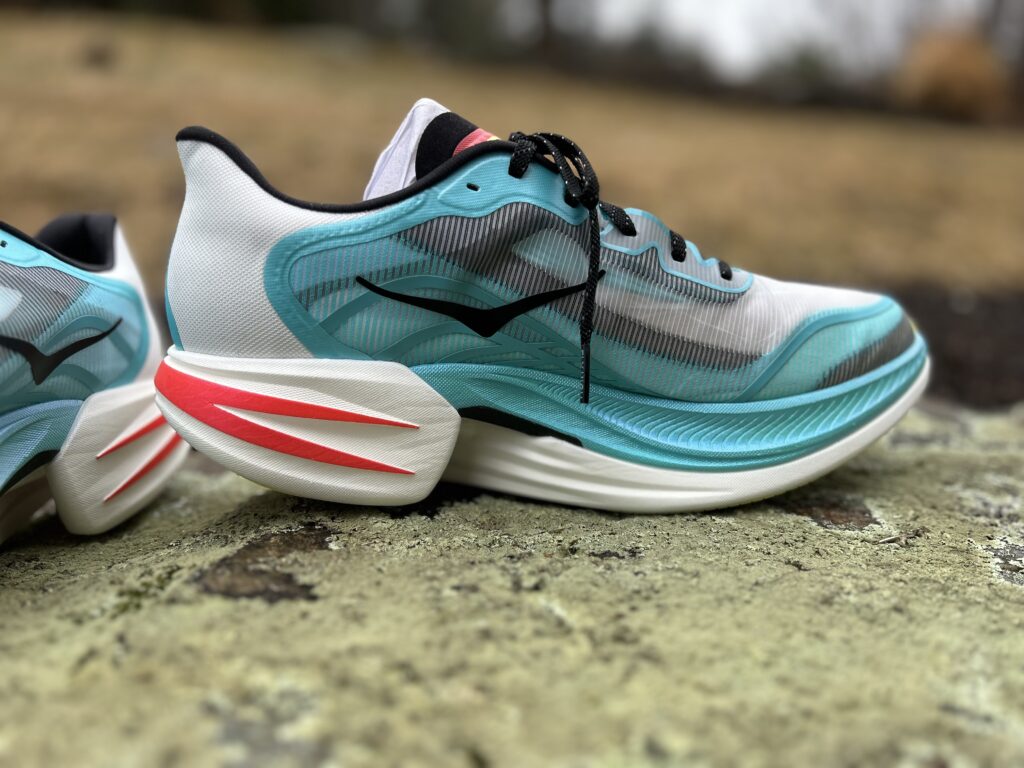
It should come to no surprise to you by now that I’m a big fan of carbon-plated running shoes. I held out for a long time, not putting my first pair of them on until early 2022, but since then it’s been all downhill from here. As part of my lead-in to IRONMAN Lake Placid a few years ago, I wrote up a comparison test of four of the then top options as I debated what shoe I would wear for the race. (A race that went catastrophically wrong for a whole lot of other reasons, but I digress.) In general: I respond really well to carbon plates, and most of the time I don’t experience any negative side effects unless I’ve already done something stupid to myself.
Yes, I am very aware how heavily the “unless” part of the prior sentence is carrying that outcome.
But when it comes to carbon shoes, there’s really not that much of a differentiation between them on paper. You find a proprietary hypercritical (or similar) foam, sandwiching a carbon fiber plate, and a lightweight upper to hold your foot to the platform. So choosing any of them should be the same, right? Wrong. Dead wrong. There’s far more nuance than that. And in some cases, it’s not nuance at all; it’s just an entirely different animal altogether.
Here are four overlooked components of some of these racers, that can help you better choose your next set of shoes.
Match Up Geometry With Your Preferred Running Style
There’s three elements of shoe geometry that, in my opinion, have the greatest impact on whether that shoe is going to work for you.
The first of these is offset. That difference between heel height and forefoot height, despite being all of a few millimeters, changes how a shoe runs significantly. In my experience, the “best” offset for an individual is typically driven by a combination of the shoe they wear on an everyday basis (outside of running), their typical run shoe, and then their preferred primary point of contact in their run stride. Example: I typically wear low to no offset shoes on a daily basis, along with run shoes that usually range from 3 to 6mm worth of offset. I typically respond most effectively to carbon racers that fall in a similar bucket. That said — it’s far easier for someone used to low offset to go up, rather than the other way around.
The second is looking at where the carbon plate actually sits in the shoe. Some plates start midfoot; some run the full length of the shoe. If you’re somebody who typically lands with a mid foot or forefoot strike, there’s little reason for you to look at a shoe that has a plate further back. If you’re more of a heel striker, you might benefit more from something that could make that transition happen faster. And maybe avoid something that is *ahem* this rounded back there.
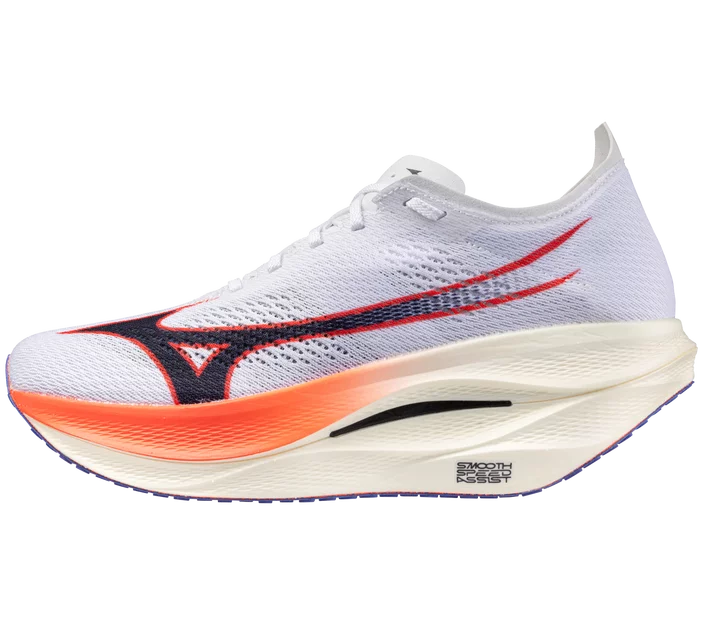
Lastly, you’ll want to check the width of the platform itself underfoot. As shoes grow taller in stack height, they generally need to be wider underfoot in order to maintain stability. Otherwise, you’re likely losing some of the efficiency gains. Nike, famously, is pretty narrow lasted, whereas HOKA is king of the widest platform underfoot, even in most of its racing shoes.
Uppers and Sockliners (and Socks)
In order for a shoe to rip your feet to shreds, there’s two issues: friction and moisture. With a shoe, there’s really only two places friction can come from: the upper or the sockliner / insole. For the most part, uppers have gotten to the point where you shouldn’t have an issue. Exceptions exist, of course; the ASICS MetaSpeed family uppers can be a little on the stiff side, with open mesh that could grab a little bit. But with recent advances in upper materials, we’re far from the overlays or stitching that tore people apart even just a few years ago.
The other main one is the sicklier, and how well it sits in the shoe and how it meets that upper. Generally speaking, if it feels flimsy when you stick your hand in the shoe, there’s a chance that will bunch when you start putting some strides into it. Also, check to see how well the sockliner arch sits against the inside of the shoe; if there’s a little bit of space there, it’s going to slide and be a potential blister source.
Also, look. Socks are your best defense and are far too overlooked. I wear a Balega sock as my daily driver, but they aren’t form-fitting enough for me to wear when running. I opt for either a Feetures Elite or Swiftwick Aspire, and can’t remember the last time I had a blister from running.
Check the Forefoot Flexibility
In a statement that should shock exactly nobody, carbon isn’t the most flexible material. Sure, it can be laid to bend and flex in certain ways, but it’s certainly more rigid than most of the foam you’ll find in today’s shoes.
Although I respond well to carbon shoes and wind up with significant time savings on downhill, flat, or gently rolling terrain, I also find there’s significant additional cost when trying to use the same shoes going uphill. Take, for instance, the recent 5K I ran in our hometown; wearing HOKA’s Cielo X1m in downhill segments, I was flying past fellow racers, touching 5:30/mile pace. Yet when the road pivoted uphill, I struggled to hit 8:00/mile pace. I’ve found that, at least with my stride, certain plates in shoes make it harder to go up.
I should’ve worn something that had more to give up front, like Diadora’s Gara Carbon or Saucony’s Endorphin Pro.
Traction Isn’t Optional
Just ask Jamie Riddle, who fell hard while cornering at IRONMAN 70.3 Aix-en-Provence, and is now awaiting results of an MRI on his knee.
Riddle was wearing the $500 Adidas Adizero Adios Pro Evo, which features a nearly bare outsole. As Riddle said in a comment on Instagram, “the evo line have always been about pure speed. adidas don’t market them for courses like this, it’s my fault. I would have been better off using the Adios Pro 4 which have grip.”
Echoing that comment, having moved to the Pacific Northwest over the past year, road surfaces get grimy with rain. At first, it’s because of all of the oil and junk that accumulates during the dry part of the year. Then it’s because it is perpetually wet and moss will wind up growing on the road surface. It’s a completely different experience than anything I’d seen before in my running career.
And it means that I look at my shoe line-up differently depending on the weather. If it has rained recently, I’ll opt for something with a better outsole to it, like the Adios Pro 4 that Riddle mentioned. But if it’s been dry for a while, I can opt to get racier in my choice, so long as there isn’t the kind of turn in the course that Riddle dealt with.




I’ll chime in here that as someone with really flat feet, the Nike Alphaflys demand that I train enough miles in them before I race, or I’ll invariably get a calf strain. Even the Nike Zoom fly 6s that are the ‘Alphafly trainer’ aren’t good enough to prevent them. I’ve since bought 2 Alphaflys and mix in one of them for training at least 2 months out, with increasing use up to race day. 3 separate calf strains have taught me the hard way about this.
A smarter version of me would abandon the Alphafly for some other sneaker, but man it’s SO fast that nothing I’ve tried can touch it. It’s even faster for me at slow easy/recovery paces (like 9-10min/mile), which remain faster to the Zoom Fly 6, for the same effort.