
Get Faster with Aero Drills from TT Fit Expert Matt Bottrill
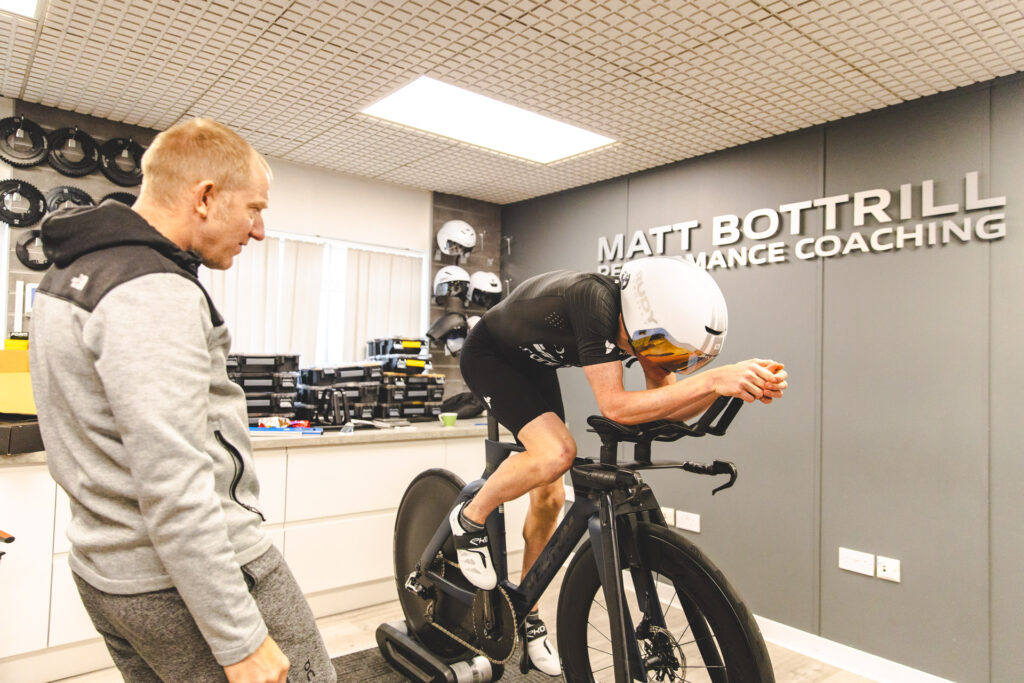
Triathletes talk about aerodynamics as if it’s just something you buy–a faster helmet, deeper wheels–but aerodynamics is also a skill. Go to any race and it’s guaranteed you’ll see someone on a very fancy TT bike sitting up because they can’t hold an aero position. And, even if you have a good position, sitting there might be easy, but holding that posture pushing race watts with mounting fatigue is a whole different demand.
The Triad of Time Trialing
When you look at the complexity of time trialing, according to coach and bike fit expert Matt Bottrill, it has three different parts: speed, power and aerodynamics.
“Ultimately, speed is the most important part of going fast,” Bottrill says, who has worked with both professional triathletes and cyclists. “This should be your ultimate goal. You want to have the least amount of power for the maximum speed.”
“Power is all about having control,” he continues. Climbing, he explains, is an easy way to understand the concept of power since your wattage output must be controlled for success. The same logic applies when you’re riding into a headwind.
“Aerodynamics is all about gaining speed and saving energy,” he says. “Eighty-five percent of drag is from the athlete–that’s why having a good bike fit, clothing and helmet are so important to save time.”
The combination of power and aerodynamics is what delivers speed and, while every athlete understands training is how to improve power, most athletes don’t understand how they can improve aerodynamics beyond a bike fit and better equipment.
Aerodynamic Positioning
Bottrill insists that having a good bike fit, preferably from a TT specialist, is essential. Investing in a good position (yes, including the equipment to get you there comfortably) is the foundation. But having a good position and riding in it are two different things. As a multiple national time-trial champion himself, backed up by a wealth of experience working with pro and amateur triathletes and cyclists, he says simply: “Nobody can hold aero for the full duration of a race.”
“It’s very hard to produce power and stay aero at the same time,” says Bottrill. “Most people think that you utilize aero the most going into a headwind, but it’s the opposite way around: you want to be able to conserve energy into the tailwind. Anyone that is pacing correctly will be utilizing the position to save energy–everything I have achieved myself and helped athletes with has been around this.”
With that in mind, Bottrill suggests having three variations of your position.
Position 1: Your climbing position, or ‘I’m wasted get me to the finish!’
Position 2: Sustained aero and 80% of the event will be spent here. Head is low and shoulders are relaxed. You’re looking down the road and not at the floor. You’re trying, but it’s sustainable.
Position 3: Maximum aero where your head is low, you’re looking forward and you’re really trying to sustain your best position.
Everyone Can Improve with Aero Drills
Having the skill to hold these positions is where the work comes in. Bottrill posits that any rider can improve their aerodynamics with specific aero drills. The drills are designed to strengthen a rider’s ability to maintain their position. Over time, riders build awareness of what the position feels like and the body begins to recognize the posture automatically. And that’s the real objective: turning something that initially feels forced into something that happens naturally when speed increases.
Just like swim, bike, run training, there is no short cut here. There must be specific, and diligent, practice, but Bottrill says it always pays off.
“I’ve worked with some of the best athletes in the world and they all improve,” he says. “The key is completing drills. I would say most age group athletes see gains of 30-40 watts if they have never done anything to improve–so a good bike fit or good coaching can change everything.”
But what if you’re already pretty dialed in? Bottrill says even the pros get a boost by investing time and energy into aero drills.
“The biggest gains I’ve seen overall from the pros were Tim Don, Tim O’Donnell, Susie Cheetham and Ruth Astle,” he says. “They all totally bought into the process. Ruth Astle was by far the most aero athlete with a CdA of 0.172.”
Drill One: The Shoulder Shrug
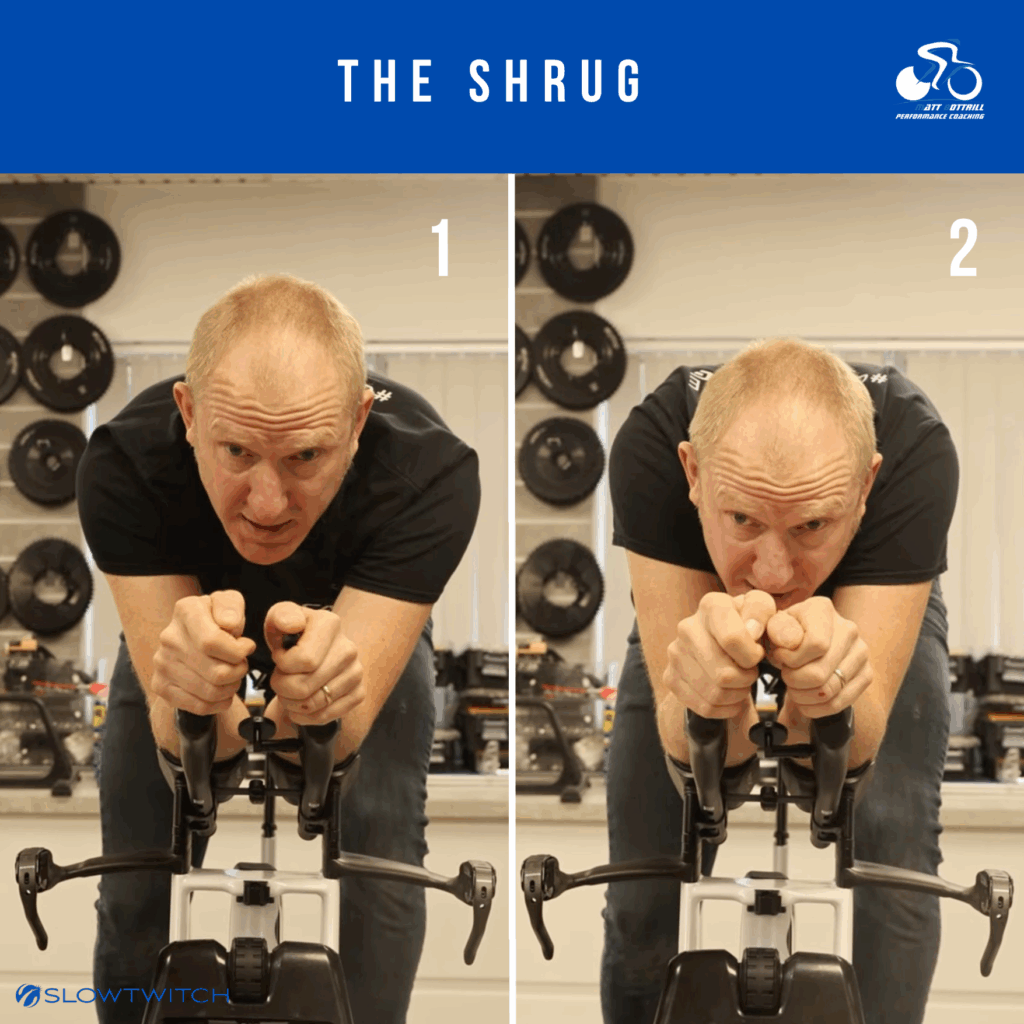
The first drill addresses one of the most important aerodynamic cues on the bike: shoulder width.
Many riders lower their torso, but leave their shoulders broad and exposed to the wind. From the front, that creates a large aerodynamic footprint. The solution is something Bottrill refers to as “the shrug.”
In your aero position, riders should “shrug their shoulders,” effectively trying to “punch a smaller hole” through the air. Done correctly, the shoulders rise slightly and roll forward toward the ears, narrowing the rider’s profile. The cue isn’t about tension or stiffness. Instead, the goal is to reshape the upper body so air flows more smoothly over the rider. The effect is subtle, but meaningful: a smaller frontal area means less drag.
Drill Two: The Turtle
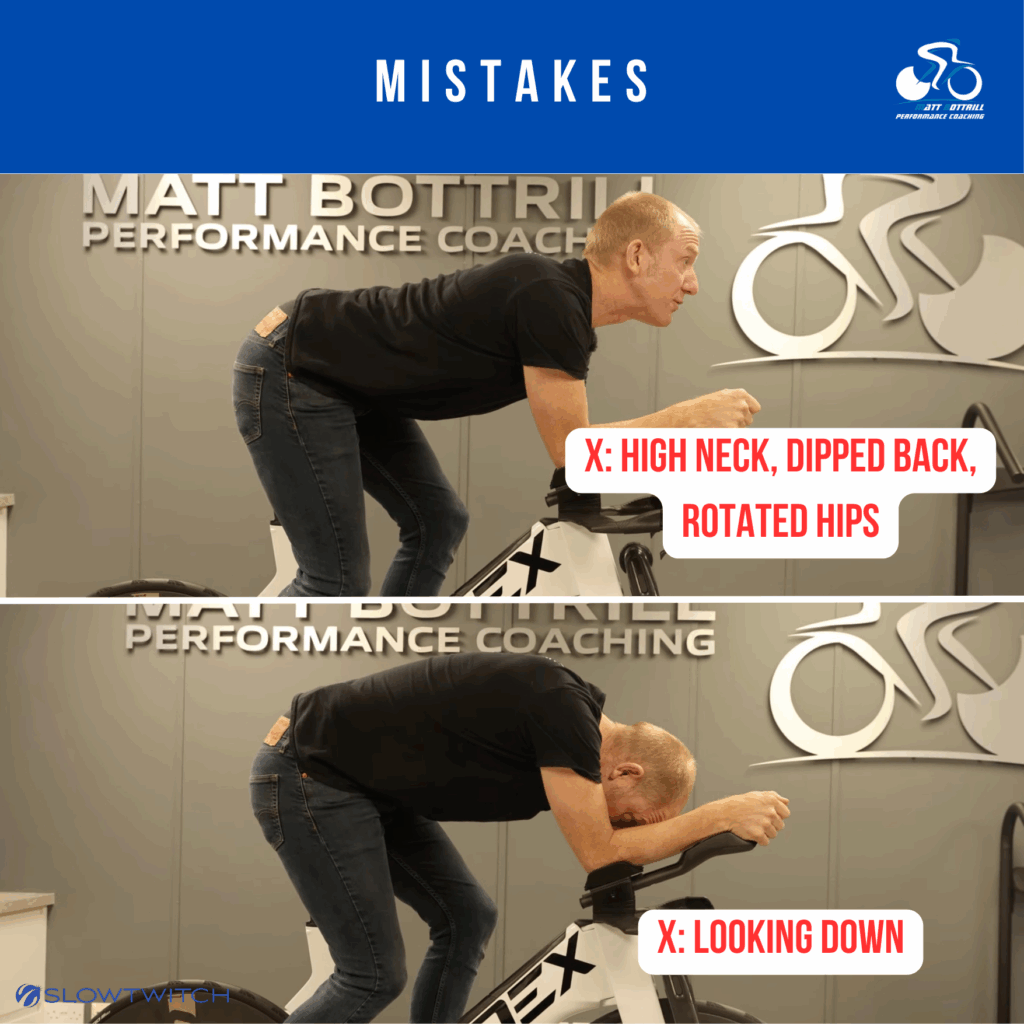
The second drill targets another common aerodynamic leak: head position. Many riders instinctively lift their head when they increase effort, or scan the road, which increases frontal area and disrupts airflow over the helmet and shoulders.
In your aero position, drop your head forward, but keep your eyes up. A simple cue is to move your head like you’re trying to eat from a bowl. And, think turtle–which makes sense once you see the momentment.
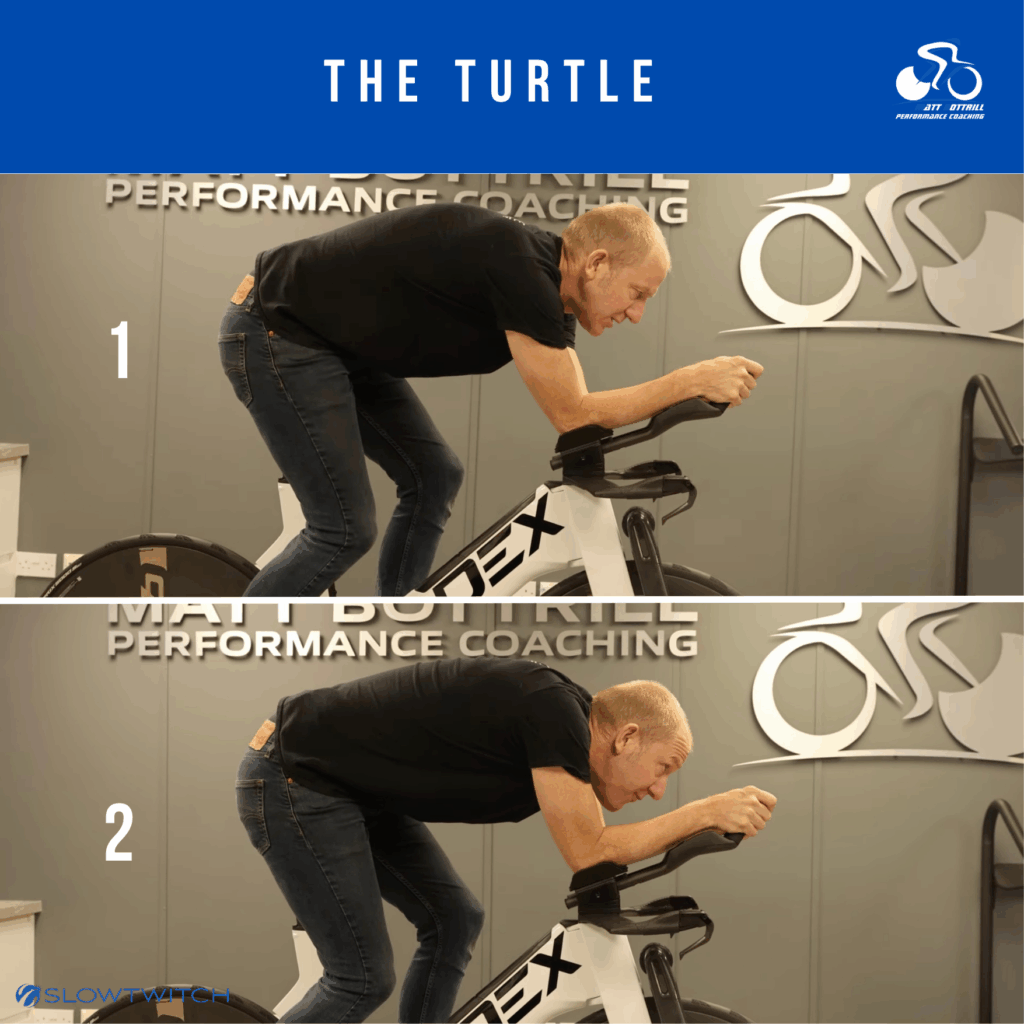
Bottrill warns that a lot of riders drop their head down which is a big mistake. Looking at the ground is simply dangerous, so always keep your eyes up the road. The goal here is to have your head sitting between the shoulders rather than above them. Ideally, the helmet is then also aligned with the back of the shoulders, maintaining a smooth aerodynamic shape.
A second mistake with the turtle drill is when a rider dips their lower back or rotates their pelvis along with the head movement, which puts tension on the shoulders. Bottrill says triathletes, specifically good runners, are susceptible to this. Maintain your saddle and core control (the “shell” of the turtle) and move only your head and neck.
Training Application
To begin incorporating the drills, start with several short repetitions, like 2-3 sets of 6 x 15-30”. It’s also best to do these on an indoor trainer during an easy ride, ideally in front of a mirror (or even a phone camera), so you can self-critique and adjust.
“Ideally, when you start doing aero drills you need to complete them twice per week,” Bottrill says. “Once you master that, then every week one session should be completed.”
Practicing the drills will train you to sit in a more aero position and hold it under fatigue–and that will pay dividends throughout a race, but especially towards the end. Not only will you be faster on the bike, but that means more energy for the run.
“I’m still amazed that more athletes don’t do this,” he says. “You can’t just train the body to get fitter, you have to adapt to improve aero, and pacing is so important. It’s the biggest factor in improving. You can’t just buy all the equipment and not train the position and improve pacing.”
Perhaps it sounds like inconsequential work, but Bottrill’s success, personally and with top athletes, says otherwise.
“Doing the drills twice a week, you will start getting gains within six weeks,” he says. “It’s pretty quick. In six months, you will see massive gains.”



Is there a link to this article?
Why isn’t aero most important going into a headwind? Why do I have it backwards?
Yes, this seems wrong to me also. Effective airspeed is what matters for air drag. And that is ground speed +/- wind speed.
Riding 40 km/h into a 20 km/h headwind = 60 km/h airspeed
vs.
Riding 50 km/h with a 20 km/h tailwind = 30 km/h airspeed.
So, being aero into the headwind would be more important
I thin k you guys are simply reading this wrong -
That “conserved energy” gets used when the course goes windward. Remember, in racing - any racing - winners spend the least amount of time going slow. That’s when you’re into the wind, going uphill, etc..
I too am confused by this… Is this a misprint? Or, is what the fit expert is trying to say is that a more powerful position (for power output / comfort) despite being less aero going into a headwind is better than a more aero position… Is he essentially saying
1. Tailwind = Try for more aero position and Headwind try for a more ‘power’ (relaxed) position…or…
2. Headwind = Try for more aero position and Tailwind Try for a more ‘power’ (relaxed) position
Thanks.
Yesterday I did a test with my Gibli on my standard test track, and had a disappointing cda of 0.245. That had been better. First I blamed the Gibli, but later I thought maybe it was the suit. I wore an old Castelli All Out one-piece, which is worn out already and flutters a bit.
So today I started on the same track with my newest Castelli PR and other socks.
I also thought about the “shrugging” discussed in this thread, and tried it out.
Today a cda of 0.220. That’s 20W at 40 km/h. Crazy difference.
Today I want to believe my Gibli.
Mostly number 1.
Joel Filliol did a great podcast with Bottrill last year. More detail and other subjects abound.
Thank you
If you slightly pull with your fingers such that you kind of cause your elbows to dig into the pads it will naturally start to draw your shoulders and head into what is described.
Getting your GPS mount sorted out so that if you must peek you can divert just the eye and not the body is important too. Some can pace by feel others look. Needing to move the head or body to see a GPS is a miss.
Personally I find rolling the hands inward tends to help my posture also. Likely because I feel less tension in the forearms that way.
In general it absolutely kills me to see folks with helmets with gaps behind their helmet and back or shoulders you could fit a bottle under.
I mean at TT race pace I can generally hear changes in the pitch of the wind noise assuming there aren’t random cars or gusts.