
Expert Indoor Training Tips from the Fastest Bike Split at Challenge Roth, Pro Merle Brunnee
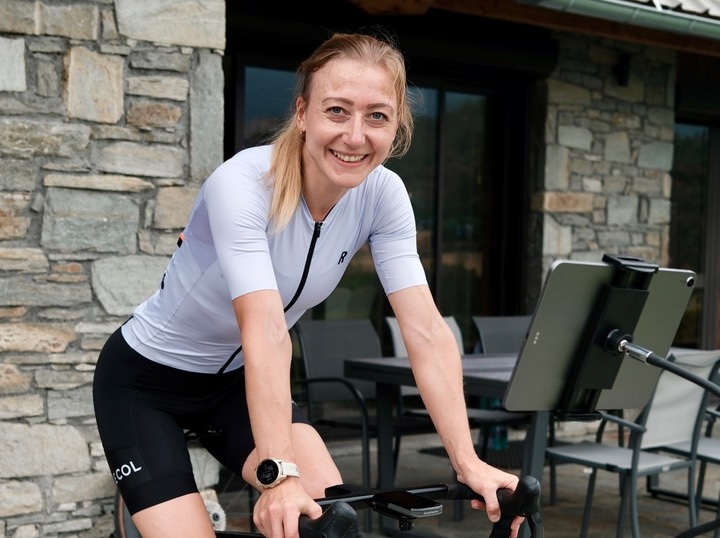
Pro long distance triathlete Merle Brunnee made her presence known at Ironman Nice in 2024–she finished third and impressively out-biked Lucy Charles-Barclay. Three months later, on the same course, she finished 14th at the IRONMAN World Championship. The following year Brunnee earned herself a Kona slot at Ironman Lanzarote, finishing third to Charles-Barclay again. She rounded out her season with a podium finish (third) at the famously mountainous full distance French race, Embrun, and a sixth-place finish at Challenge Roth, where she posted the fastest bike split–3:29 faster than Laura Philipp. Oh yeah, and she became the world duathlon champion too.
It was no surprise, then, that her leg power got her noticed by the German cycling federation. Brunnee was selected to represent her country at the 2025 Esport World Championship, where she finished fourth. As if all of this wasn’t impressive enough, sport is just a side hustle for the 31-year-old. Brunnee works full-time as a doctor in the neuro-radiology department at the University Hospital in Heidelberg, Germany.
To make everything possible, there is one tool that Brunnee relies on: indoor training. Being able to train according to her work hours and through the dark, cold German winters is essential. While most of us won’t ever be able to beat Charles-Barclay on the bike, she can still provide some valuable insights based on how she sets up, approaches and executes her indoor training.
Slowtwitch: You raced the Esport World Championships for Germany. How is racing inside different to racing outside and what did you learn from that experience, especially as a triathlete?
Merle Brunnee: Racing indoors is very different from racing outdoors because the demands you have for the task are very different. As a long-distance triathlete, or racing at middle distance, outdoors is all about pushing high numbers for a long time. You need a high FTP and consistent power over a long duration. But indoors is very different because those races are often no longer than about an hour, and in the world championships, the races were around 15 to 20 minutes. Indoor racing has a completely different stress profile. I have to be punchy, sprint, counterattack and really check what others are doing, because when they attack or someone breaks away, I have to respond tactically.
Outdoors, I don’t have as much of that. I’m more of a back-of-the-pack swimmer, so I’m often on the bike alone, just racing against myself, trying to catch others, but not having that group dynamic. Also, indoor racing has a draft effect, which is really important, whereas in triathlon, especially now with the 20-meter drafting rule, there’s basically no drafting, so I can just do my own thing. And, yes, high numbers and a strong FTP are still crucial; the strongest will always win, but it’s a very different stress profile.
What I learned most as a triathlete is not so much a technical skill, but that racing and training indoors is a huge motivation for me. Competing against the best in the world, comparing and racing really fuels me. I’m just a very competitive person, and this gives me the best motivation, and I really benefit from that.
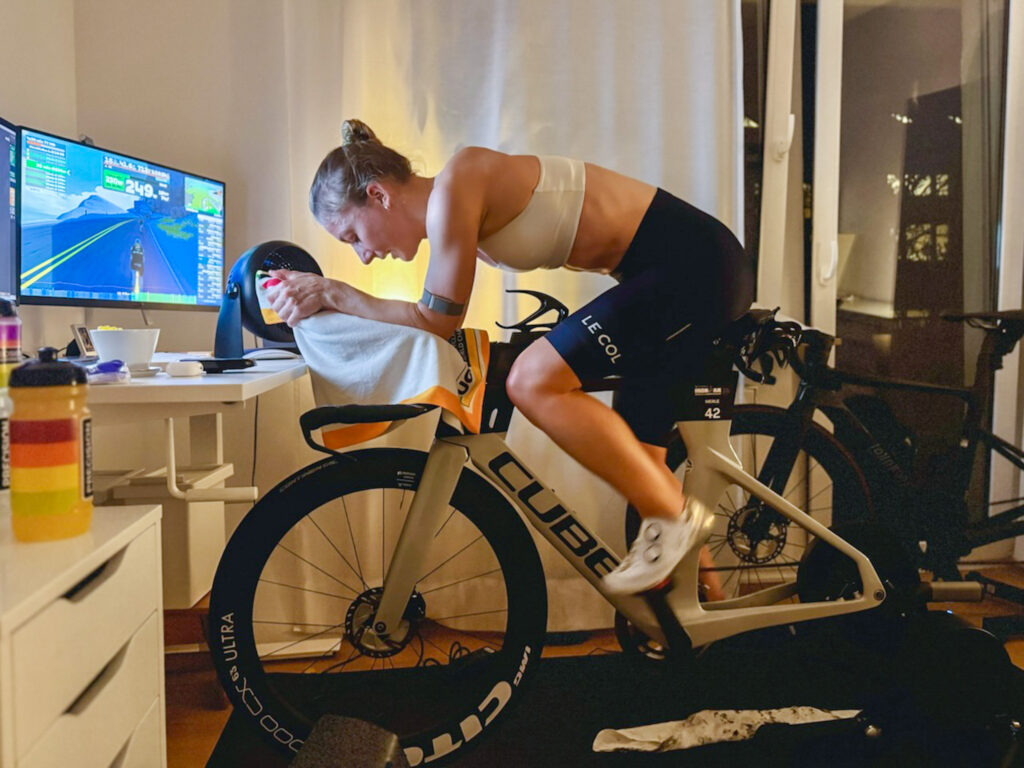
Take us through your indoor set up.
I have a really good indoor setup and I really enjoy it. My room is actually my working space as well. On one hand, it’s my office where I do my research—because I’m not only a triathlete, but also a doctor. When I’m at home working, I sit there, but I have a height-adjustable desk. So, when I switch from working as a doctor to training as a triathlete, I just raise the desk.
I have two different turbo trainers: a Wahoo KICKR V6 and an Elite Justo. I have both because I have different cassettes: one with an 11-speed cassette for my time trial bike, and another with a 12-speed cassette for my road bike. It’s convenient because I don’t have to swap cassettes. I also use different virtual platforms—sometimes I just ride freely, but mostly I use Zwift and MyWhoosh. I enjoy both; Zwift is probably my favorite, but it depends on the day.
For music, sometimes I just listen to music, especially when I’m doing intervals, since I don’t want to focus on a podcast or a show. On easy rides, I usually watch the news to stay updated, or sometimes I listen to podcasts, movies, or, what I like most, I call friends who are also on the turbo—so the time just flies by.
I usually have at least one fan; in the summer or during intense rides, I have two. One is a small one blowing directly on me, and the other is a Wahoo Headwind on the floor. I think having a lot of airflow is crucial because, when you ride indoors, you can overheat quickly—especially me, since I ride indoors in the summer. So, it’s really important. I also have a nice light scene—different light strips, like Philips Hue—so I can create a really good atmosphere when I train. It’s not exactly cozy, but it’s a great environment, and I really like it.
Do you enjoy training inside? Do you prefer it?
That’s not an easy question, I think. I mean, yes, I do enjoy training indoors, but I don’t prefer it. There are a lot of advantages, though. First, of course, is wintertime. I live in Heidelberg, Germany, so we have a cold, wet and dark winter. Also, since I work as a doctor in the hospital, I have to train around that, which means I’m often off work when it’s dark. In the winter, I don’t really want to ride outside in the wet, cold and dark—it’s not fun, and it’s a bit dangerous. So, in winter, I definitely prefer riding indoors. But especially now, as winter is ending, I’m really craving summer—riding outdoors, because time just flies by so much faster.
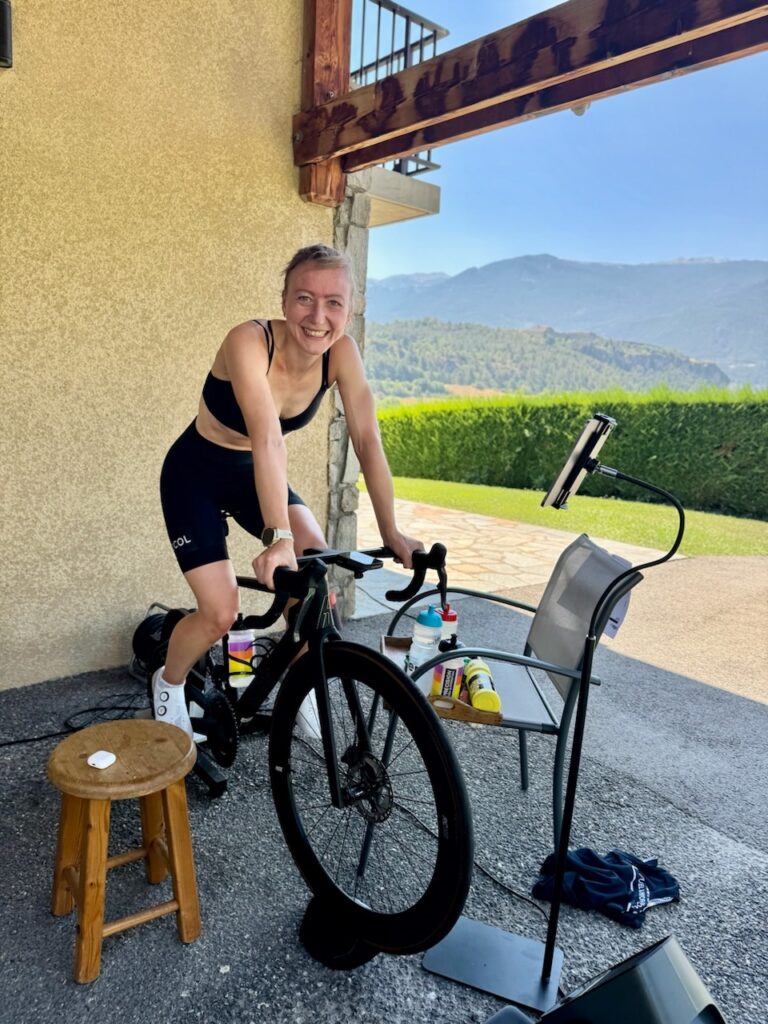
When it’s nice weather, do you still train indoors? If so, why?
Yes, I do train indoors all year round, and there are a few reasons for that. Probably the biggest one is that indoor training is very time-efficient. If I want to hit specific numbers or targets, it’s easier indoors—especially when I don’t have good terrain nearby. For example, on my time trial bike, when I want to do long race efforts—like 20 to 30 minutes at race pace—it’s really hard to find a safe, quiet stretch outdoors without traffic lights or cars. Of course, shorter intervals can be done outside, but it’s often easier to be precise indoors.
Another big advantage is nutrition. For long rides, I also do them indoors—on the turbo trainer—and I keep everything right beside me: gummies, gels, carbs, hydration—no need to stop or buy anything. Also, I’m independent of daylight, which is really nice—especially in spring and fall—when the days aren’t that long. I can start whenever I want and not worry about daylight. So, it’s easy—I don’t have to ride anywhere to begin. I just hop on the turbo. I do live in Heidelberg, which has great conditions for outdoor training—there are hills right outside my door, and the city is small—so it’s really easy. But still, sometimes I prefer doing key sessions indoors.
Are there any sessions that are better indoors? Outdoors?
As I said, I definitely prefer riding outdoors. Most of my easy rides or rides with friends are, of course, outdoors. That’s what makes it fun—riding with friends, being in nature, seeing the landscape. I’m really lucky because I have beautiful nature where I live, and when I’m on a training camp or on vacation, it’s just the most beautiful thing—climbing new hills, discovering new passes and really enjoying it. That’s what makes it worth it. So, most of the rides—like the endurance rides, when I don’t have specific numbers or targets—are definitely better outside, especially if I have people to train with. But, as I said, when I have specific goals, when I’m short on time, or when I need exact training, I do prefer riding indoors.
How do you convert outdoor training sessions to indoor ones? What do you change? Any quick rules people can follow?
You can definitely do your outdoor training sessions indoors, but you need to remember that a 90-minute indoor session usually has more training load than a 90-minute outdoor ride, since outdoors you have free riding—like coasting downhill—where you push zero watts, or are stopped at traffic lights. So, 90 minutes indoors is definitely more intense. For intervals, I don’t change that much, because I still keep my targets—for example, when I do five by four minutes, I don’t really adjust it. You just need to ask yourself if you want to ride in ERG mode—where the trainer gives you a set resistance—or if you want to do a free ride aiming for your best average. I do both, and I don’t think one is always better—sometimes I just can’t stand ERG mode, but other days, it’s easier because I just have to hold the power. So, I recommend people try both and see what works best.
And for anyone struggling to hit their numbers indoors—except for endurance rides—I’d suggest doing races. Every platform has races you can join, and racing against others is a big motivation for me. I also recommend not being too strict with the intervals—when you’re outdoors, you can just do, say, four by ten minutes or ride a local hill as fast as you can and go for the Strava KOM—same goes for indoors. If you don’t want to do exact intervals, try a hilly race or something that mimics those efforts. Be open to alternatives—there isn’t just one way. Keep what works for you, and go with what you can manage.
Can you give examples of how you convert power and time from indoor to outdoor? Do you aim for a certain TSS? Is the conversion different for base riding compared to, for example, VO2 intervals?
What I can recommend is using TSS, and I do rely on it, but another good option is just tracking the total work you see on the bike computer or platform. You can aim for a target, like a 1,000-kilojoule ride, not just to count calories, but as a motivational benchmark. So, you can hit that same work total outdoors, but it might take longer because of traffic or lights. Indoors, though, it’s easier to have that stable metric. So, instead of always relying on TSS, some people use total work as a goal. For base riding, yes, outdoor rides are usually longer. As I said, two or three hours indoors is often more intense. But, for VO2 max intervals, I don’t really adjust them—they stay the same. I just try to hit my best average, whether it’s indoors or outdoors. For me, the intervals don’t need adjusting—just the base rides.
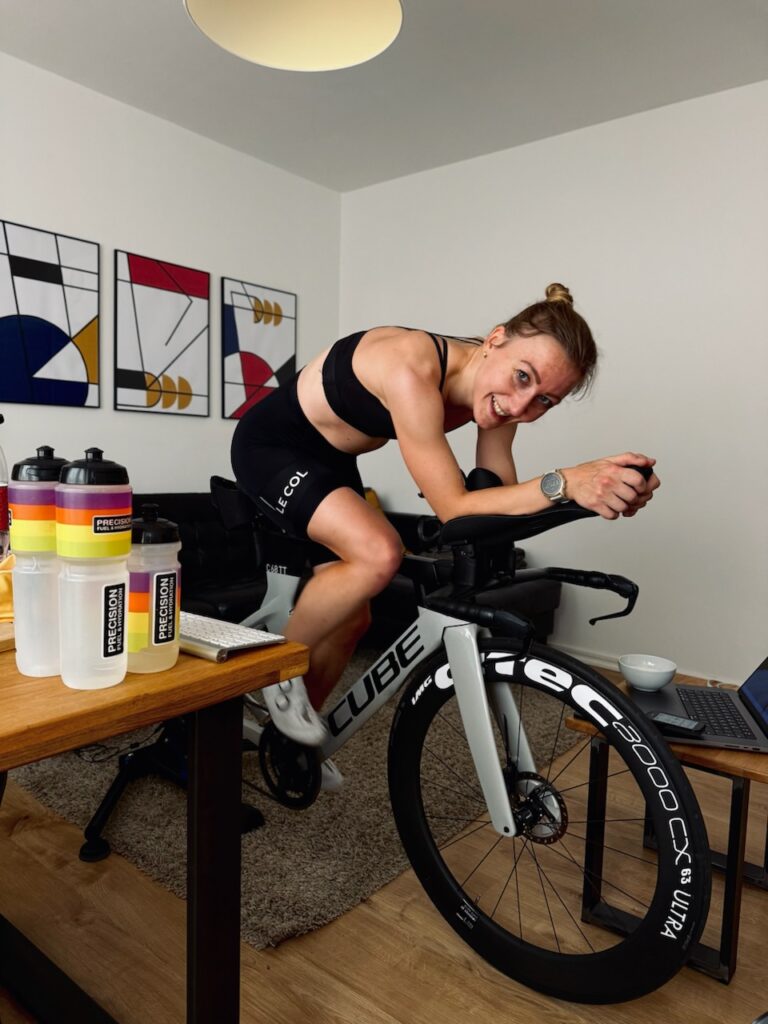
You can’t train bike handling inside, so is that something you consider? Are there any riding techniques that you work on indoors?
I think bike handling is crucial for many races, and it’s really important to train it. It’s more vital in some races than in others. For example, the IRONMAN World Championship in Nice versus the one in Hawaii—I think in Nice, it’s crucial to have the confidence to ride fast on the TT bike downhill and handle unexpected issues in the street—like potholes or speed bumps. You really need to practice that in training and get a feel for it. In Hawaii, you don’t really need that—you just go straight down the road with only one major turn—so it’s not technical at all. But, for many races, having a feel for the bike is key—understanding what happens in different conditions, like wind. I remember the IRONMAN in Lanzarote last year, where I qualified for Hawaii—the wind was intense, and because I was used to it, I knew how to handle it—even with my disc wheel. But, if you’re not used to it, it can really ruin your race.
At the same time, indoors, you can stay in the aero position for a long time. There’s no need to get out, so you can see if you’re comfortable holding that position from hour one to hour four. I sometimes film myself or take photos to check my position—like where my head is, whether it’s catching the wind—so practicing indoors is really good for that.
Do you change your nutrition inside?
Yes, I do change my nutrition inside. In fact, my nutrition inside is a bit more fun than outside. Outdoors, I usually fuel with just liquids—I put my carbs in a bottle and have a carb drink, which, you know, is fine, it tastes okay, but it’s not really exciting. But indoors, I really enjoy having a variety of snacks—sometimes I have a little snack party, with gummies, cereal bars or anything sweet. I have everything right beside me, and I don’t have to ration my water or wait for a stop. Sometimes, when we do endurance rides outdoors with friends, we do stop for a treat—like ice cream or cake and, actually, that’s a fun idea—riding for an hour indoors, then relaxing on the couch with ice cream, and then getting back on the turbo. I should try that—maybe once!




Good article and appreciate its focus.
Would be interesting to know, given she’s a (self admitted) BP swimmer, how she splits her training hours between swim, bike and run. I suspect she likes the indoor bike grind and, from a triathlon pov, over indulges in her bike and has shelved any aspiration to improve her swim. Which is fine; but she’s a decent runner who would soar up the rankings if she wasn’t losing 20 minutes in the swim (in an IM).
I further observe that with the introduction of the 20m draft zone (mentioned) here is an athlete who is a poor swimmer (so into T1 with male amateurs) but who is a great biker and will be riding almost as fast as the top amateur men (4:30 in Roth last year). Later in the year, provided she races decent races, she might be able to offer an experience based opinion on how the amateur/pro interaction plays out without much interference.