
Triathlon Rule Changes That Could Come After the SRAM/UCI Legal Drama
Late last year, SRAM took legal action UCI over the UCI’s proposed gear ratio limits, claiming that these rules were both not grounded in safety and effectively anti-competitive. An administrative panel agreed, citing that the rules lacked evidence that a gear ratio limit would, in fact, make for safer riding. The UCI appealed.
Ten days ago, a Belgian administrative authority released its decision in the UCI’s appeal. Top line: SRAM has won, and 10-tooth geared rear cassettes aren’t going anywhere. But that’s just the start of the story. The legal theory the Belgian Competition Authority (BCA) advances to base its decision off of could have wide-ranging implications for any sport that legislates advances in technology — and especially triathlon.

As reported in The Athletic, the BCA relies upon a 2023 decision from the European Court of Justice that found that FIFA and UEFA had broken monopoly law when the sporting bodies had deemed the proposed breakaway European Super League illegal.
Sports leagues have generally long had ability to regulate themselves without falling under antitrust, or anti-competition, legal frameworks. This especially holds true for the rules of the sport being played itself; for example, the maximum size of a golf ball or driver is defined by rule. That said, the business side of the sport is not always the same, as we’ve seen with the never-ending NCAA legal battles. And, of course, there are full on anti-trust exemptions for certain professional sports in the United States.
According to this ruling, though, just because the UCI had been acting in its capacity as a sports regulator was not a sufficient justification. The theory is that because there had been material economic impact against the parties involved (in this case, SRAM), the rule could not stand. In other words, the UCI had to ensure that as it developed rules that there was not significant harm to a third-party manufacturer.
In theory, then, it means that manufacturers will need to be part of a consultative process any time new rules are being developed for the sport itself, even if that rule is indicated to be for safety. (As the prior version of this case noted, the UCI could not prove that banning 10-tooth cogs would, in fact, improve safety.) It pretty dramatically shifts power towards manufacturers, who could claim that restrictions would materially impact their economics.
Pushing that theory forward, then, there are many triathlon rules that could theoretically be on the chopping block if a manufacturer decided to bring this before a European court. Here are ones that seem most ripe for challenge.
Wetsuit Temperature and Thickness Rules
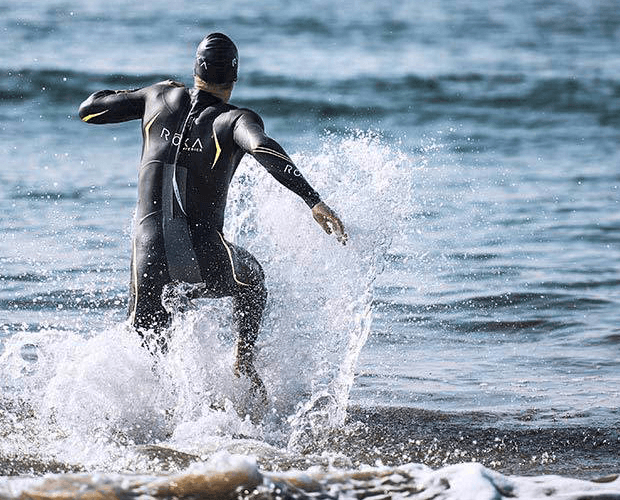
Wetsuit rules have been around since the late 1980s, but really only started to firm up into the rulebook that we all know in 2010. In February of that year, IRONMAN instituted specific rules limiting the material and thickness of swimwear and wetsuits, mandating that they could not exceed 5 mm in thickness. Prior to this point, most governing bodies, including USA Triathlon, did not have a limit on wetsuit thickness.
Overnight, it banned a wetsuit that had proven itself to be quite popular with Slowtwitchers: De Soto’s Water Rover wetsuit, which featured panels of either 8 or 10 mm in thickness. In fact, the Water Rover remains one of the few suits still specifically listed as being prohibited for use in IRONMAN races. Had this legal theory been in place at the time, it seems highly unlikely that we’d wind up with a wetsuit thickness rule today.
The other place I could see rules being modified: the wetsuit temperature cutoffs. There’s adequate literature on the safety reasons for the maximum allowable temperature limit. Where there’s a lot of gray area is probably in that so-called “wetsuit optional” range whereby athletes who wear them are ineligible for awards.
Disc Wheels in Kona

Disc wheels have been banned in Kona for decades, banned under the guise of safety. Over time, though, collectively our knowledge of bike handling and safety has changed a fair amount. We understand that front wheel depth plays a far greater part than initially imagined. And, with effectively pseudo-disc products on the market like the HED Jet 180, we’re already skirting the intent of the rule in the first place.
The Hydration Box and Fairings
God, this again? Yeah, this again.
I just don’t see how accessories fitting outside of these seemingly random sized parameters are founded in actual “safety” rules. And, as we’ve seen recently with athletes being forced to take certain components off of their bikes at bike check, there’s definitely some degree of economic impact coming down the pike. In total, it’s a poor attempt to make bikes look “normal.” And, as we’ve already seen with the UCI, that wall of logic appears to be crumbling.
Shoe Stack Heights and Carbon Plate Limits
The maximum stack height limit for running shoes, along with the single carbon-plate span limit, seem to be somewhat arbitrary. They seem to be put in place, much like the maximum spring effect and ball speed limits for golf equipment, to “preserve the integrity” of the sport.
But there’s no real evidentiary tie to safety. And with more and more shoes coming to market that either deliberately exceed the 40-millimeter maximum stack height rule, or those that simply aren’t being submitted for testing and will require additional scrutiny post-race, there is a real case to be made that outright banning shoes could meet the material economic impact testing that this particular case seems to hold up.






I think the challenge from parties wanting to press for foam, fairings and neoprene would need to be existential. SRAM = 10tooth, any other outcome from this arbitration would have been near terminal.
Wetsuit rule is definitely for safety. But perhaps allow the thicker suit for colder temperatures?
To be honest, I find your reasoning not very convincing. This case was unique in two parts, namely that the UCI’s particular choice of gearing regulations impacted one manufacturer much more significantly than others, due to previously made technology choices by SRAM, and that the UCI justified the new rule with safety concerns but could not provide any evidence that it would actually improve safety.
But limitations on stack height, neoprene thickness, or wetsuit cut-off temperatures aren’t claimed to be for safety. They exist to create a level playing field for all participants and to limit the importance of equipment versus pure athletic performance. Both are very valid reasons for regulation in sports and ones which are hard to challenge. Because unlike safety, the question how much aid from equipment athletes should be allowed to get is purely subjective. The fairness comes from them being the same for everybody.
FINA banning supersuits undoubtedly had a massive negative impact on the manufacturers of supersuits, for example. But nobody would have thought to argue that FINA didn’t have the right to decide that swimming as a sport should be about ‘naked’ performances and not about supersuit-aided performances.
what? the swim can be canceled if the water is too cold or too hot if you read the rules. 100% for safety
The logic behind the standard 22°C or (24.5°C) cut-off has nothing to do with safety, as evidenced by the fact that non-competitive waves are allowed swimming with a wetsuit even at temperatures above that cut-off. Rather it’s based on the logic that at water temperatures warmer than that it is reasonable to expect athletes to be able to not need the thermal protection of a wetsuit.
The additional cut-offs of 28.8°C, above which wetsuits are no longer allowed even in non-competitive waves, and 16°C, below which athletes will be forced to wear a wetsuit, are of course based on safety considerations. Those exist to prevent foolish athletes to endanger themselves by risking overheating or hypothermia. In practice, they are of little relevance to competitive triathlon, however.
The Hydration boxes were designed in (somewhat rough and domineering) collaboration with industry. Which would give WT a strong argument that they had followed a consultative process. The issues at races stem from random 3d printed stuff or people not following the rules with standard parts.
There are no wetsuits that exceed the rules anymore, so anyone trying to claim economic harm would be arguing that the rule prevents them from making a new suit for market advantage. Similarly for shoes.
Very different scenarios to the UCI making a arbitrary rule with no clear evidence that happened to hit one brand more than others. IMO 10T is ridiculous and would be no great loss. But for SRAM it is a strong differentiator in their product offering.
The lawsuit has caused quite a rift between the UCI and industry, so it will be interesting to see whether the UCI are smart enough to realise that they need to repair that relationship to avoid further dramas from non-consulted processes. Or whether SRAM has caused irreparable damage to everyone else.
Heh, I love it!!
The best part of your list is it turns the tables on the rule makers who all too often (but not always) point to legal issues and safety and insurance worries etc as cover.
This kind of turns that on its head in favor of innovation and the athletes.
I don’t entirely disagree; I was being somewhat speculative.
BUT – this is a relatively broad expansion of where we draw the line on anti-competitive behavior. Typically there’s a need to show that the actions taken by a party (e.g., non-natural monopoly behavior) were a violation. This is flipping it to the result of activity that, on its face, is strictly within the limits of what the sport is trying to regulate.
Do I want various legal systems attempting to tell us what the rulebook for sports should be? Not really. But this appears to be the direction we’re heading in.
I still don’t see it. Compared to other important legal cases on the limits like the Bosman, the European Superleague, or the ISU rulings, this is a nothingburger. The fact that sports regulation bodies are not exempt from EU competition laws got already established by Meca-Medina all the way back in 2006.
Meh…. Idk, these ‘might’ become issues. A lot of these particulars were a decade to decades ago. And, curious to the ‘international’ law quotient of this - How effective jurisdictionally? Are retroactive positions beyond a certain date and is it even possible to claim ‘damages / losses’?.. these are just some quick thoughts that come to mind. I think this decision may make other governing bodies ‘think’ moving forward… Also, UCI did made their decision in relation to the ‘professional’ peloton. A lot of triathlon rules are for safety of everyone / the masses.
In addition, regarding some of these manufacturing decisions by various companies (let’s say wetsuits a decade ago), how many (if any) were acquired since then and would the new ownership even be able (or willing) to dig up a past that they didn’t actively participate in… Perhaps, they even bought the entity with these losses as part of the total price calculation, and perhaps the corporate entity is different after restructuring…
Part of me feels like it is really digging up the dead and any possible/likely “settlements” would really have to be measured against the cost of a decent legal team (and time). Again, keep in mind this had to do with SRAMs losses.
I don’t see these as really being issues. The point, however, is that with a precedent about real financial damages being justification for overturning rules, it’s a credible threat to an organization that might put some of their actions in check.
Organizations often use the weight of legal or insurance ramifications to shut down criticism of their policies. Not that their concerns are unfounded, but that they often lean on that possibility as the decider to justify their bias towards their decision making.
Now if there is a credible possibility for legal ramifications, it might bias some decisions towards enabling the market rather than shutting it down.
Exactly! Essentially, I think this might just make organizations change some of their actions with their respective corporate community moving forward as suggested in the earlier post. However, I am not sure we are going to see (nor potentially should we see) in triathlon any ‘claw backs’ from the past whereas company (plaintiff) sues governing body (defendant). Maybe I am wrong… idk…
SRAM is also a very sizable company, so they definitely can have a strong stomach to pursue legal obstacles if they so choose. I am just not sure the original post conveys problems large enough and/or recent enough to have such a challenge in the Tri world at the moment. But, if the organizing body is smart it may want to take heed of what just happened…
In this example I think the larger consideration was that these products had such a performance benefit that you had to have them to compete, even at competitive junior races. So the decision was less about fairness as making the sport economically feasible for younger and lower income groups at the bottom of the sport which is an absolutely massive demographic in swimming. If cycling had as huge of a youth population as swimming I’d imagine we’d see more rules like that regulating expensive equipment and apparel.
Except that the suits that replaced them cost just about as much. I buy 2nd tier jammers and those are $350, top tier are $500+, and just for a mens jammer!! What the super suit era did was get folks used to paying 100’s of dollars for a suit, so now it is just a different legal suit in the same price range..
I’ve been out of the sport for a while so I’m not totally up on all the prices but I just looked and when the Speedo LZR Full Body suit came out in 2008 it was $550. With inflation that is about $850 today. So in today’s dollars the current $450 Speedo Fast Skin is about half the price.
But I’d also wager that the performance difference between the current $400 suit and a $100 or less race suit is less than the full body neoprene ones of the past.